Last updated 07-23-2026
Category:
Reviews:
Join thousands of AI enthusiasts in the World of AI!
Alfabird
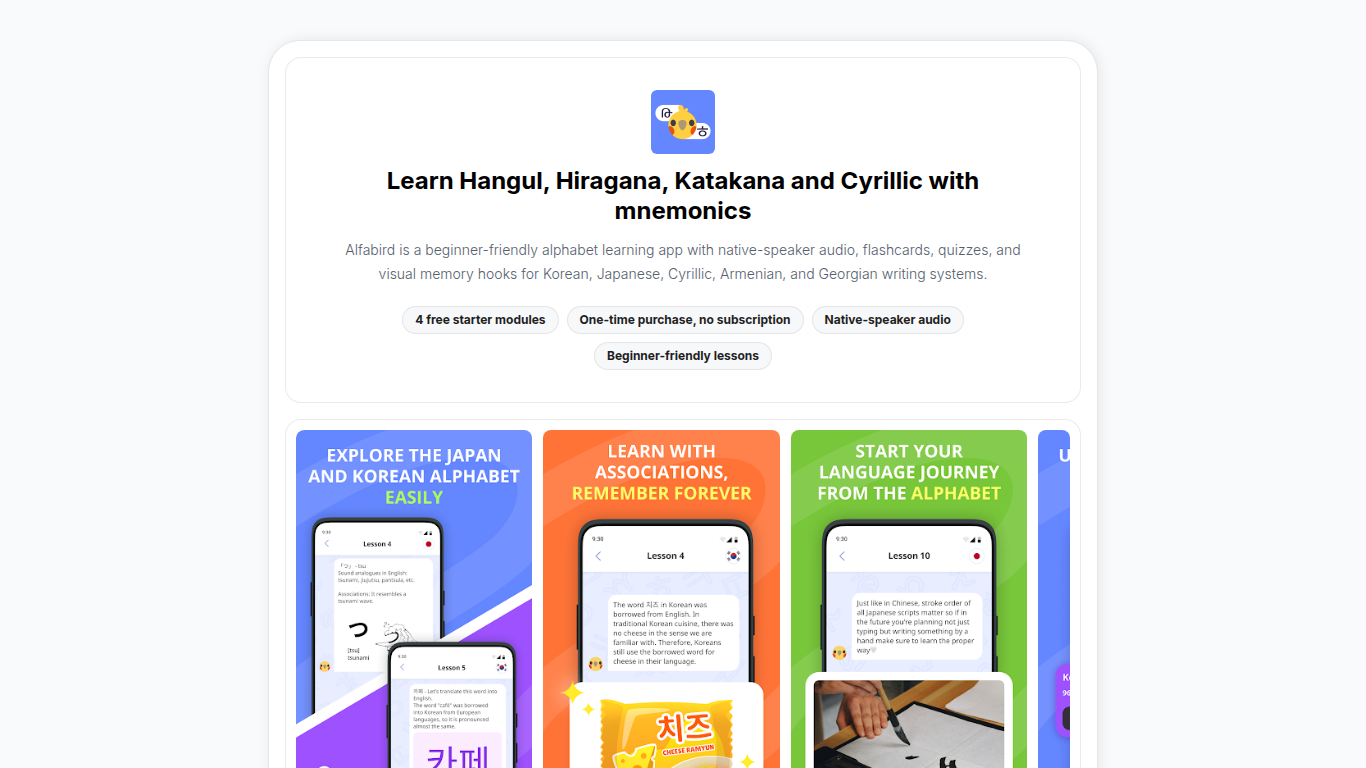
Alfabird is a mobile app from Lunapp Studio for learning new writing systems through mnemonic images, native-speaker audio, flashcards, and quizzes. It covers Hangul, Hiragana, Katakana, Cyrillic, Armenian, and Georgian alphabets.
Lessons use a chat-style format with visual memory hooks so beginners connect each letter's shape, sound, and meaning. The first four modules are free, and additional courses are sold as one-time purchases with no subscription.
The app is available on iPhone, iPad, and Android with a 4.7 App Store rating. Alfabird targets beginners who need to read a new script before moving on to vocabulary-heavy language study.
Mnemonic images link each letter to a visual memory cue
Native-speaker audio for pronunciation on every character
Flashcards and quizzes reinforce letter recognition
Courses for Hangul, Hiragana, Katakana, Cyrillic, Armenian, and Georgian
First four modules free with one-time purchase upgrades
Mnemonic method gives each letter multiple recall cues beyond rote repetition
First four modules are free with no subscription pressure
Native-speaker audio on every character
Focused on alphabet recognition, not full language fluency
Additional courses require in-app purchases
Chinese characters listed as coming soon but not yet available
What alphabets does Alfabird teach?
Alfabird includes courses for Korean Hangul, Japanese Hiragana and Katakana, Cyrillic, Armenian, and Georgian. Chinese characters are listed as coming soon.
Is Alfabird free?
The first four modules are free. Additional courses are one-time purchases, and the site does not advertise a subscription model.
Who makes Alfabird?
Alfabird is published by Lunapp Studio. Support contact listed on the site is [email protected].
Does Alfabird work on mobile?
Yes. Alfabird is available on Android and iPhone/iPad through the Google Play Store and Apple App Store.
How does Alfabird help you remember letters?
Alfabird combines mnemonic images, native-speaker audio, flashcards, and short guided lessons so each letter has shape, sound, and visual recall cues.