AI Clearing vs Cleora.AI
Explore the showdown between AI Clearing vs Cleora.AI and find out which AI Data Science tool wins. We analyze upvotes, features, reviews, pricing, alternatives, and more.
When comparing AI Clearing and Cleora.AI, which one rises above the other?
When we contrast AI Clearing with Cleora.AI, both of which are exceptional AI-operated data science tools, and place them side by side, we can spot several crucial similarities and divergences. Both tools are equally favored, as indicated by the identical upvote count. Be a part of the decision-making process. Your vote could determine the winner.
Does the result make you go "hmm"? Cast your vote and turn that frown upside down!
AI Clearing
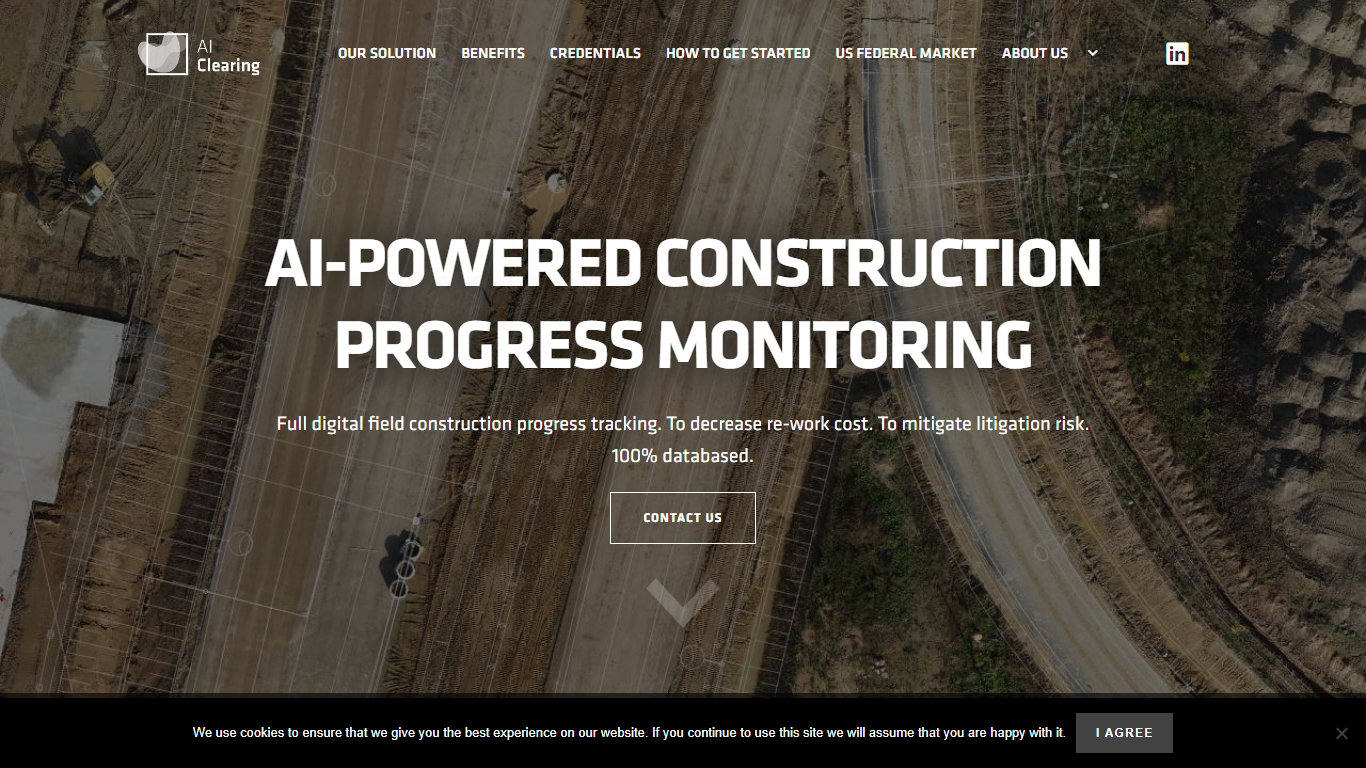

What is AI Clearing?
AI Clearing connects design and BIM data, schedules, budgets, drone imagery, mobile inputs, and ground surveys into one construction intelligence system for large-scale infrastructure and renewable energy projects. Contractors and asset owners use its CORE platform to see what is actually happening on site instead of relying on scattered spreadsheets and field notes.
A proprietary computer vision engine trained on millions of construction objects compares as-built conditions against design plans. The platform delivers progress and quality reports within 6 to 24 hours of data capture and includes Clara, a conversational assistant that answers project questions from live field data.
Where most construction software tracks tasks in spreadsheets, AI Clearing is built around visual site evidence. It reconciles drone imagery, schedules, and BIM models automatically, which makes it better suited to utility-scale earthworks and renewables than generic project management tools that lack geospatial progress verification.
General contractors, EPC firms, and asset owners working on renewables, transmission, wind, highways, pipelines, railways, and civil earthworks use AI Clearing for progress tracking, quality control, billing verification, and portfolio oversight. Customers include PCL Solar, baywa-re, and Rosendin Renewables.
Cleora.AI
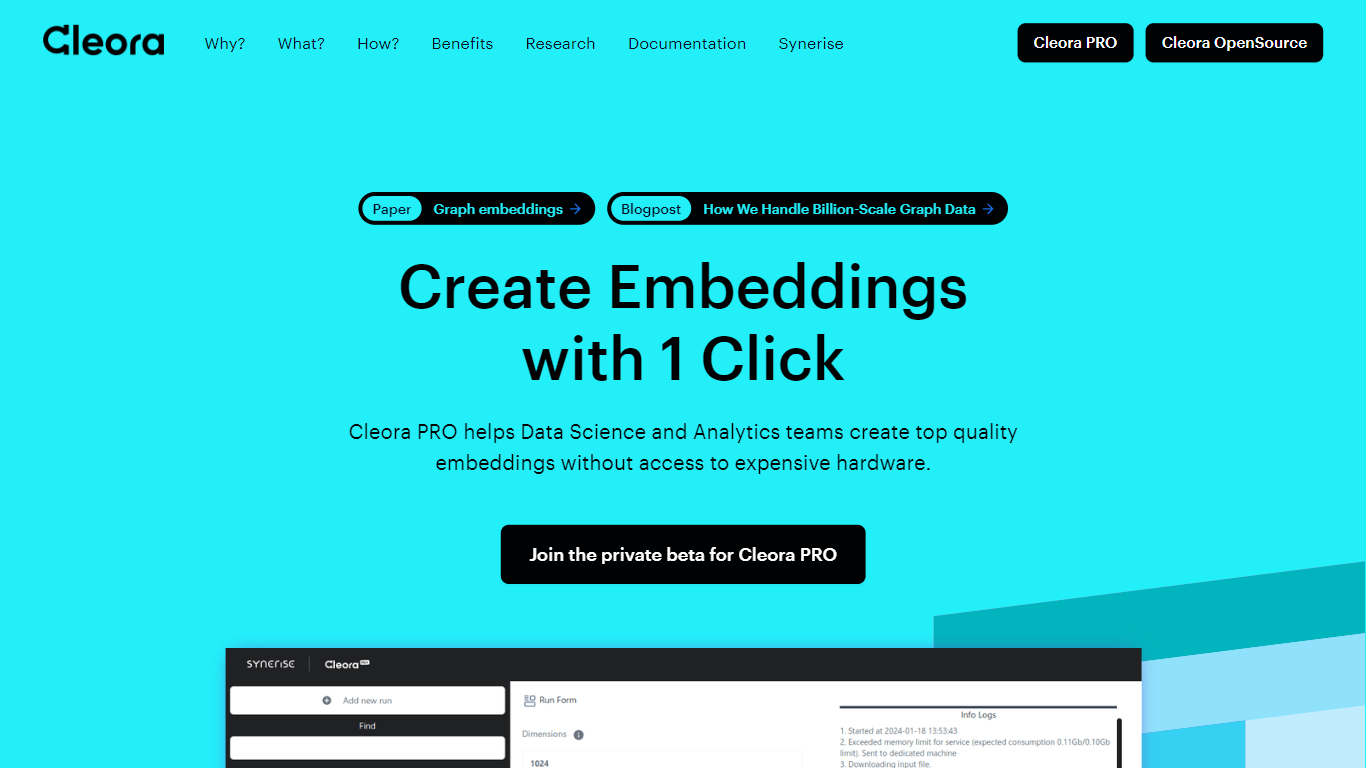
What is Cleora.AI?
Cleora turns edge lists into dense vector embeddings for every node in a graph, without GPUs or random walk sampling. The pycleora Python library ships a Rust core that computes full walk distributions through sparse Markov matrix powers, then exposes classification, similarity search, and link prediction helpers. It targets recommendation systems, fraud graphs, knowledge triples, and other jobs where relational structure matters more than text features.
Walk-based libraries like DeepWalk and Node2Vec approximate neighborhoods by sampling paths and training skip-gram models. Cleora skips both steps and aggregates every k-hop neighborhood in one deterministic pass, which is why Zomato reported embedding a customer-restaurant graph in under five minutes after GraphSAGE took about twenty hours on the same setup. The trade-off is scope: it is a graph-structure toolkit, not a general feature store for unstructured data.
Data science teams install pycleora with pip and only need NumPy and SciPy alongside the roughly 5 MB package. The MIT-licensed library includes eight baseline algorithms, heterogeneous graph support, MLP and label-propagation classifiers, and a CLI for batch jobs. Published benchmarks on SNAP, Planetoid, and DGL datasets report top accuracy on graphs up to about two million nodes while competitor methods time out or run out of memory.
AI Clearing Upvotes
Cleora.AI Upvotes
AI Clearing Top Features
Unifies BIM, schedules, budgets, drone imagery, and mobile field inputs in one dashboard
Delivers automated progress reports within 6 to 24 hours after each data capture
Clara conversational assistant answers project questions from live site data in plain language
Integrates CAD/BIM models and Primavera P6 schedules into one construction intelligence system
3D digital twin supports inspection down to individual piles and structural elements
Training dataset includes 36,382,032 tagged construction objects from real project sites
First technology company globally certified to ISO 42001, alongside ISO 27001 and ISO 9001
Cleora.AI Top Features
pip install pycleora pulls a ~5 MB package that needs only NumPy and SciPy, no GPU drivers or CUDA stack
Sparse Markov matrix powers compute all walk distributions exactly, with no random walks or negative sampling
Eight embedding algorithms in one API: Cleora, DeepWalk, Node2Vec, ProNE, RandNE, HOPE, NetMF, and GraRep
Zomato cut customer-restaurant embedding time from about 20 hours with GraphSAGE to under five minutes on the same data
Benchmarks on roadNet-CA embed 1,965,206 nodes in 31.5 seconds using about 4.1 GB RAM on one CPU core
Heterogeneous hypergraphs accept TSV edge files with typed columns like complex::reflexive::product
AI Clearing Category
- Data Science
Cleora.AI Category
- Data Science
AI Clearing Pricing Type
- Paid
Cleora.AI Pricing Type
- Free