APIPark vs BIG-bench
Dive into the comparison of APIPark vs BIG-bench and discover which AI Large Language Model (LLM) tool stands out. We examine alternatives, upvotes, features, reviews, pricing, and beyond.
When comparing APIPark and BIG-bench, which one rises above the other?
When we compare APIPark and BIG-bench, two exceptional large language model (llm) tools powered by artificial intelligence, and place them side by side, several key similarities and differences come to light. The upvote count reveals a draw, with both tools earning the same number of upvotes. Your vote matters! Help us decide the winner among aitools.fyi users by casting your vote.
Feeling rebellious? Cast your vote and shake things up!
APIPark

What is APIPark?
APIPark is an open-source LLM gateway and API developer portal for enterprises that need one place to call, govern, and bill AI models and internal APIs. It routes traffic to 200+ large language models through a single OpenAI-compatible endpoint, so teams stop wiring separate vendor SDKs for every model they add.
Where most API gateways only forward requests, APIPark also treats models and APIs as tradable assets. It bundles unified authentication, approval workflows, recharge billing, multi-level distribution, and profit reporting so platform teams can sell surplus model capacity or package business APIs without building a separate marketplace stack.
Platform engineers and AI teams use it to set per-tenant quotas, rate limits, and masking rules before production traffic hits upstream models. API managers get portals for publishing APIs, tracking usage, and approving access requests. The Community Edition covers core gateway and portal features; the Enterprise Edition adds advanced governance, runtime statistics, and premium support.
BIG-bench
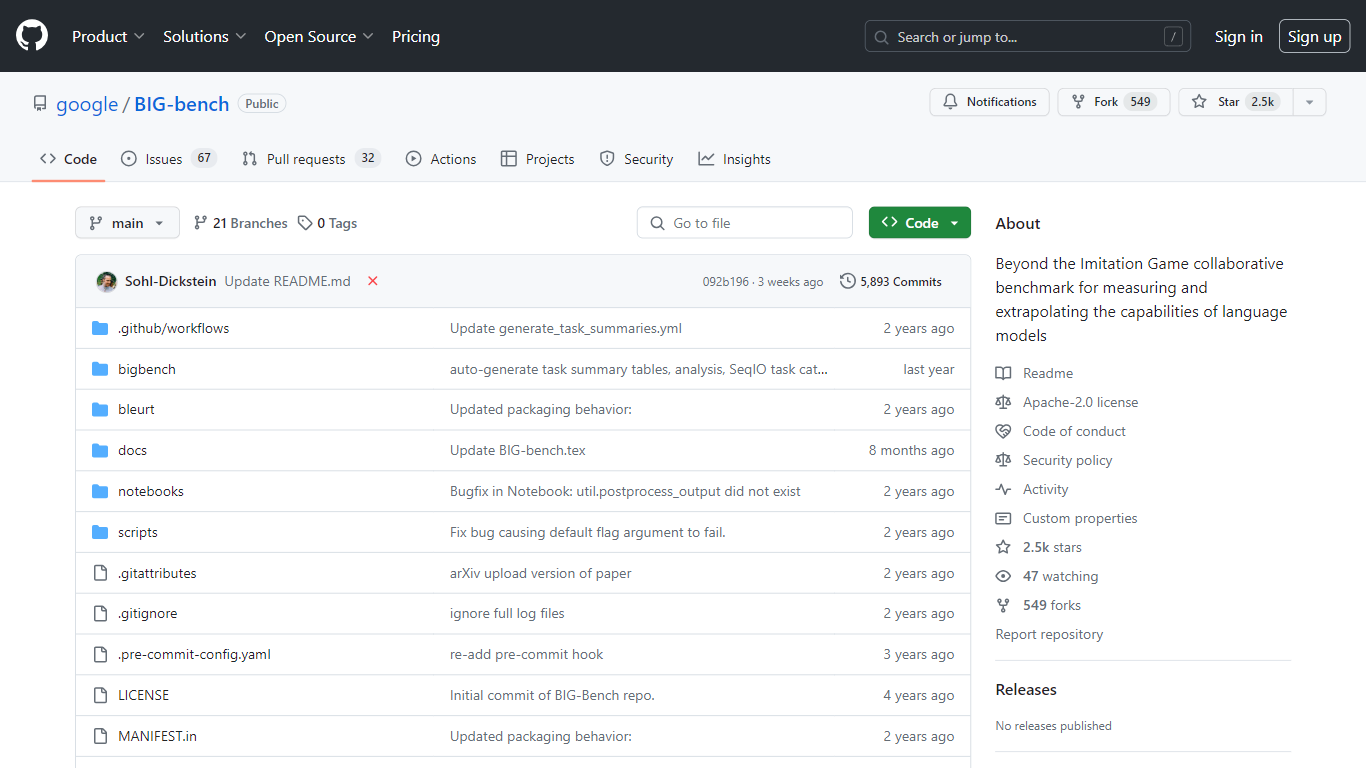
What is BIG-bench?
BIG-bench measures how well large language models handle reasoning, math, bias, and multilingual tasks across more than 200 community-written evaluation challenges. Google hosts the open source repository on GitHub, where researchers contributed tasks through pull requests and published comparative model scores on the leaderboard. Each task scores models through text generation or log-probability queries, using metrics like BLEU, BLEURT, and exact string match.
Unlike fixed benchmarks such as GLUE or SuperGLUE, BIG-bench grew through community pull requests, so task authors could submit challenges designed to exceed what existing models could solve. The suite also ships BIG-bench Lite, a 24-task subset that gives a cheaper canonical score across the full collection of 200+ tasks. Programmatic tasks support multi-turn model interaction, while JSON tasks work through a simpler task.json format with built-in scoring rules.
ML researchers use BIG-bench to compare model scaling trends and publish leaderboard results. Model developers run evaluations locally with HuggingFace models or through Docker scripts, then submit score files via pull request. The benchmark is archived and read-only as of April 2026, but the tasks, code, and published TMLR 2023 analysis paper remain available for reproducible research.
APIPark Upvotes
BIG-bench Upvotes
APIPark Top Features
Routes 200+ LLMs through one OpenAI-compatible API signature so existing client code needs no vendor-specific rewrites
Deploy the gateway and developer portal in about 5 minutes with a single command-line install
Load balancing distributes requests across LLM instances to keep failover and throughput predictable under load
Built-in API billing tracks per-user consumption so teams can meter and monetize internal or partner API access
Fine-grained quotas cap daily or monthly spend by amount, tokens, or call counts to block runaway model usage
Data masking engine flags and masks sensitive fields in request and response payloads for compliance workflows
BIG-bench Top Features
More than 200 benchmark tasks across JSON and programmatic formats, contributed via open pull requests
BIG-bench Lite packs 24 diverse tasks for a cheaper canonical model comparison score
Built-in metrics include BLEU, BLEURT, ROUGE, exact string match, and multiple-choice grading
SeqIO integration loads JSON tasks with 0-shot through 3-shot evaluation presets
Python 3.5 through 3.8 required; install with pip install -e . from the GitHub repository
APIPark Category
- Large Language Model (LLM)
BIG-bench Category
- Large Language Model (LLM)
APIPark Pricing Type
- Freemium
BIG-bench Pricing Type
- Free