APIPark vs Minerva
When comparing APIPark vs Minerva, which AI Large Language Model (LLM) tool shines brighter? We look at pricing, alternatives, upvotes, features, reviews, and more.
In a comparison between APIPark and Minerva, which one comes out on top?
When we put APIPark and Minerva side by side, both being AI-powered large language model (llm) tools, Both tools are equally favored, as indicated by the identical upvote count. Since other aitools.fyi users could decide the winner, the ball is in your court now to cast your vote and help us determine the winner.
Feeling rebellious? Cast your vote and shake things up!
APIPark

What is APIPark?
APIPark is an open-source LLM gateway and API developer portal for enterprises that need one place to call, govern, and bill AI models and internal APIs. It routes traffic to 200+ large language models through a single OpenAI-compatible endpoint, so teams stop wiring separate vendor SDKs for every model they add.
Where most API gateways only forward requests, APIPark also treats models and APIs as tradable assets. It bundles unified authentication, approval workflows, recharge billing, multi-level distribution, and profit reporting so platform teams can sell surplus model capacity or package business APIs without building a separate marketplace stack.
Platform engineers and AI teams use it to set per-tenant quotas, rate limits, and masking rules before production traffic hits upstream models. API managers get portals for publishing APIs, tracking usage, and approving access requests. The Community Edition covers core gateway and portal features; the Enterprise Edition adds advanced governance, runtime statistics, and premium support.
Minerva
What is Minerva?
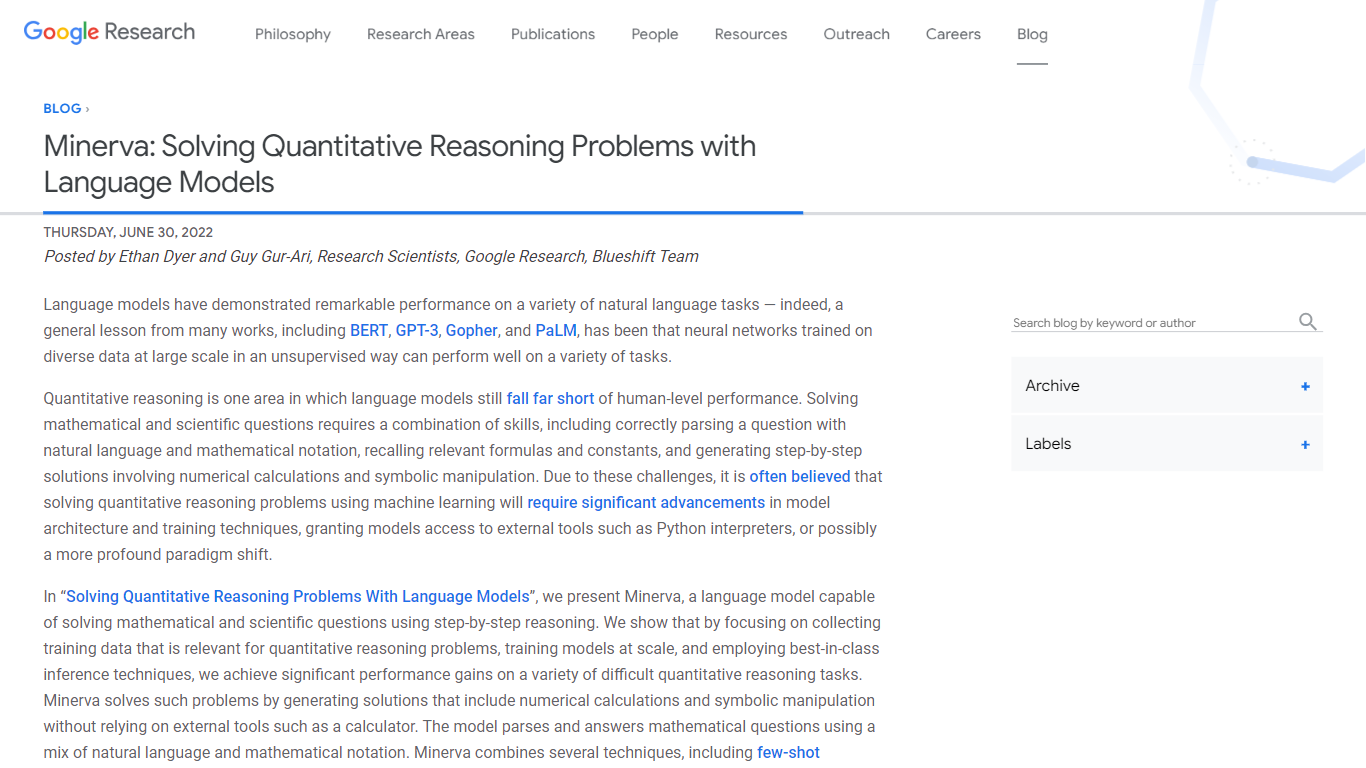
Minerva is a large language model from Google Research built to solve math and science questions through step-by-step written reasoning. It reads problems that mix plain English with LaTeX notation, then writes out solutions involving arithmetic, algebra, and symbolic steps. The model was trained on scientific papers and web pages where mathematical formatting was kept intact, rather than stripped during preprocessing.
Most math-capable models lean on external tools like Python interpreters or calculators at inference time. Minerva takes the opposite bet: it generates full worked solutions from the model weights alone, using chain-of-thought prompting and majority voting across multiple sampled answers. That informal approach covers a wider range of problem types than formal theorem provers, but the trade-off is answers cannot be machine-verified the way Coq or Lean proofs can.
Researchers studying quantitative reasoning in language models use Minerva as a reference point for STEM benchmark performance. The public sample explorer hosts 110 solved problems across algebra, physics, chemistry, and other topics, so anyone can read through how the model arrived at each answer. Educators and ML engineers reviewing benchmark methodology will find the published MATH, MMLU-STEM, GSM8k, and OCWCourses scores useful for comparing against newer models.
APIPark Upvotes
Minerva Upvotes
APIPark Top Features
Routes 200+ LLMs through one OpenAI-compatible API signature so existing client code needs no vendor-specific rewrites
Deploy the gateway and developer portal in about 5 minutes with a single command-line install
Load balancing distributes requests across LLM instances to keep failover and throughput predictable under load
Built-in API billing tracks per-user consumption so teams can meter and monetize internal or partner API access
Fine-grained quotas cap daily or monthly spend by amount, tokens, or call counts to block runaway model usage
Data masking engine flags and masks sensitive fields in request and response payloads for compliance workflows
Minerva Top Features
Built on PaLM with 118GB of arXiv papers and math-formatted web pages in training data
Scores 50.3% on the MATH benchmark at 540B parameters, up from a prior best of 6.9%
Generates solutions with arithmetic and symbolic steps without calling a calculator or Python interpreter
Uses chain-of-thought prompting, few-shot examples, and majority voting across sampled outputs
Public sample explorer shows 110 worked problems across 11 topics including algebra, physics, and chemistry
Reaches 75% on MMLU-STEM and 78.5% on GSM8k, both ahead of published prior state of the art
APIPark Category
- Large Language Model (LLM)
Minerva Category
- Large Language Model (LLM)
APIPark Pricing Type
- Freemium
Minerva Pricing Type
- Free