AUDOIR vs MusicLM
In the face-off between AUDOIR vs MusicLM, which AI Audio Generation tool takes the crown? We scrutinize features, alternatives, upvotes, reviews, pricing, and more.
In a face-off between AUDOIR and MusicLM, which one takes the crown?
If we were to analyze AUDOIR and MusicLM, both of which are AI-powered audio generation tools, what would we find? Both tools are equally favored, as indicated by the identical upvote count. Since other aitools.fyi users could decide the winner, the ball is in your court now to cast your vote and help us determine the winner.
Feeling rebellious? Cast your vote and shake things up!
AUDOIR


What is AUDOIR?
AUDOIR publishes a suite of AI web and mobile apps from Audoir, LLC, a company founded in 2016 in the SF Bay Area. Melodea generates melody and harmony ideas for songwriting, while Lyricai drafts lyrics on demand. The portfolio also includes Resunet for AI-tailored resumes, Reflexion for AI journaling, Vocali for language conversation practice, and Youhan for personalized Chinese learning.
Compared with all-in-one generators like Suno that output finished songs from a text prompt, AUDOIR splits songwriting into separate melody and lyric tools you can export into a DAW. The company trains its custom models only on AI-generated datasets, which it states keeps the tools clear of copyrighted training material. Several older songwriting apps, including Quick Lyrics AI and AI Music Builder, are no longer supported.
Songwriters reach for Melodea and Lyricai when they want starting ideas rather than a complete track. Educators and language learners use Vocali and Youhan for conversational practice. The site reports more than 1,500 daily users across the app lineup.
MusicLM
What is MusicLM?
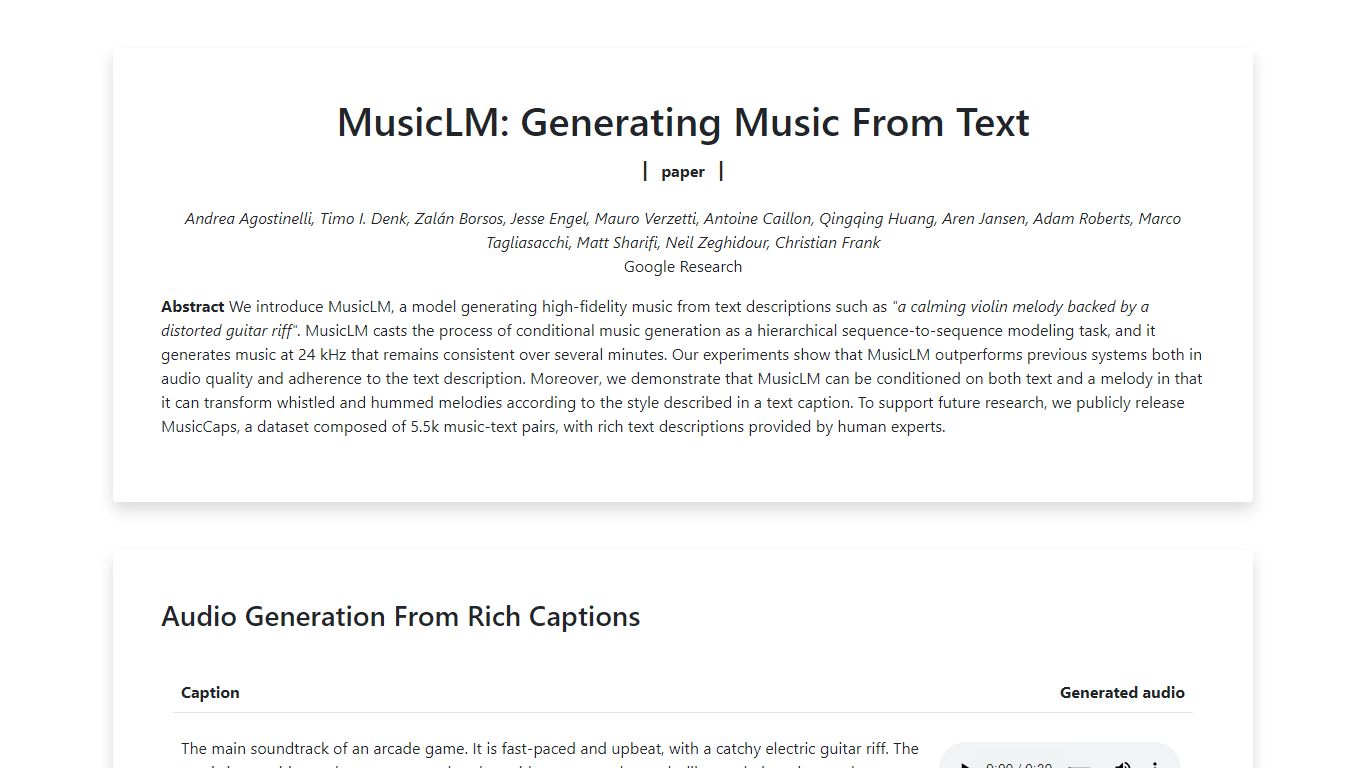
MusicLM is a Google Research audio generation model that creates music from text captions at 24 kHz. The public examples page hosts sample clips for prompts like arcade soundtracks, reggaeton-EDM fusions, and relaxing jazz, plus longer story-mode generations that shift styles across timed segments. Google released the MusicCaps dataset of 5,500 music-text pairs alongside the paper.
Unlike consumer apps that ship one prompt box, MusicLM was published as a research demo with pre-generated samples rather than a login product. Its headline trick is joint text-and-melody conditioning: you can hum or whistle a tune and have the model re-render it in a new genre described in text. Story mode chains multiple captions so the music evolves across sections.
MusicLM matters as the research foundation behind Google's later Lyria music models, but this page is for listening to published examples, not creating new tracks interactively. Researchers and musicians study it for long-form consistency, painting-to-music conditioning, and melody transfer results documented in the 2023 paper.
AUDOIR Upvotes
MusicLM Upvotes
AUDOIR Top Features
Melodea generates unique melody and harmony ideas to kickstart songwriting sessions
Lyricai drafts lyrics on demand to help writers break through creative blocks
Vocali simulates native-speaker audio conversations for language practice
Youhan adapts Chinese lessons with flashcards, contextual sentences, and pronunciation audio
Resunet tailors resumes and cover letters to specific job postings with AI
Reflexion analyzes journal entries and offers personalized insights through an AI assistant
MusicLM Top Features
Generates music at 24 kHz from rich text captions
Story mode chains multiple text prompts across timed segments
Text-and-melody conditioning transforms hummed or whistled tunes into new styles
Painting caption conditioning pairs artwork descriptions with generated audio
Long-generation examples cover melodic techno, swing, and relaxing jazz
MusicCaps dataset includes 5,500 expert-written music-text pairs
AUDOIR Category
- Audio Generation
MusicLM Category
- Audio Generation
AUDOIR Pricing Type
- Free
MusicLM Pricing Type
- Free