BIG-bench vs Monster API
In the contest of BIG-bench vs Monster API, which AI Large Language Model (LLM) tool is the champion? We evaluate pricing, alternatives, upvotes, features, reviews, and more.
If you had to choose between BIG-bench and Monster API, which one would you go for?
When we examine BIG-bench and Monster API, both of which are AI-enabled large language model (llm) tools, what unique characteristics do we discover? Both tools are equally favored, as indicated by the identical upvote count. You can help us determine the winner by casting your vote and tipping the scales in favor of one of the tools.
You don't agree with the result? Cast your vote to help us decide!
BIG-bench
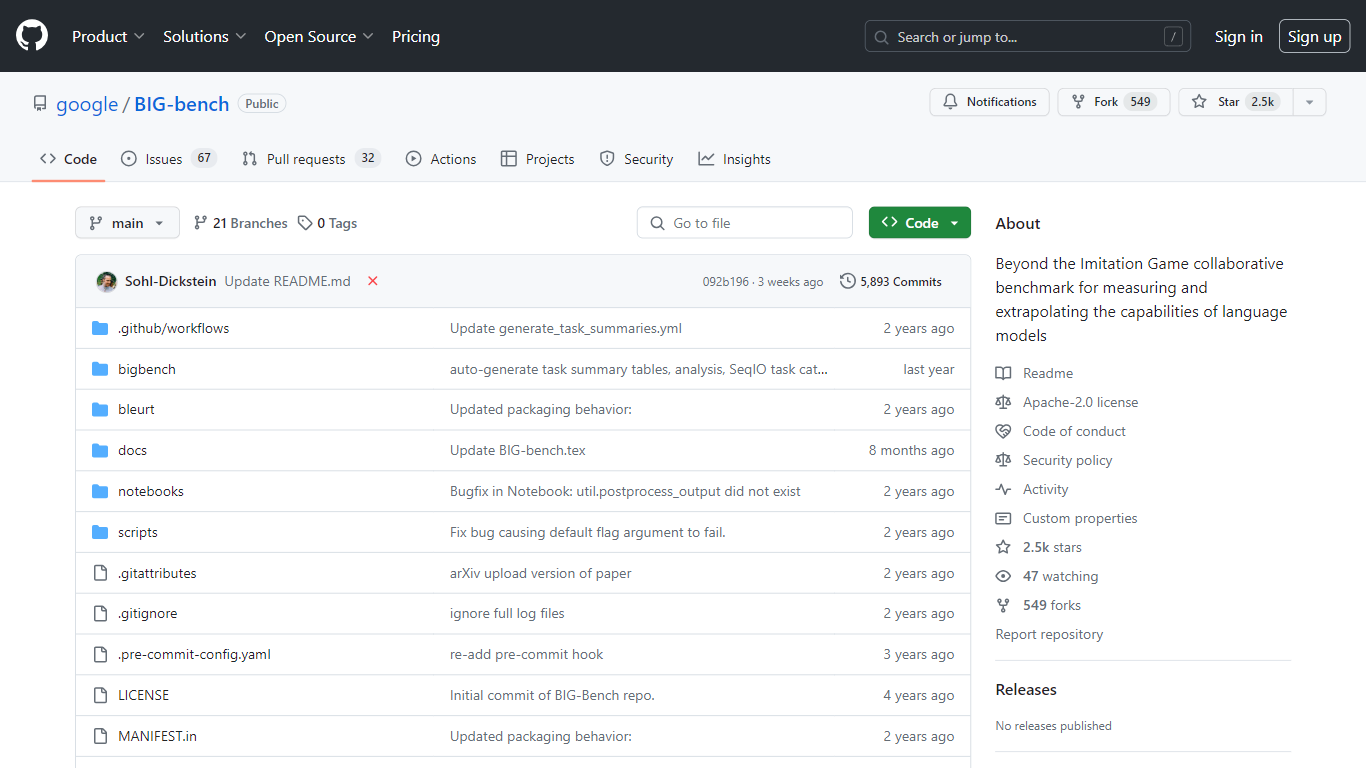

What is BIG-bench?
BIG-bench measures how well large language models handle reasoning, math, bias, and multilingual tasks across more than 200 community-written evaluation challenges. Google hosts the open source repository on GitHub, where researchers contributed tasks through pull requests and published comparative model scores on the leaderboard. Each task scores models through text generation or log-probability queries, using metrics like BLEU, BLEURT, and exact string match.
Unlike fixed benchmarks such as GLUE or SuperGLUE, BIG-bench grew through community pull requests, so task authors could submit challenges designed to exceed what existing models could solve. The suite also ships BIG-bench Lite, a 24-task subset that gives a cheaper canonical score across the full collection of 200+ tasks. Programmatic tasks support multi-turn model interaction, while JSON tasks work through a simpler task.json format with built-in scoring rules.
ML researchers use BIG-bench to compare model scaling trends and publish leaderboard results. Model developers run evaluations locally with HuggingFace models or through Docker scripts, then submit score files via pull request. The benchmark is archived and read-only as of April 2026, but the tasks, code, and published TMLR 2023 analysis paper remain available for reproducible research.
Monster API
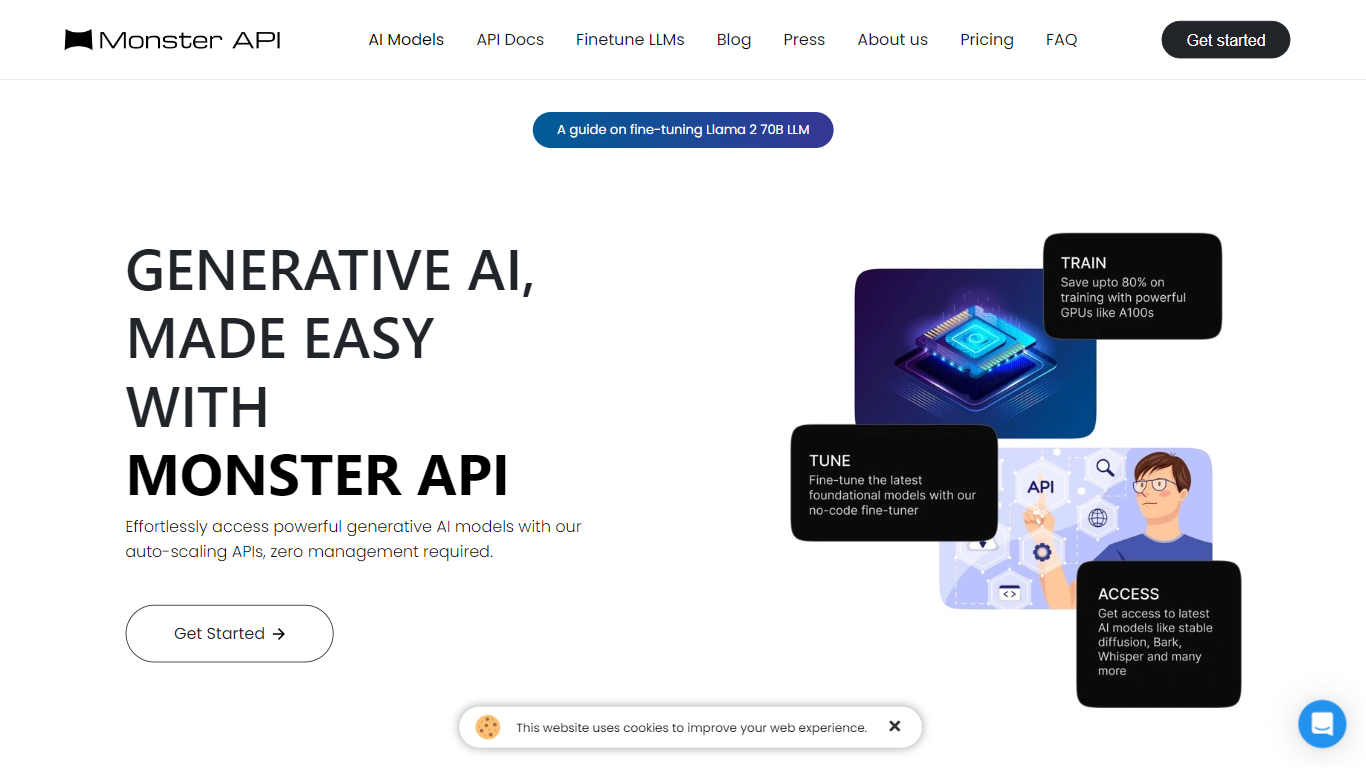
What is Monster API?
The Monster API is a robust, multi-functional interface that empowers developers and businesses to streamline their processes and integrate with the Monster job platform. Designed for ease of use and efficiency, the Monster API serves as a conduit for automating job postings, searching for resumes, and accessing a wide range of employment-related data. With its SEO-friendly features, the API helps to enhance the visibility of job listings, ensuring that they reach the most suitable candidates. The detailed documentation and responsive support make integration a breeze, allowing businesses to focus on their core operations while optimizing their recruitment strategy.
BIG-bench Upvotes
Monster API Upvotes
BIG-bench Top Features
More than 200 benchmark tasks across JSON and programmatic formats, contributed via open pull requests
BIG-bench Lite packs 24 diverse tasks for a cheaper canonical model comparison score
Built-in metrics include BLEU, BLEURT, ROUGE, exact string match, and multiple-choice grading
SeqIO integration loads JSON tasks with 0-shot through 3-shot evaluation presets
Python 3.5 through 3.8 required; install with pip install -e . from the GitHub repository
Monster API Top Features
Automated Job Postings: Enables automated posting of job listings to streamline recruitment.
Resume Search Capability: Provides advanced search features to access a vast database of resumes.
Employment-Related Data Access: Offers comprehensive access to a wide range of employment data.
SEO-Friendly: Designed to enhance the visibility of job listings on search engines.
Efficient Integration: User-friendly API with detailed documentation for easy integration.
BIG-bench Category
- Large Language Model (LLM)
Monster API Category
- Large Language Model (LLM)
BIG-bench Pricing Type
- Free
Monster API Pricing Type
- Paid