Bookshelf vs Summify
Explore the showdown between Bookshelf vs Summify and find out which AI Summarizer tool wins. We analyze upvotes, features, reviews, pricing, alternatives, and more.
In a face-off between Bookshelf and Summify, which one takes the crown?
When we contrast Bookshelf with Summify, both of which are exceptional AI-operated summarizer tools, and place them side by side, we can spot several crucial similarities and divergences. The upvote count favors Bookshelf, making it the clear winner. Bookshelf has 7 upvotes, and Summify has 6 upvotes.
Does the result make you go "hmm"? Cast your vote and turn that frown upside down!
Bookshelf
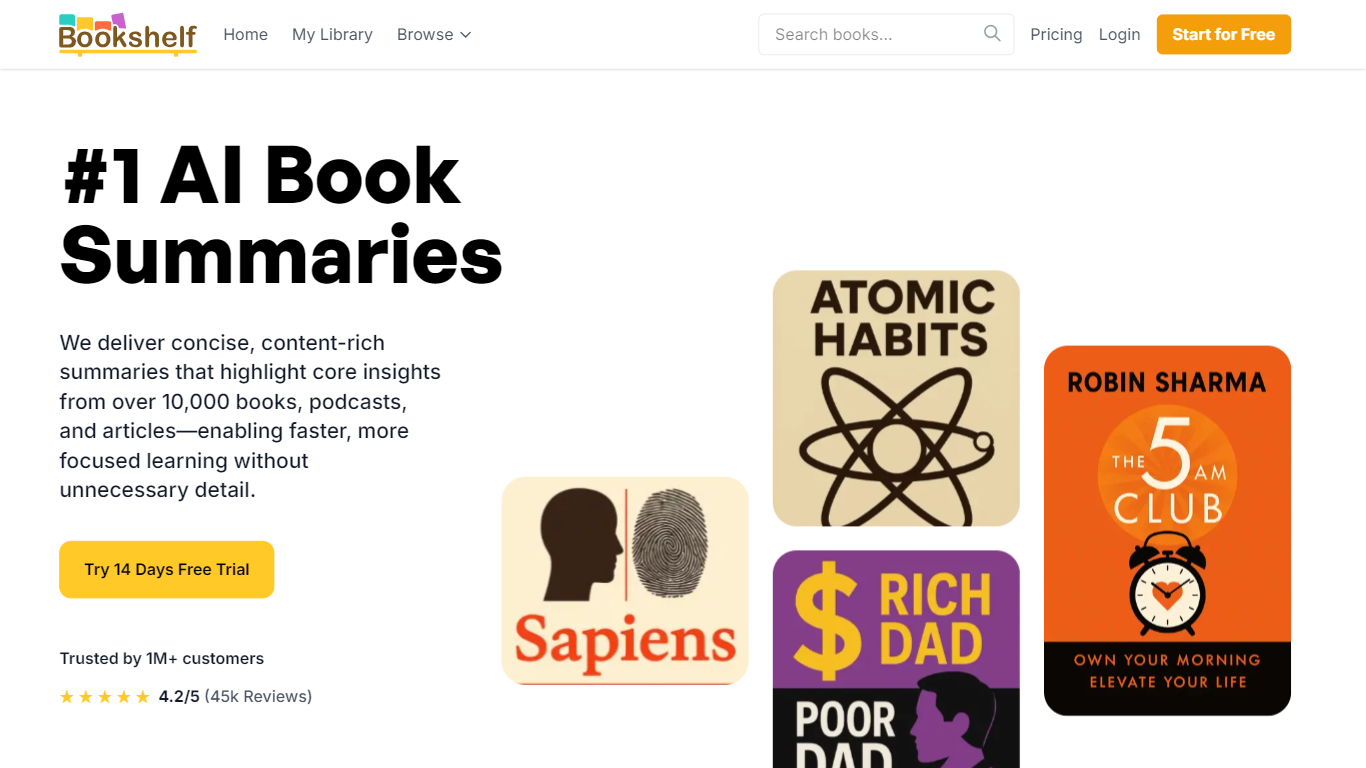

What is Bookshelf?
Bookshelf delivers 15-minute summaries of nonfiction books, podcasts, and articles you can read, listen to, or download as PDF and EPUB. The library spans 10,000+ titles across business, psychology, history, and self-help, with exercises and topic guides that go beyond a quick recap.
Blinkist made short book summaries mainstream; Bookshelf pushes the same format with heavier download options and a lifetime license. You get audio summaries, CarPlay and Android Auto support, offline listening on paid tiers, and a Basic free tier that unlocks one handpicked title per day after the trial ends.
Busy readers and commuters are the core audience. Premium unlocks unlimited access to 7,500+ summaries plus a shareable friend account. Paid plans are $9.99 per month, $59.99 per year, or a $129 lifetime license, all with a 14-day free trial.
Summify
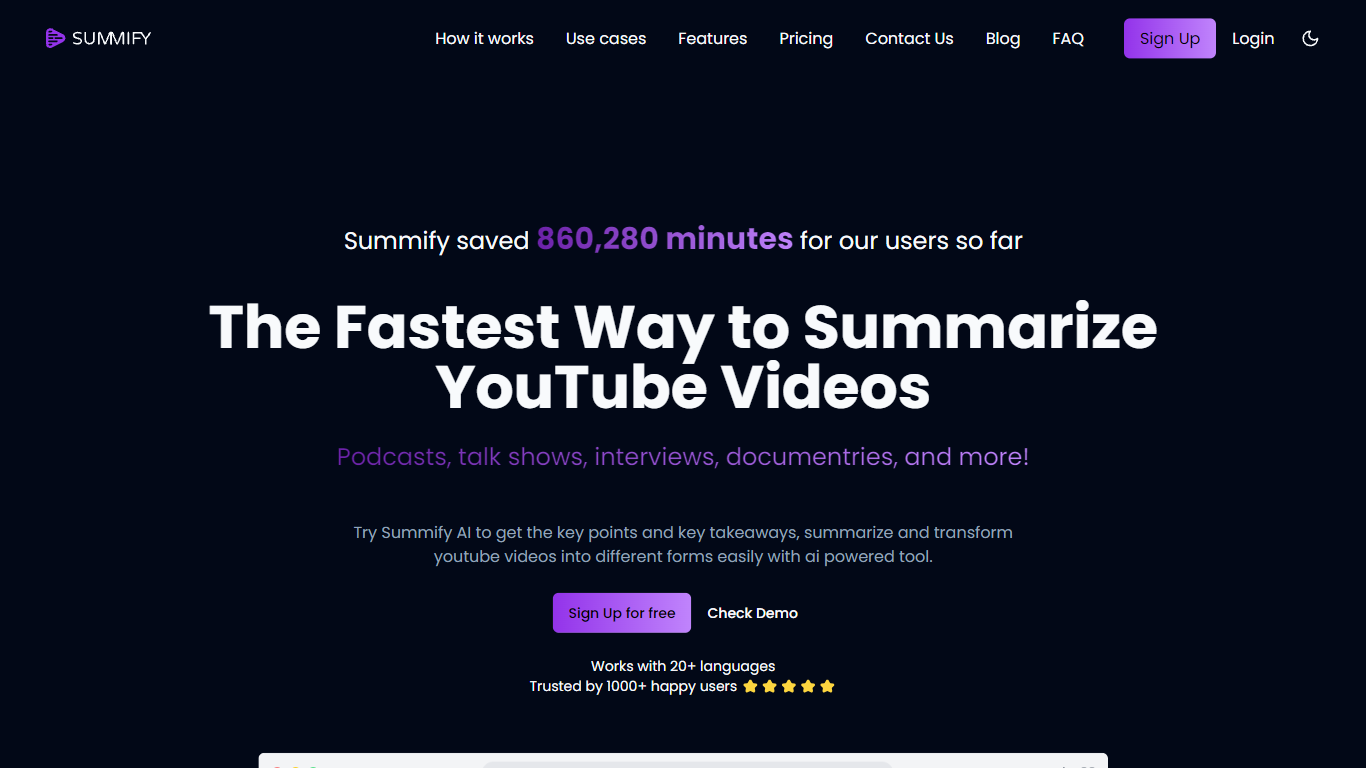
What is Summify?
Summify turns videos, podcasts, PDFs, articles, and voice notes into searchable knowledge pods you can query with citations. It still summarizes YouTube with TL;DR takeaways and timestamps, but the core pitch now is one curated library that follows you across Claude, ChatGPT, and any MCP-compatible AI instead of re-uploading the same files to every chat window.
Generic chatbots answer from the open web. Summify indexes your trusted sources, groups them into scoped pods by client or project, and exposes that context through built-in AI chat or MCP connections with daily limits on paid tiers. That makes it closer to a personal RAG layer than a single-purpose YouTube summarizer, though capture tools for PDFs, voice notes, and 130-plus languages remain central.
Researchers, content creators, consultants, and students are the stated audience. The site reports 50,000 plus users and 30 million minutes summarized. Pro and Max plans connect pods to external AI tools, while Starter focuses on summaries and uploads with tighter transcription and pod caps.
Bookshelf Upvotes
Summify Upvotes
Bookshelf Top Features
10,000+ book, podcast, and article summaries with 15-minute read or listen formats
PDF, EPUB, and audiobook downloads plus Apple CarPlay and Android Auto support
14-day free trial on paid plans with a Basic tier of one handpicked title per day
Premium unlocks 7,500+ summaries, offline access, personalized picks, and a friend account
Monthly plan at $9.99, yearly at $59.99, or $129 lifetime one-time payment
Topic analyses and reflection exercises beyond standard chapter summaries
Summify Top Features
Starter plan includes 800 transcription minutes per month and 5 knowledge pods at $8 per month
Pro plan offers 1,800 minutes, 20 pods, and 100 MCP connections per day at $16 per month
Max plan includes 8,000 minutes, unlimited pods, and 300 MCP connections per day at $33 per month
Supports 11 summary styles including Deep Dive, Q&A, Academic, Blog, and Action List formats
Translates and summarizes content in 130 plus languages with automatic detection
MCP integration connects pods to Claude, ChatGPT, Cursor, Windsurf, and other compatible AI tools
Free trial grants full access to all features before choosing a paid plan
Bookshelf Category
- Summarizer
Summify Category
- Summarizer
Bookshelf Pricing Type
- Freemium
Summify Pricing Type
- Freemium