Claude 3 \ Anthropic vs GPT-4
In the battle of Claude 3 \ Anthropic vs GPT-4, which AI Large Language Model (LLM) tool comes out on top? We compare reviews, pricing, alternatives, upvotes, features, and more.
Between Claude 3 \ Anthropic and GPT-4, which one is superior?
Upon comparing Claude 3 \ Anthropic with GPT-4, which are both AI-powered large language model (llm) tools, The upvote count favors Claude 3 \ Anthropic, making it the clear winner. Claude 3 \ Anthropic has garnered 8 upvotes, and GPT-4 has garnered 7 upvotes.
Want to flip the script? Upvote your favorite tool and change the game!
Claude 3 \ Anthropic
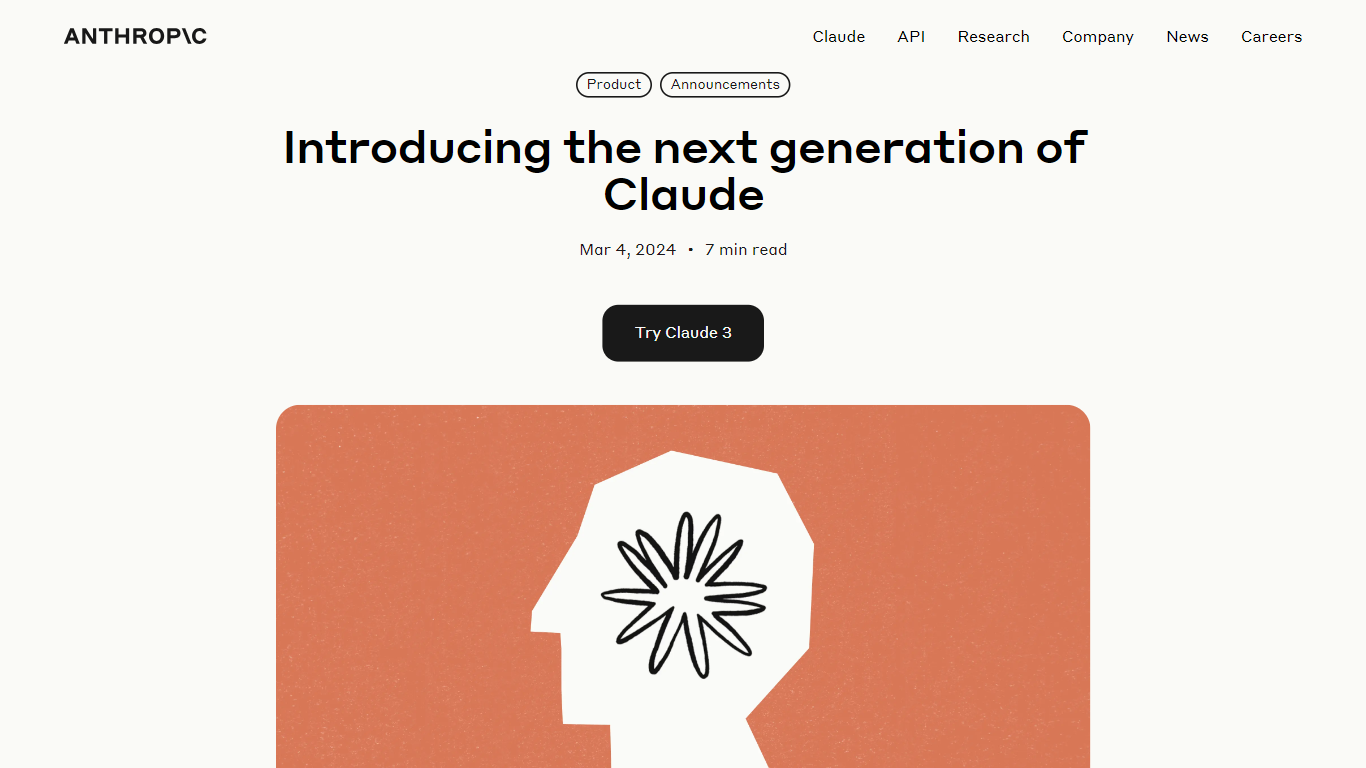

What is Claude 3 \ Anthropic?
Claude 3 is Anthropic's third-generation large language model family, released in March 2024. It includes three tiers: Haiku for speed and cost, Sonnet for balanced performance, and Opus for the highest reasoning depth. Each model targets a different tradeoff between intelligence, latency, and price.
The family handles text, code, analysis, and vision tasks. Claude 3 models process photos, charts, graphs, and technical diagrams. They support a 200K token context window at launch, with inputs exceeding 1 million tokens available to select customers. Opus and Sonnet launched on claude.ai and the Claude API in 159 countries, with Haiku following shortly after.
Anthropic built Claude 3 with Constitutional AI safety methods and Responsible Scaling Policy guardrails. The models are available through the Claude API, Amazon Bedrock, and Google Cloud Vertex AI. Sonnet powers the free tier on claude.ai, while Opus is available to Claude Pro subscribers.
GPT-4
What is GPT-4?
GPT-4 is OpenAI's large language model built for advanced reasoning, instruction following, and safer responses across text tasks. OpenAI positions it as the successor along the GPT research line and makes it available through ChatGPT Plus and the developer API. The product page highlights alignment work with human feedback and expert review before release.
Compared with earlier GPT-3.5 chat models, GPT-4 emphasizes measurable safety and factuality gains rather than raw parameter counts alone. OpenAI reports it is 82% less likely to answer disallowed requests and 40% more likely to give factual replies on internal tests versus GPT-3.5. That trade-off targets teams that need stronger guardrails even if latency and cost run higher than smaller models.
GPT-4 shows up in production stories from Duolingo, Be My Eyes, Stripe, and Morgan Stanley wealth management on OpenAI's site. Developers reach it through the API platform, while ChatGPT Plus subscribers access it inside the chat product. OpenAI notes ongoing limitations around bias, hallucinations, and adversarial prompts that remain under active research.
Claude 3 \ Anthropic Upvotes
GPT-4 Upvotes
Claude 3 \ Anthropic Top Features
Three model tiers (Haiku, Sonnet, Opus) let you pick the right balance of speed, cost, and reasoning depth
200K token context window at launch, with 1M+ token inputs available to select enterprise customers
Vision support for photos, charts, graphs, PDFs, and technical diagrams
Haiku reads a ~10k token research paper with charts in under three seconds for live chat workloads
Available on claude.ai, the Claude API, Amazon Bedrock, and Google Cloud Vertex AI
GPT-4 Top Features
82% lower rate of disallowed responses versus GPT-3.5 on OpenAI internal tests
40% higher likelihood of factual answers versus GPT-3.5 on OpenAI evaluations
Alignment pipeline used feedback from over 50 expert reviewers before launch
Available through ChatGPT Plus and the OpenAI developer API
Trained on Microsoft Azure AI supercomputers per OpenAI infrastructure notes
Claude 3 \ Anthropic Category
- Large Language Model (LLM)
GPT-4 Category
- Large Language Model (LLM)
Claude 3 \ Anthropic Pricing Type
- Freemium
GPT-4 Pricing Type
- Freemium