Claude 3 \ Anthropic vs Orca
In the face-off between Claude 3 \ Anthropic vs Orca, which AI Large Language Model (LLM) tool takes the crown? We scrutinize features, alternatives, upvotes, reviews, pricing, and more.
When we put Claude 3 \ Anthropic and Orca head to head, which one emerges as the victor?
If we were to analyze Claude 3 \ Anthropic and Orca, both of which are AI-powered large language model (llm) tools, what would we find? The upvote count shows a clear preference for Claude 3 \ Anthropic. Claude 3 \ Anthropic has received 8 upvotes from aitools.fyi users, while Orca has received 6 upvotes.
Not your cup of tea? Upvote your preferred tool and stir things up!
Claude 3 \ Anthropic

What is Claude 3 \ Anthropic?
Claude 3 is Anthropic's third-generation large language model family, released in March 2024. It includes three tiers: Haiku for speed and cost, Sonnet for balanced performance, and Opus for the highest reasoning depth. Each model targets a different tradeoff between intelligence, latency, and price.
The family handles text, code, analysis, and vision tasks. Claude 3 models process photos, charts, graphs, and technical diagrams. They support a 200K token context window at launch, with inputs exceeding 1 million tokens available to select customers. Opus and Sonnet launched on claude.ai and the Claude API in 159 countries, with Haiku following shortly after.
Anthropic built Claude 3 with Constitutional AI safety methods and Responsible Scaling Policy guardrails. The models are available through the Claude API, Amazon Bedrock, and Google Cloud Vertex AI. Sonnet powers the free tier on claude.ai, while Opus is available to Claude Pro subscribers.
Orca
What is Orca?
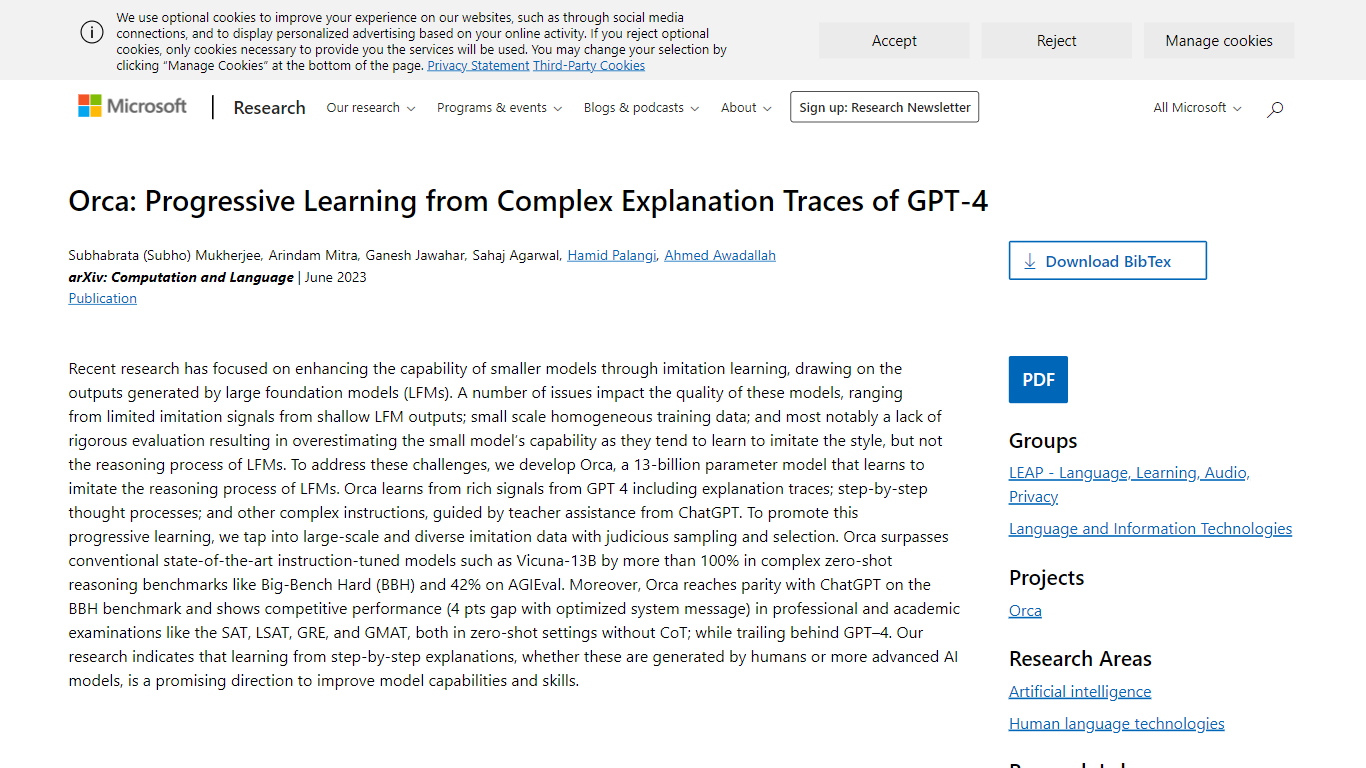
Orca is an AI model with 13 billion parameters designed to learn the reasoning process of large foundation models like GPT-4. It achieves this by imitating detailed explanation traces and step-by-step thought processes rather than just mimicking output styles.
What sets Orca apart is its use of rich explanation traces generated by GPT-4 and teacher guidance from ChatGPT, enabling it to progressively improve its reasoning capabilities. This approach allows Orca to surpass many instruction-tuned models on complex zero-shot reasoning benchmarks.
Orca is trained on large-scale, diverse imitation data with careful sampling to enhance learning quality. It performs competitively on professional and academic exams such as the SAT, LSAT, GRE, and GMAT without requiring chain-of-thought prompting.
The model addresses challenges common in small model training, including limited learning signals and lack of rigorous evaluation, by focusing on learning the reasoning process. Microsoft Research continues to develop Orca through projects like Orca 2 and domain-specialized variants such as Orca-Math.
Orca is part of Microsoft's broader AI research ecosystem, which emphasizes responsible AI development, transparency, and practical applications integrating insights from large language models.
Claude 3 \ Anthropic Upvotes
Orca Upvotes
Claude 3 \ Anthropic Top Features
Three model tiers (Haiku, Sonnet, Opus) let you pick the right balance of speed, cost, and reasoning depth
200K token context window at launch, with 1M+ token inputs available to select enterprise customers
Vision support for photos, charts, graphs, PDFs, and technical diagrams
Haiku reads a ~10k token research paper with charts in under three seconds for live chat workloads
Available on claude.ai, the Claude API, Amazon Bedrock, and Google Cloud Vertex AI
Orca Top Features
🧠 Learns reasoning steps from GPT-4 explanations to improve understanding
📊 Surpasses Vicuna-13B by over 100% on Big-Bench Hard zero-shot reasoning benchmark
📚 Trains on large-scale, diverse imitation data with careful sampling
🔍 Uses teacher guidance from ChatGPT for enhanced learning quality
⚙️ Supports progressive learning enabling continuous model improvement
Claude 3 \ Anthropic Category
- Large Language Model (LLM)
Orca Category
- Large Language Model (LLM)
Claude 3 \ Anthropic Pricing Type
- Freemium
Orca Pricing Type
- Freemium