CodeBaby vs Chatterdocs
In the battle of CodeBaby vs Chatterdocs, which AI Customer Support tool comes out on top? We compare reviews, pricing, alternatives, upvotes, features, and more.
Between CodeBaby and Chatterdocs, which one is superior?
Upon comparing CodeBaby with Chatterdocs, which are both AI-powered customer support tools, The upvote count is neck and neck for both CodeBaby and Chatterdocs. Every vote counts! Cast yours and contribute to the decision of the winner.
Don't agree with the result? Cast your vote and be a part of the decision-making process!
CodeBaby

What is CodeBaby?
CodeBaby deploys conversational digital human avatars on websites, apps, kiosks, and hologram devices for customer support teams. The avatars speak, gesture, and respond in real time using connected knowledge bases, CRM data, and large language models. Visitors can ask questions in natural language and get guided through support, intake, training, or shopping flows.
Generic chatbots deliver text in a widget. CodeBaby focuses on visible avatars with real-time animation, voice synthesis, and deployment paths that include self-serve avatar building, turnkey managed builds, and Proto Hologram hardware bundles. Use case pages cite 40 to 60 percent ticket deflection for customer support and 20 to 40 percent e-commerce conversion lifts when avatars act as product concierges.
The platform targets enterprises in healthcare, retail, hospitality, education, and corporate training. Documented deployments include CBS Big Brother Season 26 avatars, a PrimarAIcare rural healthcare project in the Dominican Republic, and SHARP Literacy classroom avatar creation for fourth graders. Sales run through demo requests rather than self-serve checkout.
Chatterdocs
What is Chatterdocs?
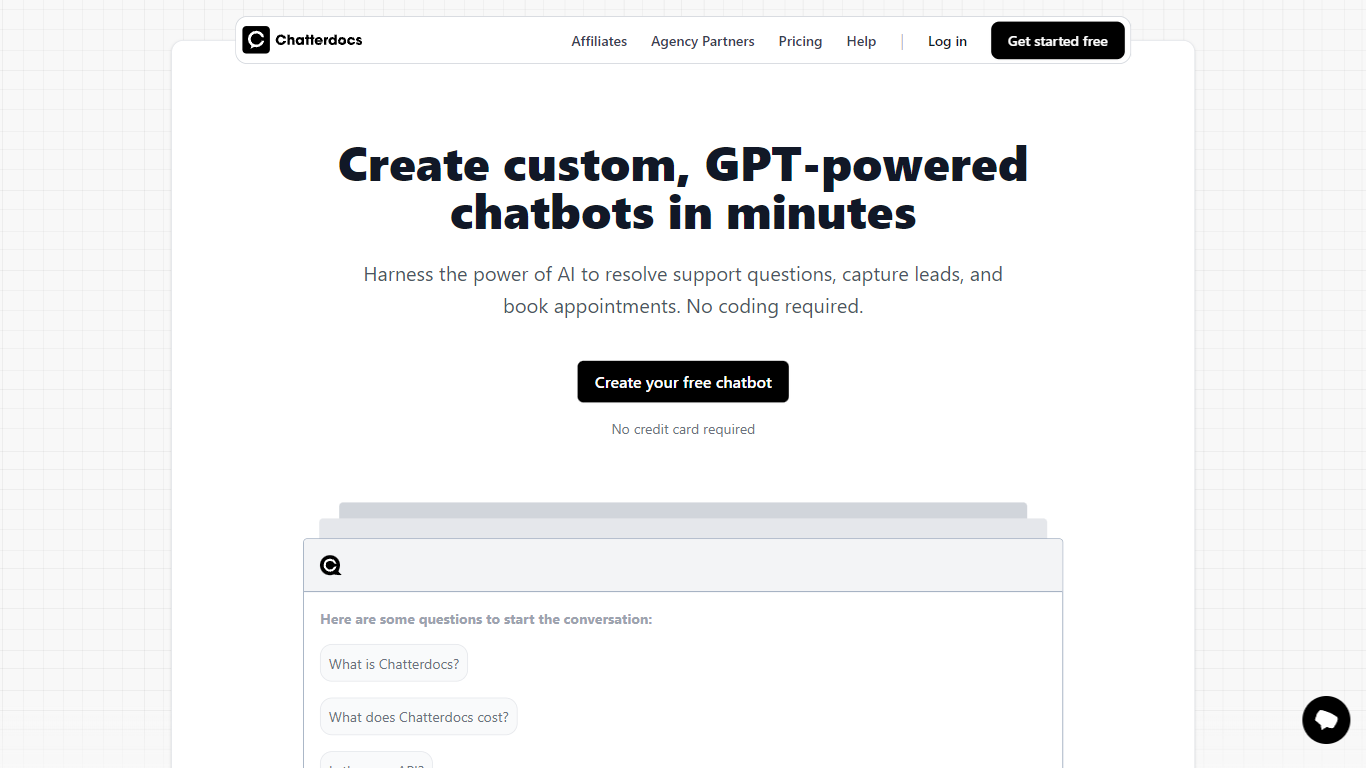
Chatterdocs is a customer support chatbot builder that trains GPT-powered assistants on your website pages, documents, and Notion workspaces. You import content, customize responses, and deploy a chat widget, Slack slash commands, or API push without writing code. The homepage still offers a free chatbot signup with no credit card required.
Chatterdocs now directs new customers to ResolveAI, its merged successor brand, but the original site remains live with docs and onboarding. Compared with Intercom or Zendesk bots tied to full help desks, Chatterdocs focuses on fast GPT training from files and URLs, plus lead capture and appointment booking inside the chat widget.
It fits support teams, agencies, and SaaS sites that want 24/7 answers trained on their own data. Plans on the linked ResolveAI pricing page start at $9 per month with a 10-day free trial, scaling to Expert at $79 per month for higher message and character limits.
CodeBaby Upvotes
Chatterdocs Upvotes
CodeBaby Top Features
Supports GPT-4, Claude, Sonnet, and custom large language models as the conversational engine
Uses Amazon Polly and Azure Speech for text-to-speech with standard and neural voice options
Three deployment paths: self-serve avatar builder, turnkey managed solution, and Proto Hologram bundles
Customer support avatars cite 40 to 60 percent ticket volume reduction on routine inquiries
Healthcare intake avatars collect patient history and run evidence-based triage with EHR integration
Embeds on websites via script tag or API connections to CRM and internal databases
Chatterdocs Top Features
Basic plan at $9 per month includes 1 chatbot, 20 training sources, and 2,000 AI messages
Import website pages, PDFs, CSV, Markdown, audio files, and Notion workspaces as training data
Embed a chat widget, use Slack slash commands, or push responses via API
Lead capture and appointment booking built into the chat interface
Human live chat takeover when visitors ask to speak with a real person
10-day free trial on paid plans with 5-minute setup per ResolveAI pricing page
CodeBaby Category
- Customer Support
Chatterdocs Category
- Customer Support
CodeBaby Pricing Type
- Paid
Chatterdocs Pricing Type
- Freemium