Connected Papers vs Browse AI
Compare Connected Papers vs Browse AI and see which AI Research tool is better when we compare features, reviews, pricing, alternatives, upvotes, etc.
Which one is better? Connected Papers or Browse AI?
When we compare Connected Papers with Browse AI, which are both AI-powered research tools, The upvote count shows a clear preference for Browse AI. Browse AI has received 25 upvotes from aitools.fyi users, while Connected Papers has received 6 upvotes.
Not your cup of tea? Upvote your preferred tool and stir things up!
Connected Papers


What is Connected Papers?
Connected Papers helps researchers explore academic literature through visual similarity graphs instead of citation trees. Enter a paper DOI, arXiv link, PubMed URL, or title and the site builds a force-directed map of closely related work. Each graph analyzes about 50,000 papers and surfaces the few dozen with the strongest bibliographic connections to your origin paper.
Unlike citation indexes that only link direct references, Connected Papers clusters papers by co-citation and bibliographic coupling, so related studies can sit side by side even when they never cite each other. The layout pushes dissimilar work away and highlights the shortest similarity path back to your seed paper. That visual approach makes it easier to spot seminal papers and emerging trends than scrolling flat result lists.
Grad students, thesis writers, and applied scientists use it to skim new fields, catch papers they missed, and build bibliographies from a shortlist of must-include references. The free tier covers casual exploration, while premium plans remove the monthly graph cap for heavy literature reviews.
Browse AI
What is Browse AI?
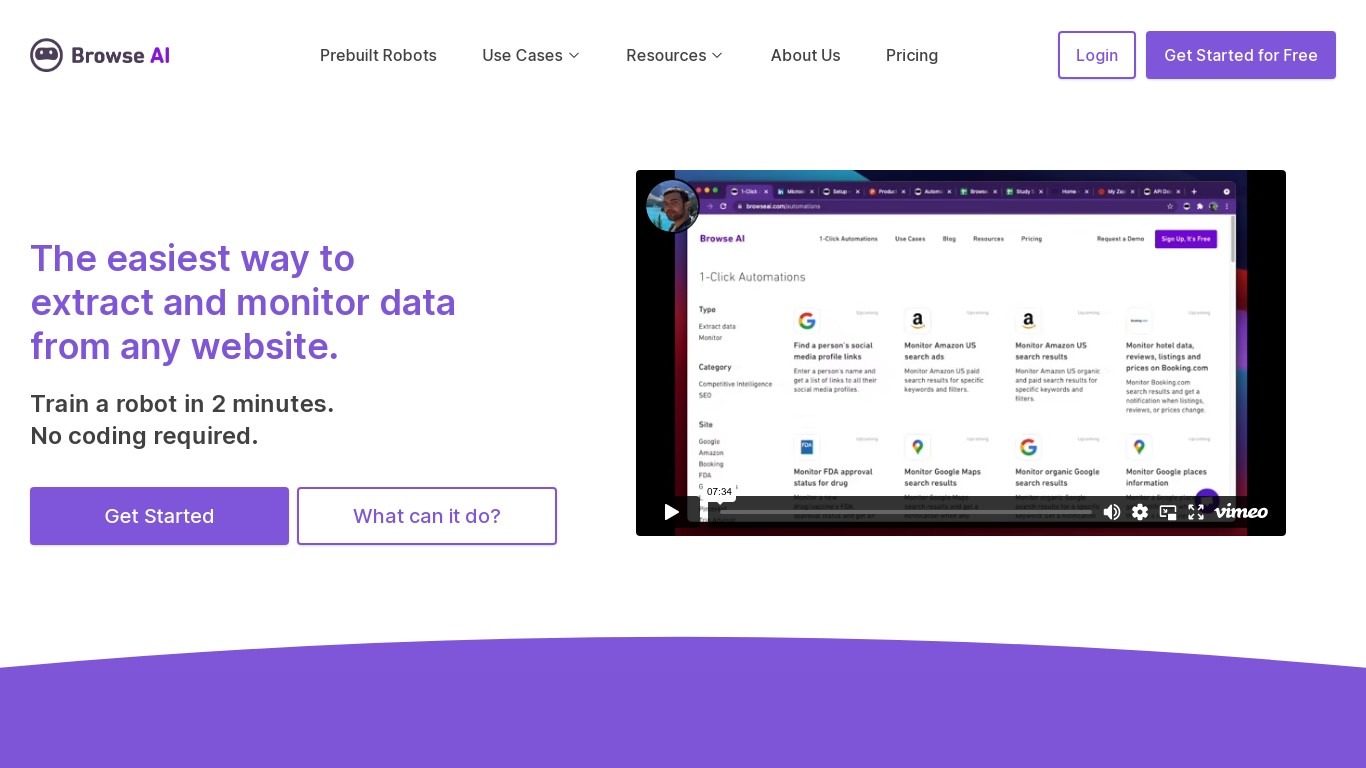
Browse AI is a no-code web scraping and website monitoring platform built for research teams that need structured data from sites they do not control. You train robots with point-and-click actions to extract lists, details, and screenshots, then schedule runs or set change alerts without writing scripts. The platform reports over 770,000 users and has delivered more than 10 billion rows of extracted data.
Where most scrapers break the moment a target site redesigns, Browse AI leans on adaptive change detection that adjusts robot selectors when layouts shift. That trade-off favors operators who monitor competitor pricing or job boards on a schedule and cannot babysit Python scripts every time a CSS class changes. You still get deep scraping workflows, bulk runs across up to 500,000 pages, and exports to Google Sheets, Airtable, Zapier, Make, webhooks, or a REST API.
Browse AI fits ecommerce analysts tracking catalogs, real estate teams pulling listings from Airbnb or Redfin, and growth operators building lead lists from directories. Over 250 prebuilt robots cover Amazon, Indeed, Google Maps, and other high-traffic sites. A Premium tier adds fully managed scraping with custom delivery for high-volume or complex pipelines.
Connected Papers Upvotes
Browse AI Upvotes
Connected Papers Top Features
Each graph analyzes about 50,000 papers and selects the strongest matches to your origin paper
Build graphs from a DOI, arXiv URL, PubMed link, or paper title search
Similarity ranking uses co-citation and bibliographic coupling, not just direct citations
Free plan includes 5 graphs per month with multi-origin graphs, saved papers, and graph history
Premium Academic plan is $6 per month billed at $72 annually for unlimited graphs
Paper data comes from the Semantic Scholar corpus covering hundreds of millions of publications
Browse AI Top Features
Point-and-click robot builder trains on any page with no code required
Adaptive change detection adjusts robots when target sites redesign layouts
250+ prebuilt robots for Amazon, Indeed, Google Maps, and other popular sites
Bulk extraction runs across up to 500,000 pages in a single operation
Paid plans monitor sites every 5 minutes; free plans allow hourly checks at minimum
Syncs to Google Sheets, Airtable, Zapier, Make, REST API, webhooks, or Amazon S3
Connected Papers Category
- Research
Browse AI Category
- Research
Connected Papers Pricing Type
- Freemium
Browse AI Pricing Type
- Freemium