DATAKU vs Catching Unicorns with GLTR
In the battle of DATAKU vs Catching Unicorns with GLTR, which AI Data Science tool comes out on top? We compare reviews, pricing, alternatives, upvotes, features, and more.
Between DATAKU and Catching Unicorns with GLTR, which one is superior?
Upon comparing DATAKU with Catching Unicorns with GLTR, which are both AI-powered data science tools, In the race for upvotes, DATAKU takes the trophy. DATAKU has 7 upvotes, and Catching Unicorns with GLTR has 6 upvotes.
Feeling rebellious? Cast your vote and shake things up!
DATAKU

What is DATAKU?
DATAKU is a data science site that tracks AI benchmarks, API pricing, and model releases, then packages the numbers into free calculators and downloadable datasets. The homepage archives articles on inference costs, funding rounds, and head-to-head model comparisons, while the Tools section hosts eight utilities such as an LLM cost calculator, benchmark decoder, and model graveyard.
Most AI news sites summarize press releases. DATAKU cross-references provider docs, leaderboard scores, and its own pricing tables, which is why the downloadable datasets page lists 48-row pricing histories and 62-row benchmark score tables under CC BY 4.0 licenses.
Data analysts, ML engineers, and buyers use DATAKU when they need cost-per-token math, benchmark context, or CSV exports instead of marketing claims. The About page describes the project as benchmark and pricing tracking run by a former Tokyo data analyst.
Catching Unicorns with GLTR
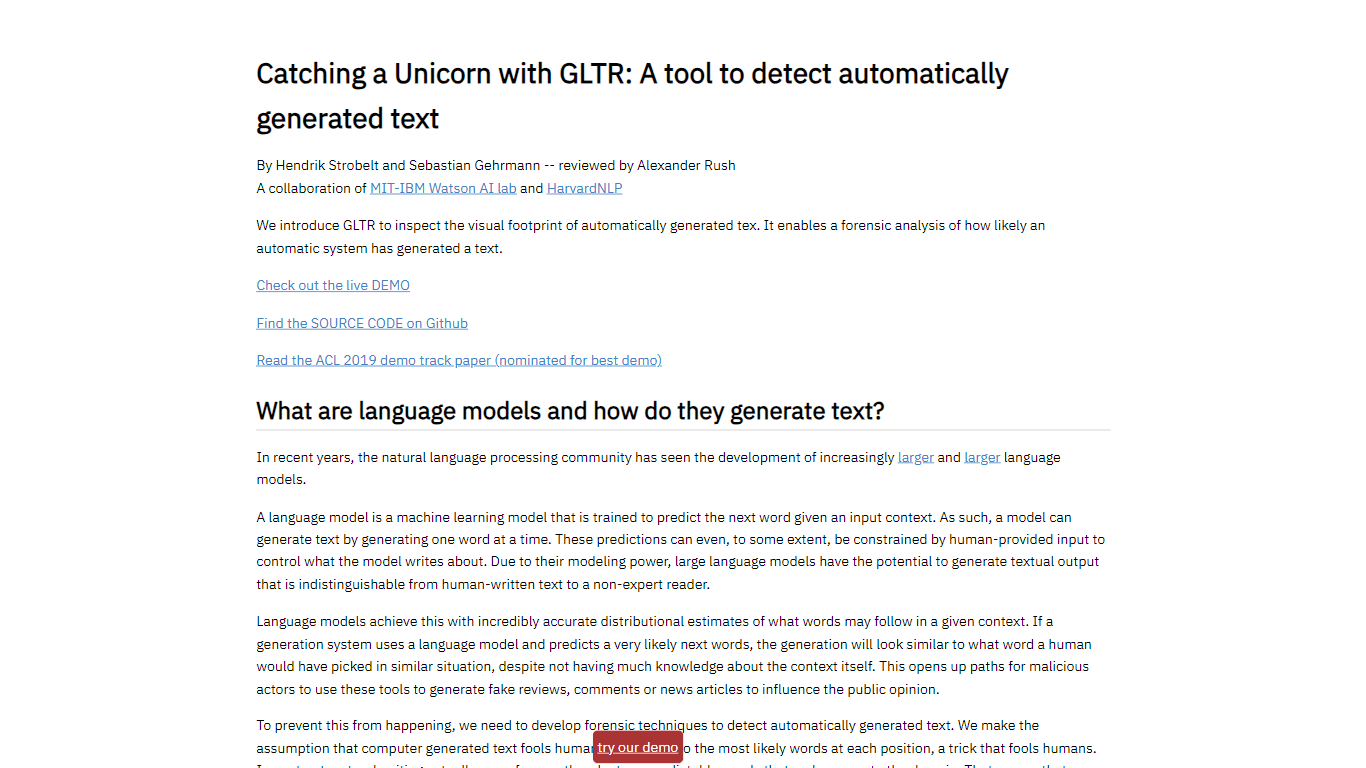
What is Catching Unicorns with GLTR?
GLTR is a forensic text analysis demo that highlights how predictable each word in a passage looks to a language model and colors the text so you can spot machine-written prose at a glance. Paste a sample into the live demo, and GLTR ranks every next-word prediction from GPT-2 117M, painting likely picks green or yellow and surprising human choices purple.
Unlike black-box AI detectors that return a single score, GLTR shows the forensic footprint word by word, plus histograms for top-k counts, probability ratios, and prediction entropy across the passage. That makes it useful for teaching how generative models stick to safe, high-probability wording while human writers reach for rarer terms that still fit the topic.
Researchers, journalists, and educators use GLTR to compare sample texts, explore model behavior, and sanity-check suspicious copy. The project is free, open source, and backed by an ACL 2019 demo paper from MIT-IBM Watson AI Lab and Harvard NLP, though the maintainers note it was built for GPT-2 era text and may struggle with newer models like ChatGPT.
DATAKU Upvotes
Catching Unicorns with GLTR Upvotes
DATAKU Top Features
LLM Cost Calculator estimates API spend across OpenAI, Anthropic, Google, Meta, and Mistral models
Benchmark Decoder explains what benchmarks measure and which models score highest
AI Training Data Tracker documents sources and cutoff dates for 18+ major models
Model Graveyard archives 25+ deprecated models with replacement notes
Downloadable datasets include 48-row pricing history and 62-row benchmark tables (CC BY 4.0)
AI Energy Calculator estimates watts, kWh, and CO2 per model query
Catching Unicorns with GLTR Top Features
Colors each word green, yellow, red, or purple based on GPT-2 117M top 10, 100, 1,000, or rarer predictions
Live demo at demo.gltr.io accepts custom text plus bundled real and fake samples
Hover overlays show the top 5 predicted next words with probabilities for any token
Three histograms chart top-k counts, probability ratios, and prediction entropy across a passage
Open-source code lives on GitHub under detecting-fake-text for local deployment
ACL 2019 demo paper reports human fake-text detection rising from 54% to 72% with GLTR overlays
Maintainers link to the newer RADAR demo for testing text from recent large models
DATAKU Category
- Data Science
Catching Unicorns with GLTR Category
- Data Science
DATAKU Pricing Type
- Free
Catching Unicorns with GLTR Pricing Type
- Free