DATAKU vs JADBio
In the clash of DATAKU vs JADBio, which AI Data Science tool emerges victorious? We assess reviews, pricing, alternatives, features, upvotes, and more.
When we put DATAKU and JADBio head to head, which one emerges as the victor?
Let's take a closer look at DATAKU and JADBio, both of which are AI-driven data science tools, and see what sets them apart. The upvote count favors DATAKU, making it the clear winner. The upvote count for DATAKU is 7, and for JADBio it's 6.
Not your cup of tea? Upvote your preferred tool and stir things up!
DATAKU

What is DATAKU?
DATAKU is a data science site that tracks AI benchmarks, API pricing, and model releases, then packages the numbers into free calculators and downloadable datasets. The homepage archives articles on inference costs, funding rounds, and head-to-head model comparisons, while the Tools section hosts eight utilities such as an LLM cost calculator, benchmark decoder, and model graveyard.
Most AI news sites summarize press releases. DATAKU cross-references provider docs, leaderboard scores, and its own pricing tables, which is why the downloadable datasets page lists 48-row pricing histories and 62-row benchmark score tables under CC BY 4.0 licenses.
Data analysts, ML engineers, and buyers use DATAKU when they need cost-per-token math, benchmark context, or CSV exports instead of marketing claims. The About page describes the project as benchmark and pricing tracking run by a former Tokyo data analyst.
JADBio
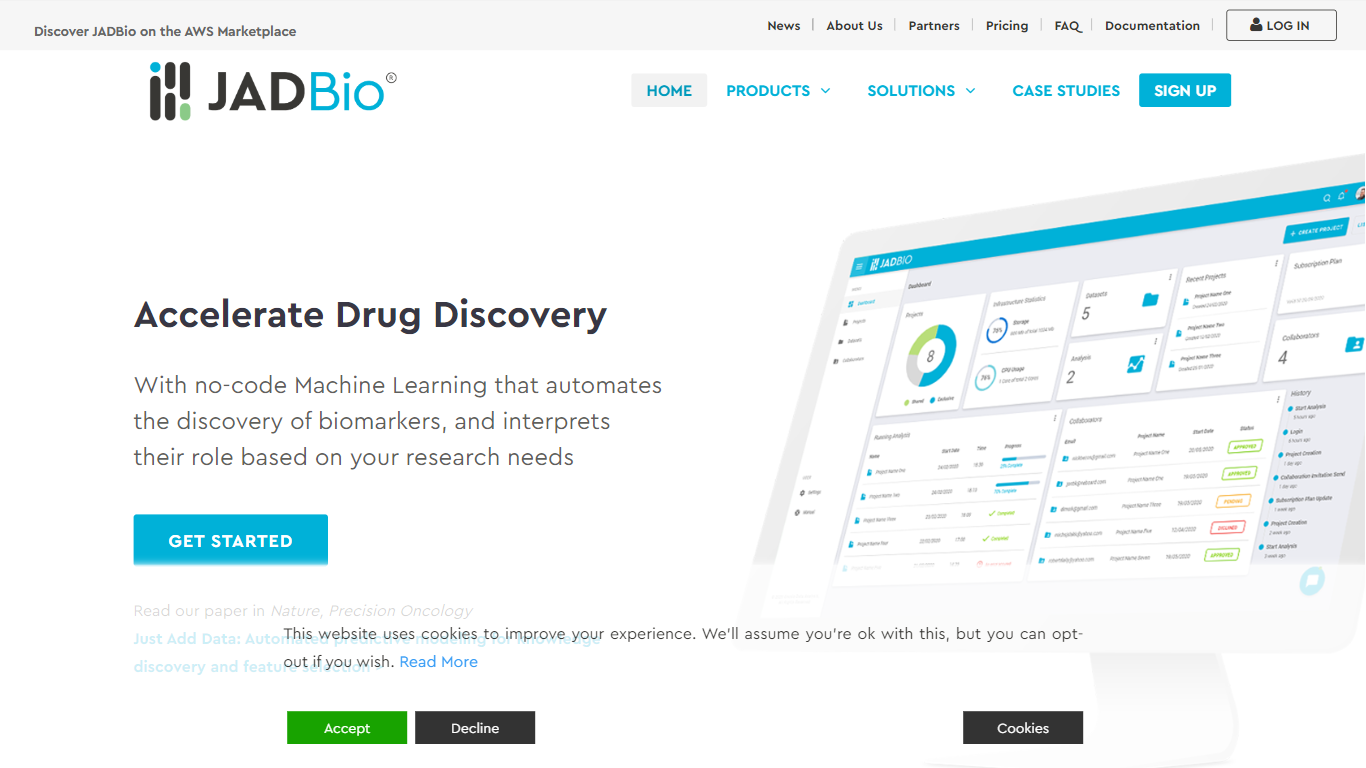
What is JADBio?
JADBio gives life scientists a no-code AutoML workspace for biomarker discovery on multi-omics datasets. You upload curated CSV or delimited files, pick a predictive outcome like disease status or time to event, and the platform runs feature selection, model training, and interpretation without writing Python or R. It handles genomics, transcriptome, proteome, metabolome, clinical phenotype, and image data in one project.
General-purpose AutoML tools treat biology tables like any other spreadsheet. JADBio is built around survival analysis, biomarker ranking, and multi-omics combinations that pharma and academic teams actually publish on. The trade-off is a narrower domain focus and enterprise pricing once you leave the free Basic tier, but you get interpretable feature reports instead of a black-box score.
Oncology researchers, bioinformaticians, and biotech R&D teams use JADBio for early biomarker discovery, disease subtype classification, drug repurposing signals, and trial monitoring. The GUI runs in the browser, a REST API is available on paid Team plans, and the product is also listed on AWS Marketplace for teams that deploy inside AWS.
DATAKU Upvotes
JADBio Upvotes
DATAKU Top Features
LLM Cost Calculator estimates API spend across OpenAI, Anthropic, Google, Meta, and Mistral models
Benchmark Decoder explains what benchmarks measure and which models score highest
AI Training Data Tracker documents sources and cutoff dates for 18+ major models
Model Graveyard archives 25+ deprecated models with replacement notes
Downloadable datasets include 48-row pricing history and 62-row benchmark tables (CC BY 4.0)
AI Energy Calculator estimates watts, kWh, and CO2 per model query
JADBio Top Features
Upload multi-omics CSV datasets up to 50 MB on the free Basic plan
Run classification, regression, and survival analysis with automated feature selection
Interpret models with ROC curves, confusion matrices, and feature importance charts
Start free on the Basic plan with 3 projects and 1 model export included
Scale to Team plans from $2,199 per month billed annually for 5+ seats with API access
DATAKU Category
- Data Science
JADBio Category
- Data Science
DATAKU Pricing Type
- Free
JADBio Pricing Type
- Freemium