Decision AI vs Personal AI
When comparing Decision AI vs Personal AI, which AI Companion tool shines brighter? We look at pricing, alternatives, upvotes, features, reviews, and more.
In a comparison between Decision AI and Personal AI, which one comes out on top?
When we put Decision AI and Personal AI side by side, both being AI-powered companion tools, In the race for upvotes, Personal AI takes the trophy. Personal AI has attracted 7 upvotes from aitools.fyi users, and Decision AI has attracted 6 upvotes.
Want to flip the script? Upvote your favorite tool and change the game!
Decision AI


What is Decision AI?
Decision AI is a companion for team choices, helping groups make traceable decisions with structured frameworks, async input, and an assistant that organizes options before you commit. The marketing site pitches faster decisions with a searchable history so past rationale survives employee turnover.
Built-in frameworks include pros and cons, best and worst case, evaluation matrix, and risk-impact views so groups compare scenarios without another spreadsheet. Decision AI can brainstorm options, tighten writing, and surface facts from earlier calls, though several assistant features are still marked coming soon on the waitlist page.
Channels keep conversation context attached to each decision, and async workflows let contributors respond on their own schedule instead of adding meetings. Pricing is not public yet; visitors join a waiting list for early access while the product finishes rollout.
Personal AI
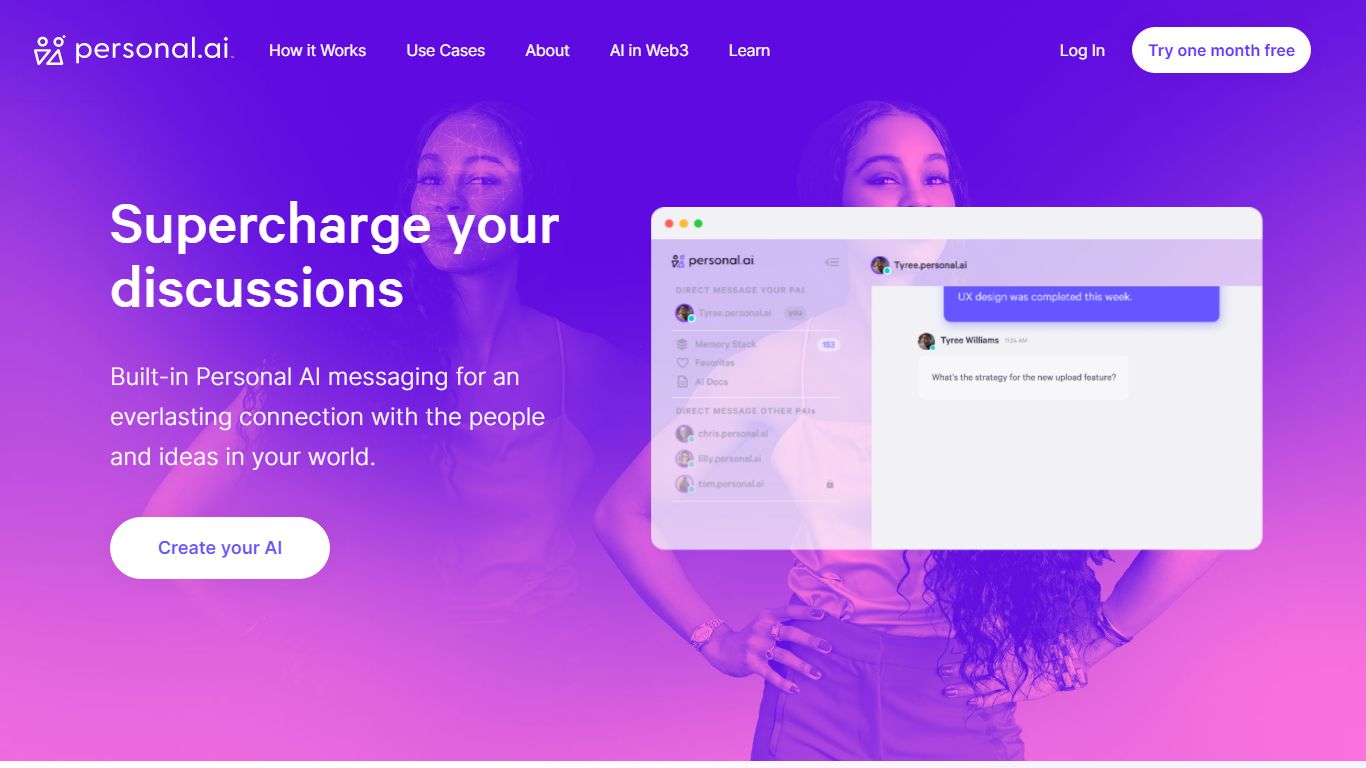
What is Personal AI?
Personal AI builds memory infrastructure that gives AI a persistent identity instead of resetting every session. Its Memory Core encodes, stabilizes, stores, retrieves, and updates experiences so an assistant remembers what it has lived, not just documents you upload. The stack spans My AI for end users, Persona Studio for builders, and carrier-grade Memory Core deployments on operator networks.
Most AI assistants treat context as static files you attach before each chat. Personal AI separates memory (accumulated experiences with temporal structure) from context (static uploads) and lets identity emerge over time. Carrier benchmarks on Comcast's network cite 15ms time to first token, $0.02 per million tokens, and sub-500ms end-to-end voice versus cloud LLM baselines.
Telecom carriers, enterprise AI teams, and individual users who want a long-running assistant use Personal AI. Carriers deploy MODEL-4 on their own networks under custom agreements. Builders use Persona Studio to configure personas without code. Consumers get My AI, an assistant that remembers conversations and learns preferences over time.
Decision AI Upvotes
Personal AI Upvotes
Decision AI Top Features
4 frameworks on decision.so: pros/cons, best-worst case, matrix, and risk-impact
Decision AI assistant for brainstorming, writing help, and past lookup
3 collaboration modes: async input, channels, and searchable history
Searchable history preserves context across staff turnover
Channels on decision.so keep discussion tied to each decision record
Traceable audit trail for compliance and post-mortem reviews
Join the decision.so waitlist for early access before the public launch
Personal AI Top Features
Memory Core with five primitives: encoding, stabilizing, storing, retrieving, and updating
15ms time to first token in carrier benchmarks versus 1,000ms cloud LLM baseline
$0.02 per million tokens cited versus $0.80 on Gemma-27B in published benchmarks
Persona Studio lets builders define personality, knowledge, and memory without code
AI Training Studio with batch uploads, Gmail, Google Drive, Outlook, and OneDrive sync
Sub-500ms end-to-end voice pipeline versus 1,500ms OpenAI Realtime benchmark
Decision AI Category
- Companion
Personal AI Category
- Companion
Decision AI Pricing Type
- Free
Personal AI Pricing Type
- Paid