Entry Point AI vs Deep Realms
In the battle of Entry Point AI vs Deep Realms, which AI Text Generation tool comes out on top? We compare reviews, pricing, alternatives, upvotes, features, and more.
Between Entry Point AI and Deep Realms, which one is superior?
Upon comparing Entry Point AI with Deep Realms, which are both AI-powered text generation tools, The upvote count is neck and neck for both Entry Point AI and Deep Realms. Every vote counts! Cast yours and contribute to the decision of the winner.
Think we got it wrong? Cast your vote and show us who's boss!
Entry Point AI

What is Entry Point AI?
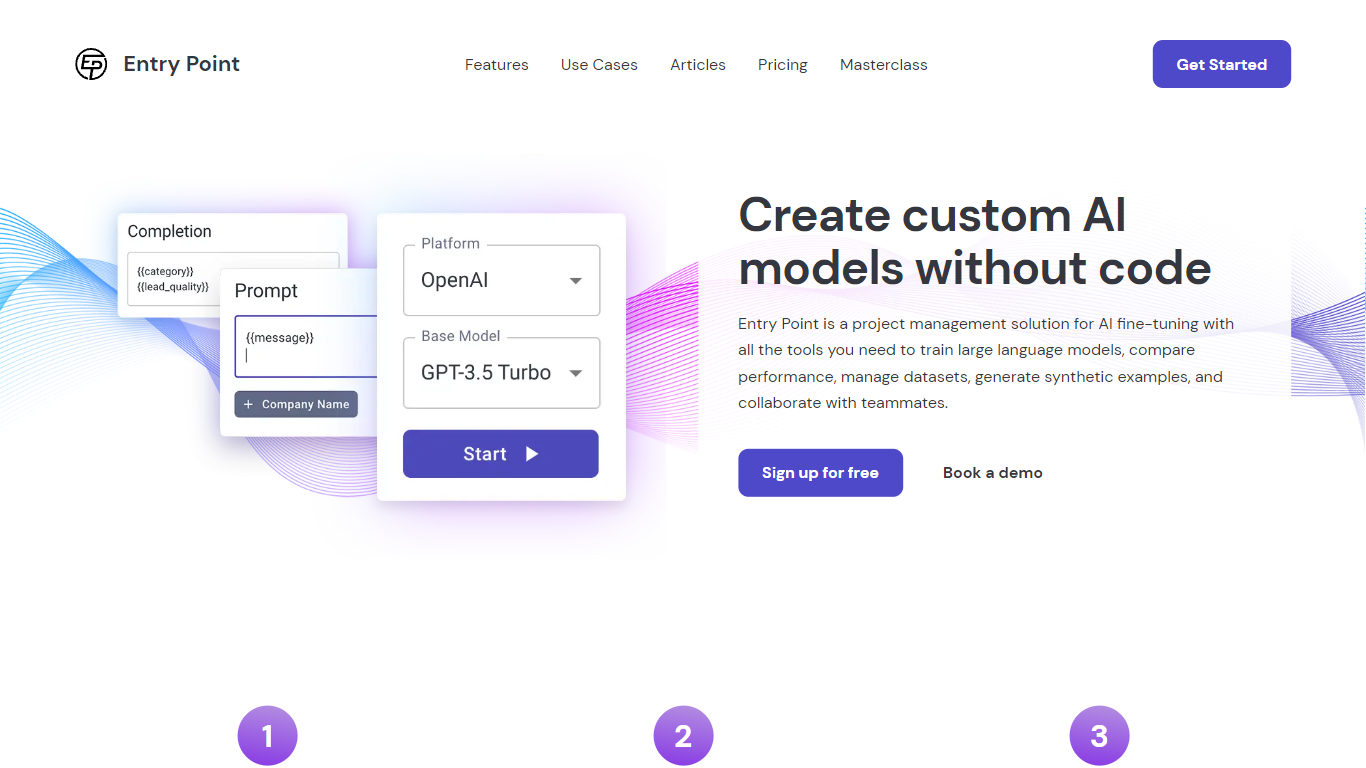
Entry Point AI is a fine-tuning platform for large language models. It helps teams train smaller, task-specific models when frontier LLMs are too slow, expensive, or inconsistent for high-volume production work.
The platform covers the full workflow in one place: import and structure training data, write prompt and completion templates, train across multiple providers, then evaluate, export, and share the results. You work through a browser UI instead of hand-building JSONL files and wiring up provider APIs yourself.
Entry Point AI targets teams shipping structured NLP tasks like classification, tagging, extraction, moderation, and prioritization. Product, ops, and ML-adjacent roles can iterate on datasets and hyperparameters without writing training scripts.
Deep Realms
What is Deep Realms?
Deep Realms lets you play, write, and extend interactive fiction inside custom worlds powered by large language models. Each world splits story text from world lore so the model stays grounded in your characters, locations, and rules while you send actions or edit passages in the Play view.
Compared with generic chatbots, Deep Realms adds Adventure Mode for choose-your-own-adventure pacing, automatic memory, mods for suggested actions and inline images, and a World Engine for RPG-style experiences. Credits are spent when you create worlds or generate story text, while sharing worlds to the public gallery does not consume credits.
Writers, role-players, and game designers use Deep Realms to run parallel stories in one universe, publish worlds to the gallery, and pick from models such as GPT-4o mini, Claude 4.6 Sonnet, and DeepSeek V4 Pro listed in the share dialog.
Entry Point AI Upvotes
Deep Realms Upvotes
Entry Point AI Top Features
Train the same dataset across OpenAI, Anthropic, Google AI, and Groq Cloud from one interface
Template engine lets you iterate on prompt structure, labels, and completion formats before training
Export full datasets as JSONL anytime in the syntax and structure you choose
Share fine-tuned models behind a one-click test frontend with completions saved for review
Built-in validation catches empty completions, bad JSONL, and role formatting issues before training
Team workspaces track datasets, jobs, token counts, cost estimates, and hyperparameter comparisons
Hyperparameter controls expose epochs, learning rate, and estimated training time without touching code
Deep Realms Top Features
Worlds combine story text and world lore for grounded multi-story adventures
Play view supports Author Notes, memory sections, Adventure Mode, and NSFW toggles
Mods add suggested actions, image generation, and visual consistency controls
World Engine supports RPG, visual novel, and CYOA experiences with optional code
Gallery sharing lists recommended models including GPT-5.3 and Claude 4.6 Sonnet
Creating a world spends credits while sharing to the gallery does not
Entry Point AI Category
- Text Generation
Deep Realms Category
- Text Generation
Entry Point AI Pricing Type
- Paid
Deep Realms Pricing Type
- Paid