Galactica vs Stellaris AI
When comparing Galactica vs Stellaris AI, which AI Large Language Model (LLM) tool shines brighter? We look at pricing, alternatives, upvotes, features, reviews, and more.
Between Galactica and Stellaris AI, which one is superior?
When we put Galactica and Stellaris AI side by side, both being AI-powered large language model (llm) tools, Galactica stands out as the clear frontrunner in terms of upvotes. The number of upvotes for Galactica stands at 8, and for Stellaris AI it's 6.
Think we got it wrong? Cast your vote and show us who's boss!
Galactica

What is Galactica?
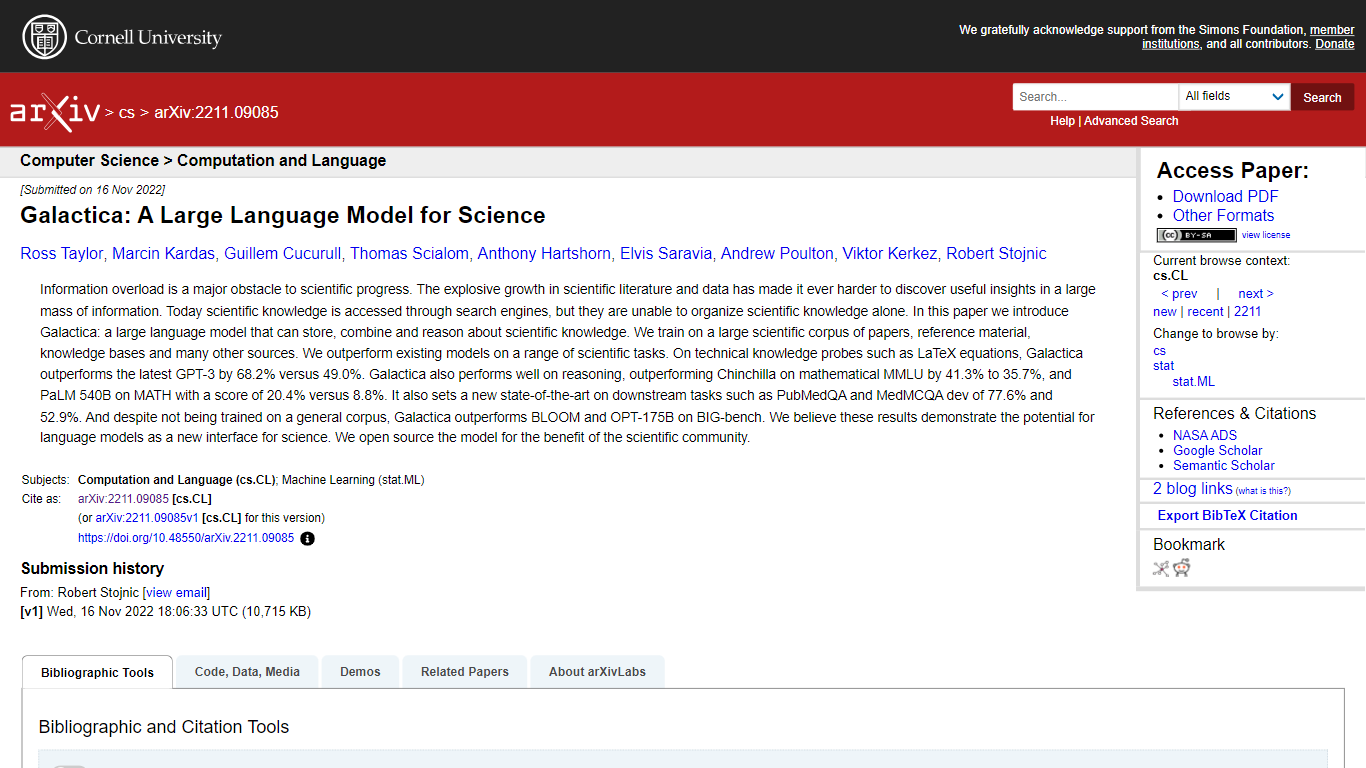
Five open-weight checkpoints from 125M to 120B parameters give researchers a science-trained language model built from 106 billion curated tokens across 48 million papers, textbooks, encyclopedias, and knowledge bases. Galactica stores, combines, and reasons across modalities including LaTeX, Python code, SMILES formulas, and amino acid sequences inside one decoder-only Transformer architecture. Meta's Papers with Code team open sourced the weights for researchers who want to study how language models organize scientific knowledge.
General-purpose LLMs train on broad web crawls where social chatter can dominate the token budget. Galactica used only curated open-access science sources, which the paper argues lets it train for multiple epochs without overfitting. Meta removed the public web demo three days after launch in November 2022 when critics showed confident but fabricated citations and equations, so today you download checkpoints from Hugging Face rather than chat through a hosted interface.
Machine learning researchers can reproduce benchmark numbers from the arXiv paper, including 77.6% on PubMedQA and 52.9% on MedMCQA dev. Computational biologists and chemists can test protein annotation and molecule tasks through Galactica's specialized tokens for amino sequences and SMILES strings. Graduate students exploring scientific QA, citation prediction, or math word problems can experiment with sizes up to 120 billion parameters without training from scratch.
Stellaris AI
What is Stellaris AI?
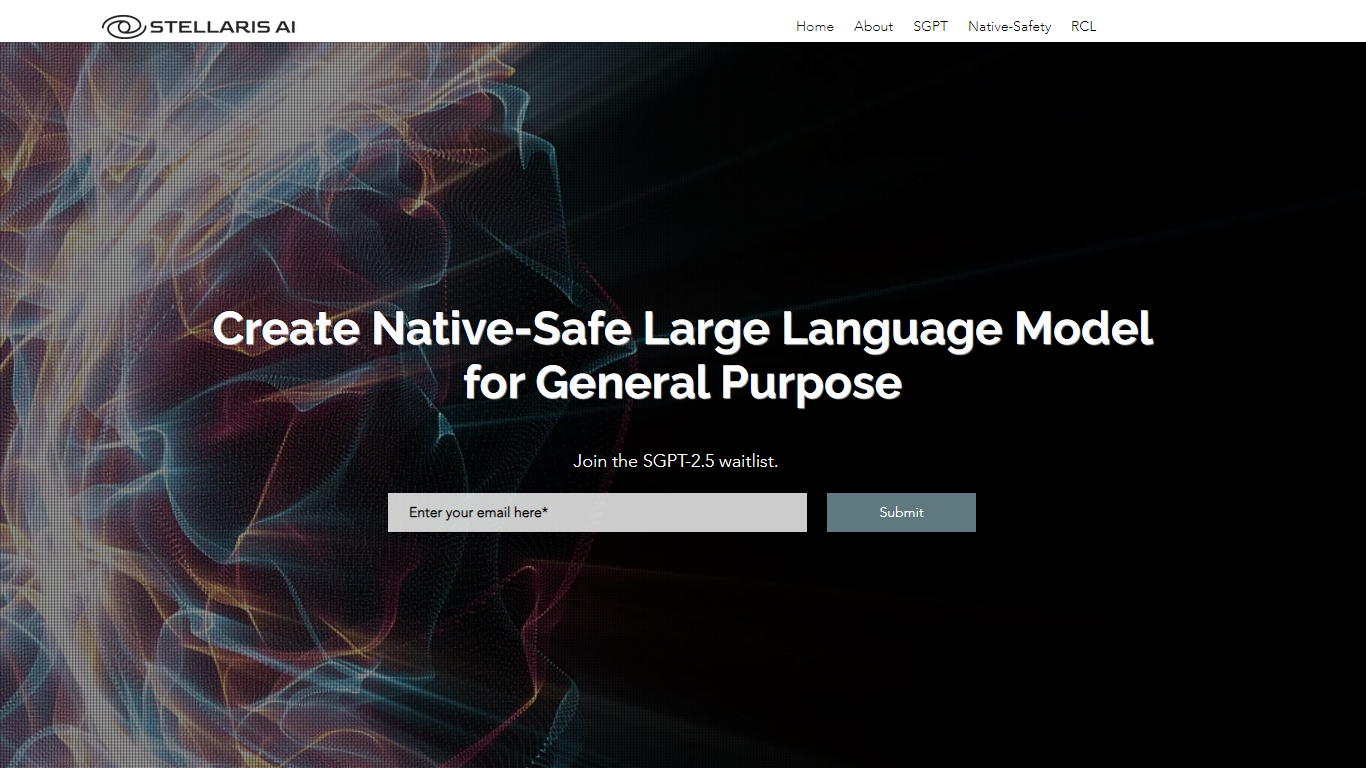
Stellaris AI builds large language models marketed around native safety and human-like reasoning for real-world tasks. Its flagship SGPT line targets text and code generation, knowledge Q&A, logical reasoning, and analytics at a scale the company describes as hundreds of billions of parameters. The public site centers on a waitlist for SGPT-4.5 rather than a self-serve chat product you can open today.
Where many LLM labs bolt safety filters on after training, Stellaris AI frames safety as part of the model stack through strict source referencing and harm minimization in the architecture. It also highlights Real-time Context Learning (RCL) for adapting answers with live knowledge, a combination aimed at teams that want cited outputs instead of unchecked generation.
Researchers, enterprise AI teams, and early adopters join the SGPT-4.5 waitlist for first access. The company cites 10+ years of research and three core product pillars: Stellaris GPT, Native Safety, and RCL.
Galactica Upvotes
Stellaris AI Upvotes
Galactica Top Features
Five checkpoints span 125M, 1.3B, 6.7B, 30B, and 120B parameters
Training corpus totals 106 billion tokens across 48 million scientific papers
Scores 68.2% on LaTeX equation probes versus GPT-3 at 49.0%
Hits 77.6% on PubMedQA and 52.9% on MedMCQA dev benchmarks
30B model reaches 20.4% on MATH versus PaLM 540B at 8.8%
Special tokens cover citations, SMILES formulas, and amino acid sequences
Stellaris AI Top Features
SGPT models described at 100B+ parameters for text, code, and reasoning tasks
Native Safety framework with strict source referencing and harm minimization
Real-time Context Learning (RCL) for live knowledge integration
Three product pillars: Stellaris GPT, Native Safety, and RCL
SGPT-4.5 waitlist open for early access signups on the homepage
Galactica Category
- Large Language Model (LLM)
Stellaris AI Category
- Large Language Model (LLM)
Galactica Pricing Type
- Free
Stellaris AI Pricing Type
- Freemium