ghola vs Personal AI
When comparing ghola vs Personal AI, which AI Companion tool shines brighter? We look at pricing, alternatives, upvotes, features, reviews, and more.
In a comparison between ghola and Personal AI, which one comes out on top?
When we put ghola and Personal AI side by side, both being AI-powered companion tools, With more upvotes, Personal AI is the preferred choice. Personal AI has 7 upvotes, and ghola has 6 upvotes.
You don't agree with the result? Cast your vote to help us decide!
ghola
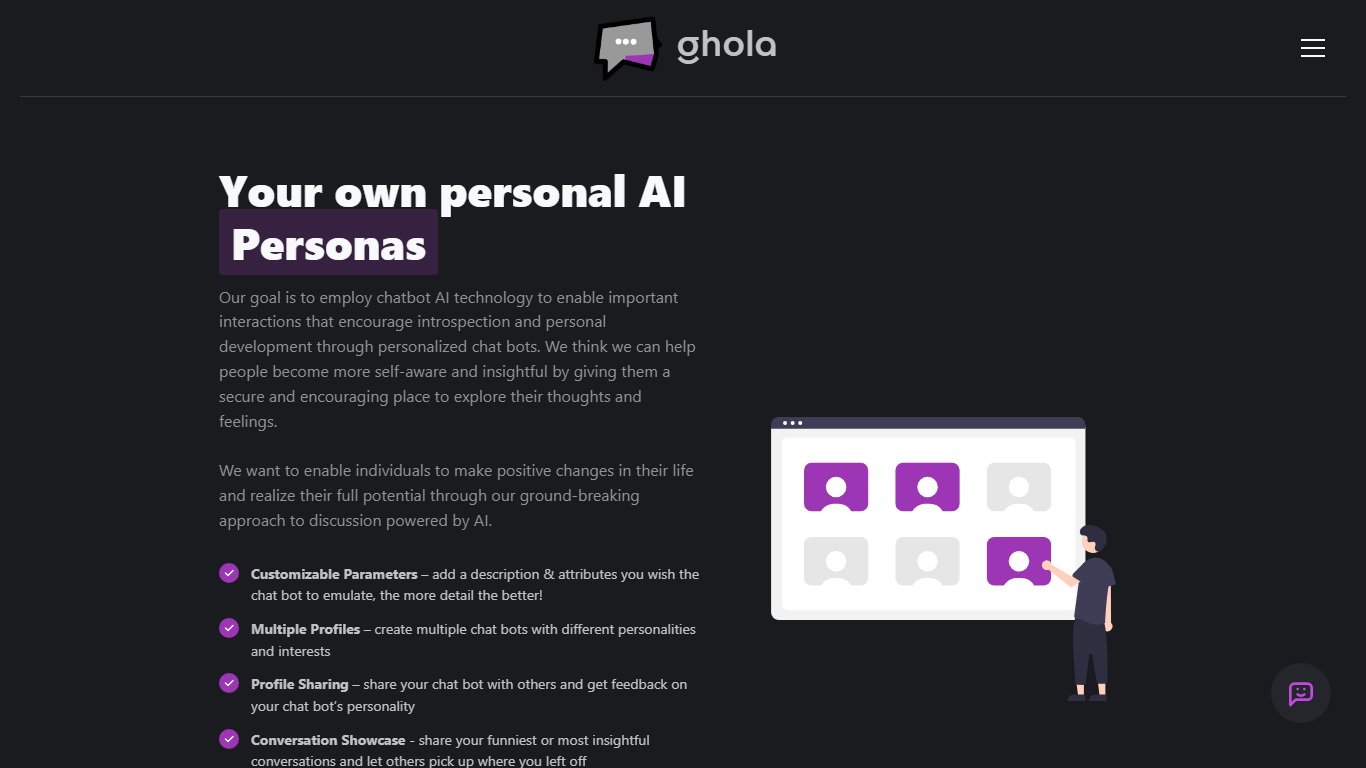

What is ghola?
ghola lets you build custom AI chat personas with detailed personality parameters, then talk to them for reflection, practice conversations, or creative roleplay. You can create multiple profiles with different traits, share public bots with the community, and showcase standout chats on an explore page. Sign-in runs through Google OAuth, and ghola states it does not store private conversations unless you choose to publish them.
Generic companion apps give you one preset character. ghola focuses on persona authoring: you write the description and attributes, spin up as many bots as you want, and even run group chats where multiple personas talk to each other (beta). A backend API is available for embedding those profiles in your own projects, with document uploads listed as in development.
People use ghola for self-reflection, testing dialogue ideas, building character-driven side projects, and experimenting with multi-bot group dynamics. The site positions the product around introspection and personal growth rather than productivity automation.
Personal AI
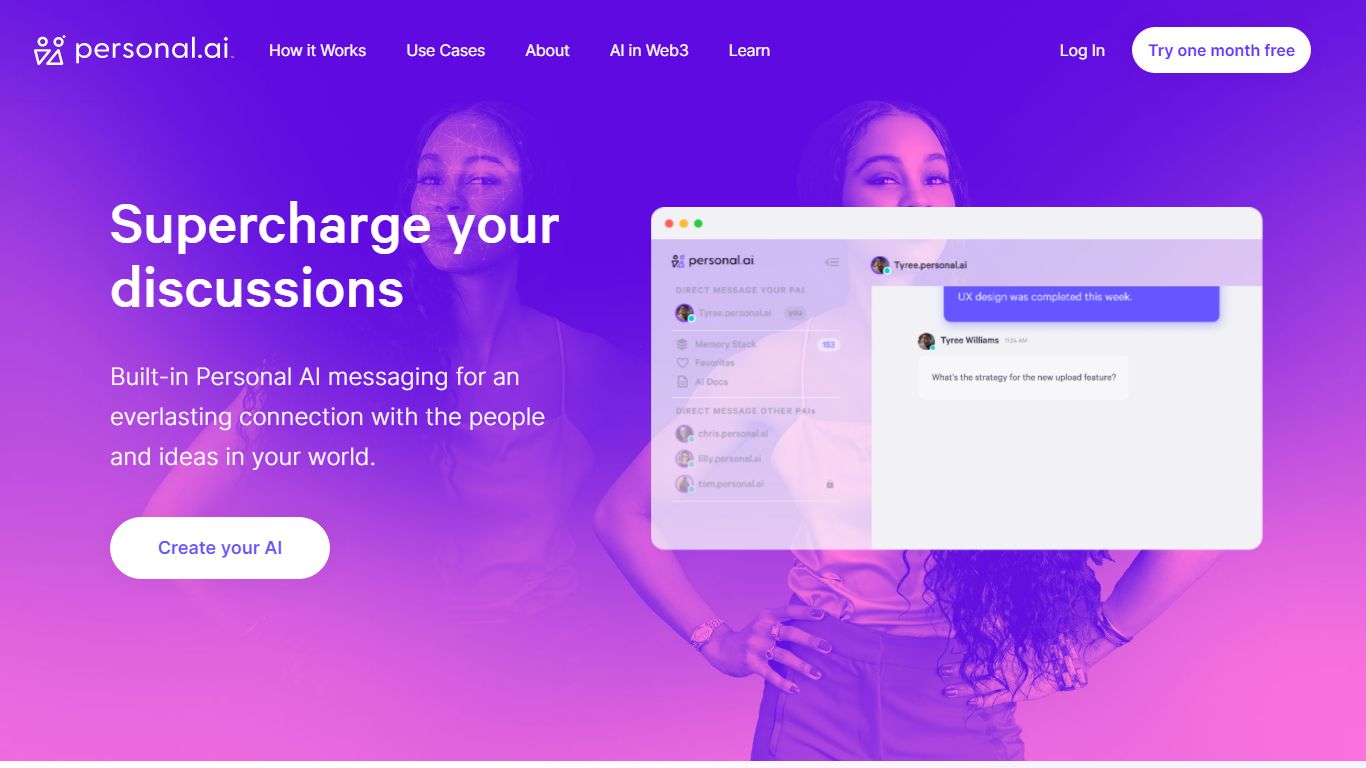
What is Personal AI?
Personal AI builds memory infrastructure that gives AI a persistent identity instead of resetting every session. Its Memory Core encodes, stabilizes, stores, retrieves, and updates experiences so an assistant remembers what it has lived, not just documents you upload. The stack spans My AI for end users, Persona Studio for builders, and carrier-grade Memory Core deployments on operator networks.
Most AI assistants treat context as static files you attach before each chat. Personal AI separates memory (accumulated experiences with temporal structure) from context (static uploads) and lets identity emerge over time. Carrier benchmarks on Comcast's network cite 15ms time to first token, $0.02 per million tokens, and sub-500ms end-to-end voice versus cloud LLM baselines.
Telecom carriers, enterprise AI teams, and individual users who want a long-running assistant use Personal AI. Carriers deploy MODEL-4 on their own networks under custom agreements. Builders use Persona Studio to configure personas without code. Consumers get My AI, an assistant that remembers conversations and learns preferences over time.
ghola Upvotes
Personal AI Upvotes
ghola Top Features
Customizable persona parameters with detailed descriptions and attribute fields
Unlimited profile creation with distinct personalities and interests per bot
Group Conversations beta chats multiple personas in one thread
Backend API for integrating ghola profiles into external apps
Google OAuth sign-in with stated policy of not storing private chats
Conversation Showcase lets users publish insightful chats to the explore page
Personal AI Top Features
Memory Core with five primitives: encoding, stabilizing, storing, retrieving, and updating
15ms time to first token in carrier benchmarks versus 1,000ms cloud LLM baseline
$0.02 per million tokens cited versus $0.80 on Gemma-27B in published benchmarks
Persona Studio lets builders define personality, knowledge, and memory without code
AI Training Studio with batch uploads, Gmail, Google Drive, Outlook, and OneDrive sync
Sub-500ms end-to-end voice pipeline versus 1,500ms OpenAI Realtime benchmark
ghola Category
- Companion
Personal AI Category
- Companion
ghola Pricing Type
- Free
Personal AI Pricing Type
- Paid