Kie.ai - 4o Image API vs Stable Cascade
In the contest of Kie.ai - 4o Image API vs Stable Cascade, which AI Image Generation tool is the champion? We evaluate pricing, alternatives, upvotes, features, reviews, and more.
If you had to choose between Kie.ai - 4o Image API and Stable Cascade, which one would you go for?
When we examine Kie.ai - 4o Image API and Stable Cascade, both of which are AI-enabled image generation tools, what unique characteristics do we discover? The upvote count favors Kie.ai - 4o Image API, making it the clear winner. Kie.ai - 4o Image API has 7 upvotes, and Stable Cascade has 6 upvotes.
Feeling rebellious? Cast your vote and shake things up!
Kie.ai - 4o Image API

What is Kie.ai - 4o Image API?
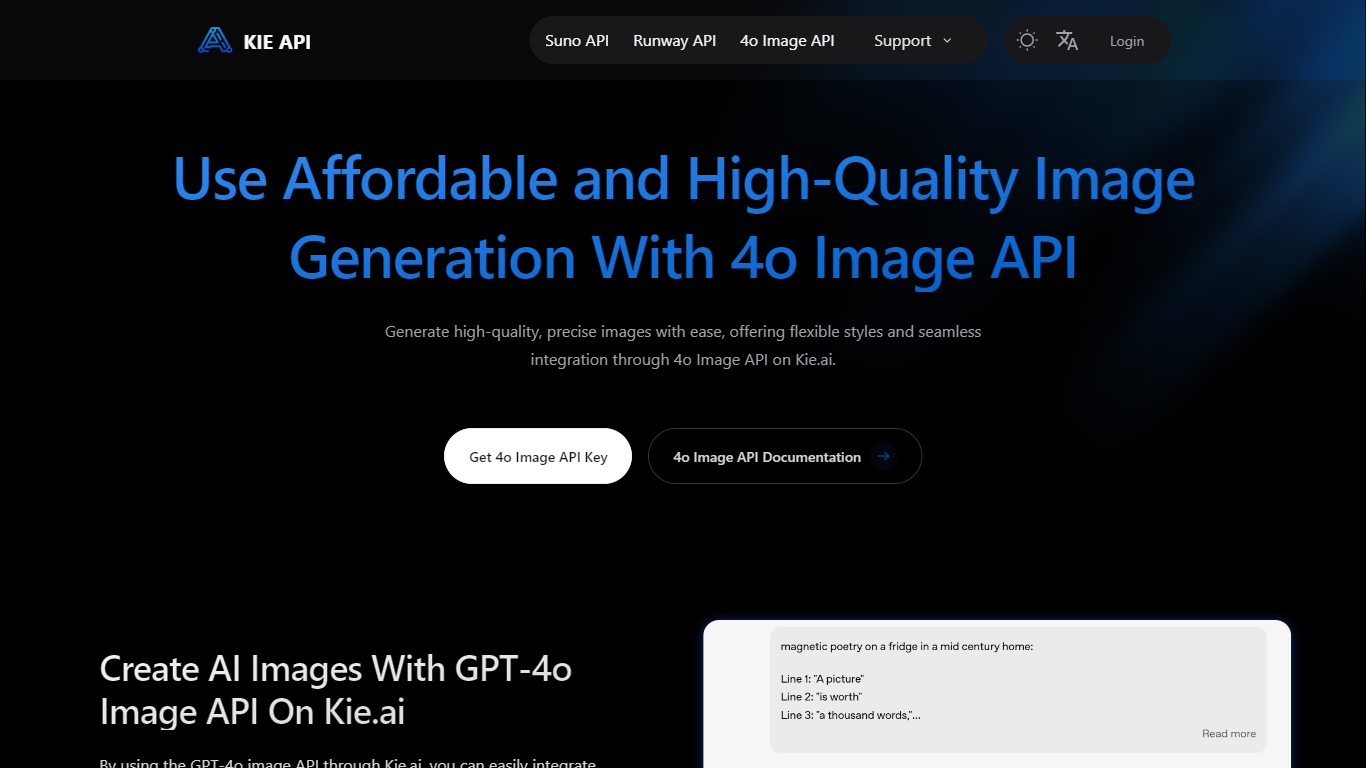
Kie.ai - 4o Image API is a developer image generation API that exposes OpenAI's GPT-Image-1 model through Kie.ai's gateway at api.kie.ai. You send text prompts or source images over REST and receive generated or edited visuals, with a browser playground on the product page for testing before integration. The model is pitched as ChatGPT 4o Image and targets workflows where prompts, layout, and readable text matter.
Kie.ai prices calls on a flat credit system rather than OpenAI's token-based image billing. A single-image generation costs 6 credits, about $0.03, with no subscription required and credit top-ups starting at $5. That trade-off favors predictable per-call costs over running your own GPU stack or decoding OpenAI's output token math.
The API fits product teams, marketers, and app builders who need instruction-following generation, legible text in images, and style consistency across batches. Kie.ai documents use cases such as product mockups, labeled infographics, Ghibli-style art, and keeping characters consistent across scenes.
Stable Cascade
What is Stable Cascade?
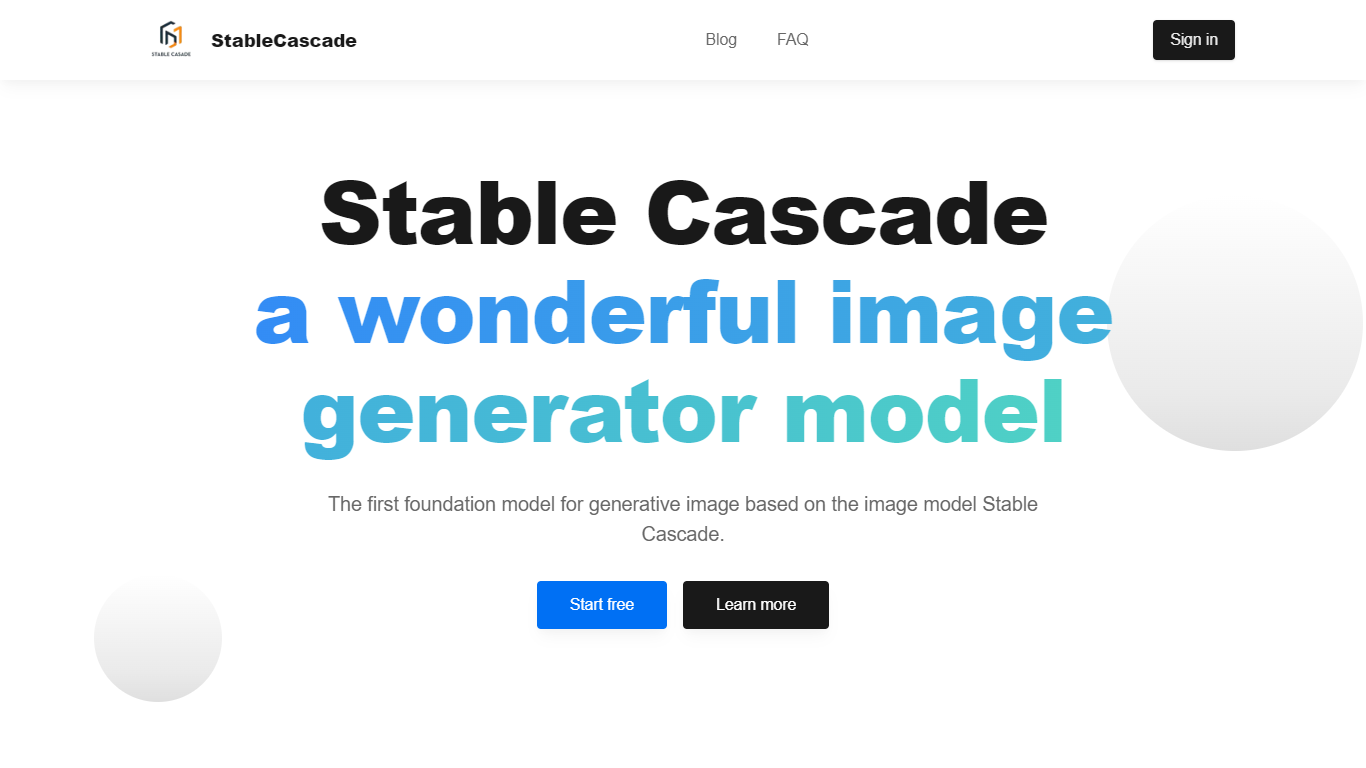
Stable Cascade is a text-to-image diffusion model from Stability AI, built on the Wurstchen architecture. It uses a three-stage pipeline (Stages A, B, and C) that compresses images into a 24x24 latent space before generating high-resolution output, making training and inference far cheaper than standard Stable Diffusion models.
The modular design separates text-conditional generation (Stage C) from pixel decoding (Stages A and B). That split lets you fine-tune Stage C alone for ControlNet, LoRA, and custom training workflows without retraining the full stack. Stability AI released training, finetuning, ControlNet, and LoRA scripts alongside inference code on GitHub.
Stable Cascade targets researchers, ML engineers, and artists who want efficient image generation on consumer hardware. It supports text-to-image, image variations via CLIP embeddings, and image-to-image generation. Model weights are on Hugging Face and run through the diffusers library.
Kie.ai - 4o Image API Upvotes
Stable Cascade Upvotes
Kie.ai - 4o Image API Top Features
Single-image API calls cost 6 credits, about $0.03 per generation
Output aspect ratios are limited to 1:1, 3:2, and 2:3
Each request can return 1, 2, or 4 variants through the nVariants parameter
Image-to-image uploads accept PNG, JPG, and WEBP files in the playground
Async jobs return a task ID polled through the /record-info endpoint
Stable Cascade Top Features
Three-stage cascade compresses 1024x1024 images down to 24x24 latents
Stage C fine-tuning runs separately from the decoder for cheaper custom training
Ships with ControlNet support for inpainting, Canny edge, and 2x super resolution
LoRA training lets you add custom tokens and fine-tune the text-conditional model
Image variations work by feeding CLIP embeddings back into the generation pipeline
Gradio app included for local inference without writing your own UI
Kie.ai - 4o Image API Category
- Image Generation
Stable Cascade Category
- Image Generation
Kie.ai - 4o Image API Pricing Type
- Paid
Stable Cascade Pricing Type
- Free