Kin AI vs Personal AI
In the battle of Kin AI vs Personal AI, which AI Companion tool comes out on top? We compare reviews, pricing, alternatives, upvotes, features, and more.
Between Kin AI and Personal AI, which one is superior?
Upon comparing Kin AI with Personal AI, which are both AI-powered companion tools, In the race for upvotes, Kin AI takes the trophy. Kin AI has attracted 9 upvotes from aitools.fyi users, and Personal AI has attracted 7 upvotes.
Don't agree with the result? Cast your vote and be a part of the decision-making process!
Kin AI

What is Kin AI?
Kin AI puts five persistent AI advisors in your pocket for work, relationships, values, energy, and social confidence, with memory that carries across sessions. Structured Sessions, voice check-ins, proactive Insights, and a guided Journal sit on top of a local-first memory engine with encrypted sync. Kin cites 60,000+ installs, 5 million messages exchanged, and a 4.8 App Store rating on mykin.ai.
Most companion apps reset every session. Kin stores semantic and episodic memory locally with encrypted sync, which means sessions, journal entries, and voice chats build on what it already knows about your patterns and relationships. That local-first setup is the trade-off it sells against cloud-only assistants that treat every prompt like a first meeting.
Founders, operators, and people juggling personal and professional decisions use Kin for structured Sessions, voice check-ins, proactive Insights, and guided journaling. Pricing runs through the mobile app stores rather than a public web page, and the marketing site emphasizes privacy ownership over feature checklists. The company lists Denmark as headquarters in its entity data.
Personal AI
What is Personal AI?
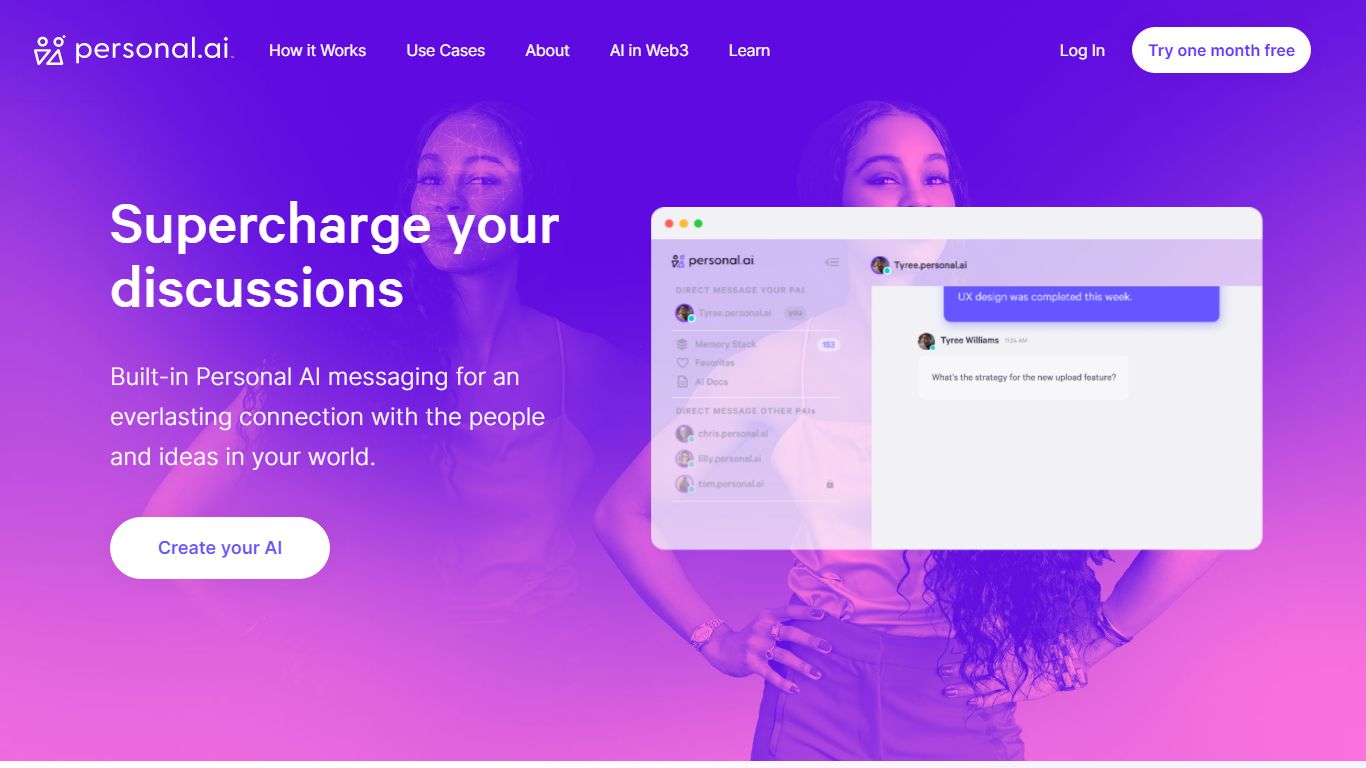
Personal AI builds memory infrastructure that gives AI a persistent identity instead of resetting every session. Its Memory Core encodes, stabilizes, stores, retrieves, and updates experiences so an assistant remembers what it has lived, not just documents you upload. The stack spans My AI for end users, Persona Studio for builders, and carrier-grade Memory Core deployments on operator networks.
Most AI assistants treat context as static files you attach before each chat. Personal AI separates memory (accumulated experiences with temporal structure) from context (static uploads) and lets identity emerge over time. Carrier benchmarks on Comcast's network cite 15ms time to first token, $0.02 per million tokens, and sub-500ms end-to-end voice versus cloud LLM baselines.
Telecom carriers, enterprise AI teams, and individual users who want a long-running assistant use Personal AI. Carriers deploy MODEL-4 on their own networks under custom agreements. Builders use Persona Studio to configure personas without code. Consumers get My AI, an assistant that remembers conversations and learns preferences over time.
Kin AI Upvotes
Personal AI Upvotes
Kin AI Top Features
Five advisor personas cover work, relationships, values, body energy, and social confidence
Local-first semantic and episodic memory keeps context between sessions
Structured Sessions guide daily prep, decisions, and stuck-point conversations
Voice mode supports spoken advisor conversations outside text chat
Insights surface recurring themes and blind spots proactively
Guided Journal entries build on prior history instead of blank pages
Encrypted sync lets you choose what to share while data stays on your device
Personal AI Top Features
Memory Core with five primitives: encoding, stabilizing, storing, retrieving, and updating
15ms time to first token in carrier benchmarks versus 1,000ms cloud LLM baseline
$0.02 per million tokens cited versus $0.80 on Gemma-27B in published benchmarks
Persona Studio lets builders define personality, knowledge, and memory without code
AI Training Studio with batch uploads, Gmail, Google Drive, Outlook, and OneDrive sync
Sub-500ms end-to-end voice pipeline versus 1,500ms OpenAI Realtime benchmark
Kin AI Category
- Companion
Personal AI Category
- Companion
Kin AI Pricing Type
- Freemium
Personal AI Pricing Type
- Paid