Kvery vs SDF
In the battle of Kvery vs SDF, which AI SQL tool comes out on top? We compare reviews, pricing, alternatives, upvotes, features, and more.
Between Kvery and SDF, which one is superior?
Upon comparing Kvery with SDF, which are both AI-powered sql tools, The upvote count favors Kvery, making it the clear winner. Kvery has 7 upvotes, and SDF has 6 upvotes.
You don't agree with the result? Cast your vote to help us decide!
Kvery

What is Kvery?
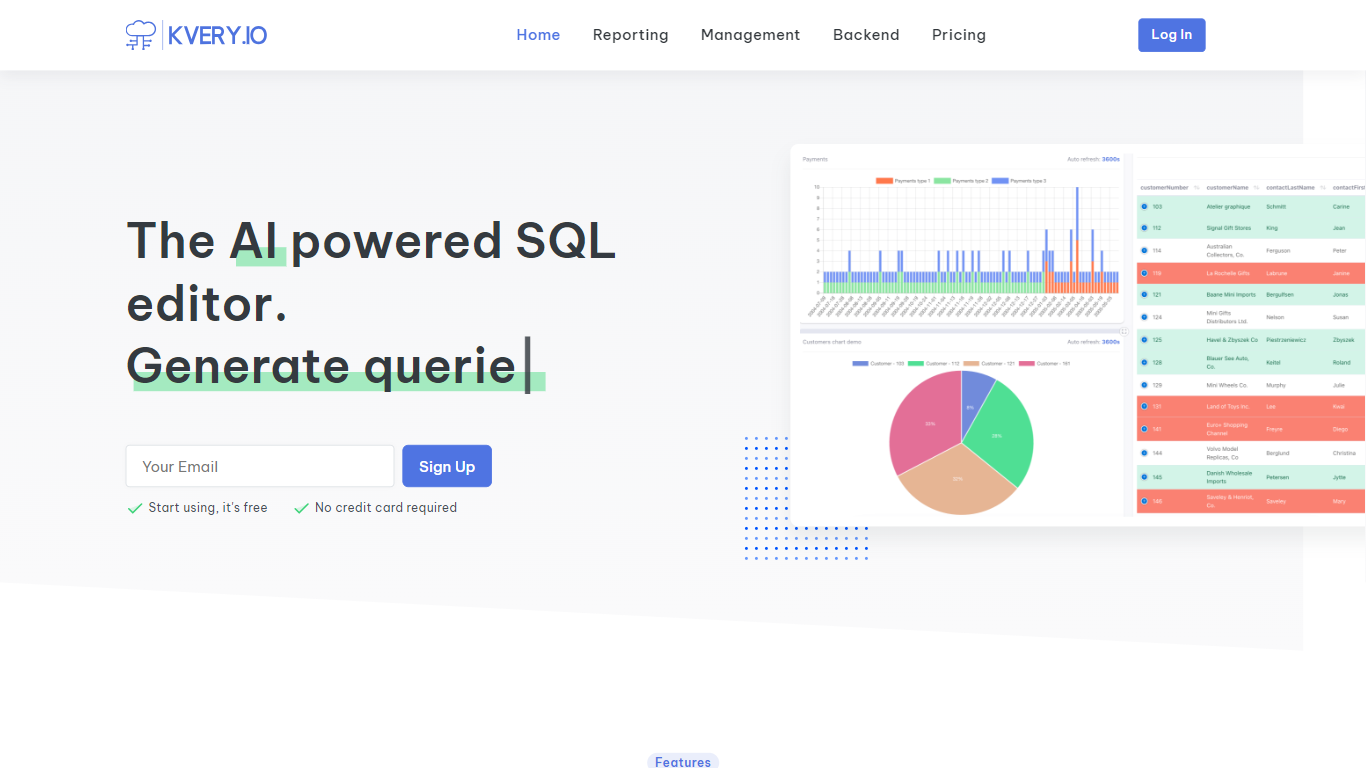
Kvery is an SQL workspace that turns a written query into live tables, charts, REST endpoints, and shareable dashboards without you writing backend code. You connect MySQL, PostgreSQL, SQL Server, or MariaDB, write or generate SQL, and the platform builds the data views and APIs around that query in minutes instead of a multi-week sprint.
Most SQL clients stop at query results. Kvery ships the query as a product surface: auto-generated REST routes, drag-and-drop dashboards, scheduled runs with email or webhook delivery, and a built-in Model Context Protocol server so Claude, Cursor, or n8n can search and execute your saved queries with scoped tokens. That combination targets teams who want SQL-first delivery rather than a separate BI suite or hand-built API layer.
Developers, data analysts, and small product teams use Kvery to prototype internal tools, client reporting, and ops dashboards. Role-based workspaces, AES-256 encrypted connections, and native iOS and Android apps make it workable for production data when you need mobile access or tight permission boundaries.
SDF
What is SDF?
SDF is a SQL comprehension engine that reads warehouse SQL, builds intermediate representations of each query, and flags mistakes before anything runs. It sits in the analytics stack between raw SQL text and the database, giving teams compile-time insight into syntax, types, and downstream column shapes.
Most SQL linters stop at surface syntax. SDF works through three stacked levels: parsing into a syntax tree, compiling a logical plan with function signatures and return types, and executing a physical plan when data-level checks matter. That ladder catches wrong argument order on Snowflake dateadd calls and impossible cast dates that parsers alone would miss, which is why dbt Labs bought SDF Labs to embed the engine inside dbt rather than bolt on another string preprocessor.
Analytics engineers and dbt developers use SDF to harden large warehouse projects, trace column-level lineage, and ship transformations with fewer surprise runtime failures. Since the mid-2024 GA launch, sdf.com routes visitors to dbt Labs pages explaining how the acquisition folds SDF into the next dbt engine.
Kvery Upvotes
SDF Upvotes
Kvery Top Features
Free plan includes 3 saved SQL queries with full API and dashboard generation
Natural language prompts convert to SQL inside the multi-tab query editor
Built-in MCP server exposes six tools for listing, searching, and executing queries
Team plan supports 100 queries, 10 users, and 3 editors at $1499 per year
Schedule queries with CRON syntax and deliver results via email or webhooks
Connect MySQL, PostgreSQL, SQL Server, and MariaDB over direct or SSH tunnels
Native iOS and Android apps save dashboards with auto-refresh and deep-link sharing
SDF Top Features
Three SQL comprehension levels: parsing syntax trees, compiling logical plans, and executing physical plans
Level 2 compilation validates Snowflake function signatures and catches wrong dateadd argument order before runtime
dbt Labs acquisition targets true column-level lineage inside dbt projects
Static analysis flags impossible casts such as January 32 dates that parsers approve
Logical plans infer column return types without executing warehouse queries
Kvery Category
- SQL
SDF Category
- SQL
Kvery Pricing Type
- Freemium
SDF Pricing Type
- Paid