Lifestack vs Tulsk
In the contest of Lifestack vs Tulsk, which AI Productivity tool is the champion? We evaluate pricing, alternatives, upvotes, features, reviews, and more.
If you had to choose between Lifestack and Tulsk, which one would you go for?
When we examine Lifestack and Tulsk, both of which are AI-enabled productivity tools, what unique characteristics do we discover? There's no clear winner in terms of upvotes, as both tools have received the same number. Join the aitools.fyi users in deciding the winner by casting your vote.
Don't agree with the result? Cast your vote and be a part of the decision-making process!
Lifestack

What is Lifestack?
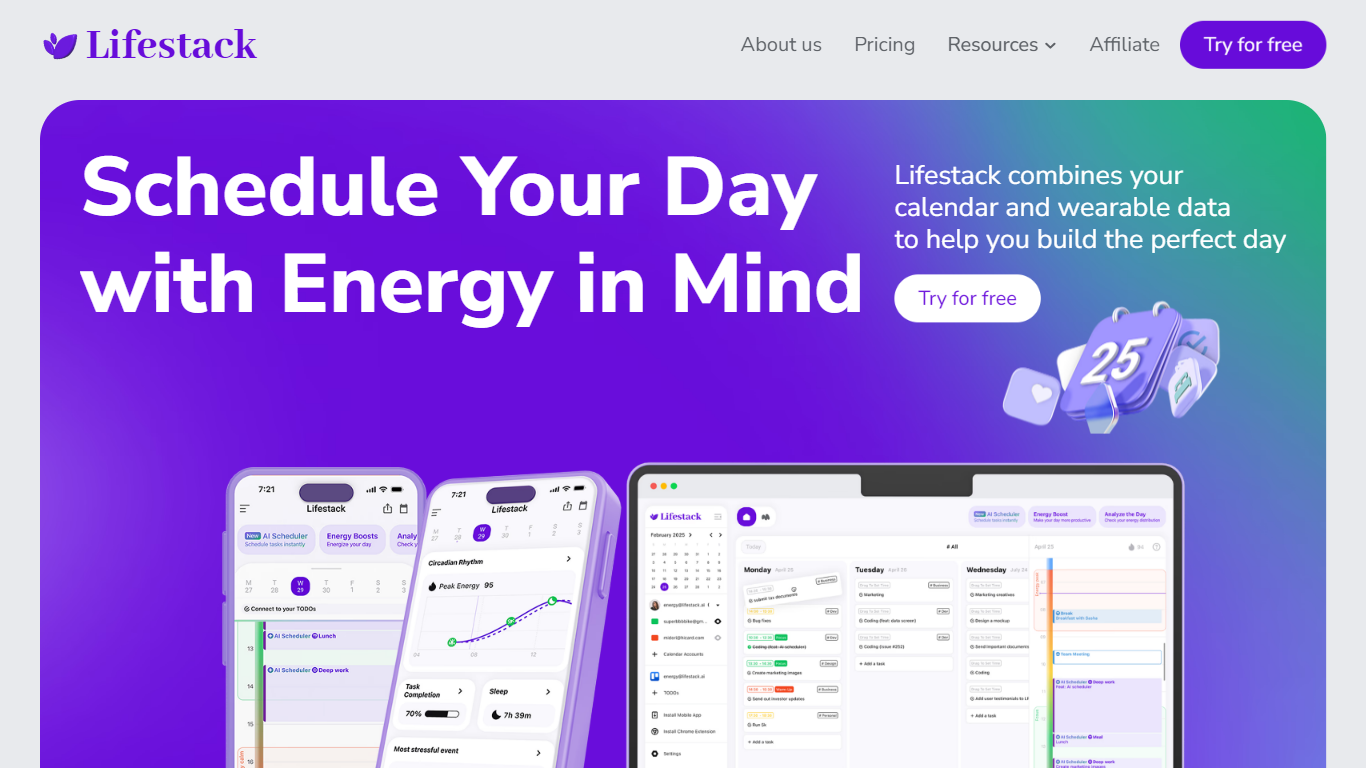
Lifestack is a productivity planner that builds your daily schedule around sleep, recovery, and focus instead of empty calendar blocks. It reads wearable and health signals, maps energy peaks and calm periods across your day, and drafts a schedule that places demanding work when you can actually focus.
Most calendar apps treat you like a task executor with unlimited stamina. Lifestack treats energy, meals, and rest as first-class inputs, overlaying focus and calm zones on your calendar so you see when deep work fits and when lighter tasks make sense. That body-first layer is the trade-off: it is narrower than a general project manager, but it connects health data to scheduling decisions most planners ignore.
The product suits professionals juggling meetings and deep work, ADHD users who need external structure around energy swings, and anyone syncing tasks from tools like Trello while trying to protect sleep and meal timing. Apps run on iPhone, Mac, Android, and Chrome, with a desktop Mac download and browser extension for calendar access.
Tulsk

What is Tulsk?
Tulsk runs an AI-native project management workspace where humans and autonomous agents share the same task board. You track projects, sprints, and dependencies in a Linear-style issue tracker, then assign work to sandboxed agents that post updates as comments and delegate to each other up to three levels deep.
Most PM tools treat AI as a sidebar chatbot. Tulsk's Workspace Chat acts as an always-on project manager that watches the board, surfaces risks, generates briefings, and routes work to specialist agents. That setup fits teams who want agent labor inside the tracker instead of copying context into separate automation tools.
Startup product teams, ops leads, and growth groups use Tulsk for scheduled workflows like Stripe reconciliation, GitHub changelog updates, and Slack reply nudges. Integrations cover Slack natively plus Gmail, GitHub, and Google Calendar through Composio, with an MCP server exposing 51+ tools for external agents.
Lifestack Upvotes
Tulsk Upvotes
Lifestack Top Features
Maps Energy Zones on your calendar so focus work lands during peak energy periods
Pulls wearable and Apple Health data into the same view as your schedule
Syncs tasks from third-party tools such as Trello alongside calendar events
Plans meals and sleep blocks around the day's meetings and task load
Chat copilot answers daily planning questions with your schedule in context
Runs on iPhone, Mac, Android, and Chrome with unlimited calendars and tasks on paid plans
Used by 30,000+ users per the Lifestack homepage
Tulsk Top Features
Free tier includes unlimited projects and tasks plus $5 of agent work with no credit card
Starter plan at $39 per month includes $50 of monthly agent work and up to 6 AI agents
Workspace Chat monitors the board and delegates tasks to specialist agents automatically
MCP server at tulsk.io/api/mcp/sse exposes 51+ tools for external agent integrations
Agents can delegate work to other agents up to three levels deep inside sandboxes
Pro tier adds $120 of monthly agent work, unlimited agents, and 99.9% uptime SLA
Lifestack Category
- Productivity
Tulsk Category
- Productivity
Lifestack Pricing Type
- Paid
Tulsk Pricing Type
- Freemium