Minerva vs GPT-4
In the face-off between Minerva vs GPT-4, which AI Large Language Model (LLM) tool takes the crown? We scrutinize features, alternatives, upvotes, reviews, pricing, and more.
In a face-off between Minerva and GPT-4, which one takes the crown?
If we were to analyze Minerva and GPT-4, both of which are AI-powered large language model (llm) tools, what would we find? With more upvotes, GPT-4 is the preferred choice. GPT-4 has received 7 upvotes from aitools.fyi users, while Minerva has received 6 upvotes.
Not your cup of tea? Upvote your preferred tool and stir things up!
Minerva

What is Minerva?
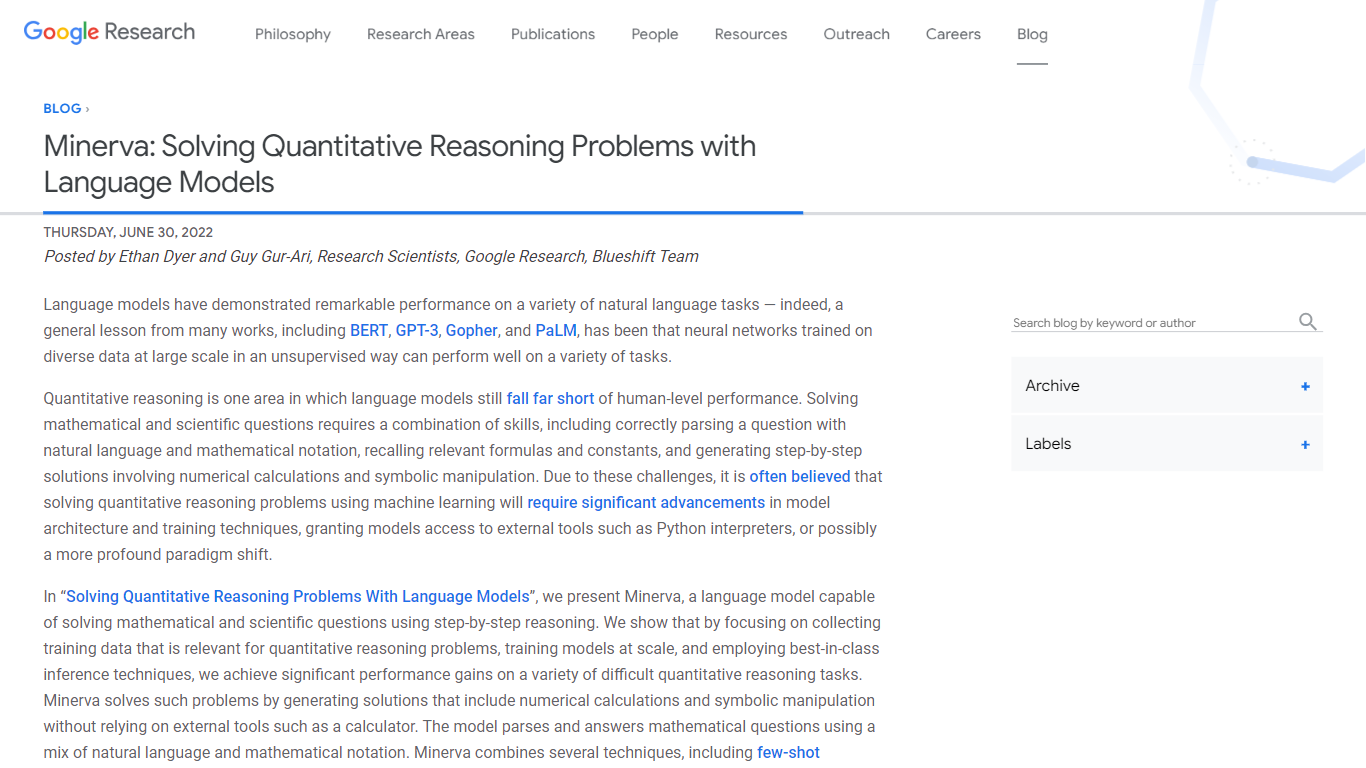
Minerva is a large language model from Google Research built to solve math and science questions through step-by-step written reasoning. It reads problems that mix plain English with LaTeX notation, then writes out solutions involving arithmetic, algebra, and symbolic steps. The model was trained on scientific papers and web pages where mathematical formatting was kept intact, rather than stripped during preprocessing.
Most math-capable models lean on external tools like Python interpreters or calculators at inference time. Minerva takes the opposite bet: it generates full worked solutions from the model weights alone, using chain-of-thought prompting and majority voting across multiple sampled answers. That informal approach covers a wider range of problem types than formal theorem provers, but the trade-off is answers cannot be machine-verified the way Coq or Lean proofs can.
Researchers studying quantitative reasoning in language models use Minerva as a reference point for STEM benchmark performance. The public sample explorer hosts 110 solved problems across algebra, physics, chemistry, and other topics, so anyone can read through how the model arrived at each answer. Educators and ML engineers reviewing benchmark methodology will find the published MATH, MMLU-STEM, GSM8k, and OCWCourses scores useful for comparing against newer models.
GPT-4
What is GPT-4?
GPT-4 is OpenAI's large language model built for advanced reasoning, instruction following, and safer responses across text tasks. OpenAI positions it as the successor along the GPT research line and makes it available through ChatGPT Plus and the developer API. The product page highlights alignment work with human feedback and expert review before release.
Compared with earlier GPT-3.5 chat models, GPT-4 emphasizes measurable safety and factuality gains rather than raw parameter counts alone. OpenAI reports it is 82% less likely to answer disallowed requests and 40% more likely to give factual replies on internal tests versus GPT-3.5. That trade-off targets teams that need stronger guardrails even if latency and cost run higher than smaller models.
GPT-4 shows up in production stories from Duolingo, Be My Eyes, Stripe, and Morgan Stanley wealth management on OpenAI's site. Developers reach it through the API platform, while ChatGPT Plus subscribers access it inside the chat product. OpenAI notes ongoing limitations around bias, hallucinations, and adversarial prompts that remain under active research.
Minerva Upvotes
GPT-4 Upvotes
Minerva Top Features
Built on PaLM with 118GB of arXiv papers and math-formatted web pages in training data
Scores 50.3% on the MATH benchmark at 540B parameters, up from a prior best of 6.9%
Generates solutions with arithmetic and symbolic steps without calling a calculator or Python interpreter
Uses chain-of-thought prompting, few-shot examples, and majority voting across sampled outputs
Public sample explorer shows 110 worked problems across 11 topics including algebra, physics, and chemistry
Reaches 75% on MMLU-STEM and 78.5% on GSM8k, both ahead of published prior state of the art
GPT-4 Top Features
82% lower rate of disallowed responses versus GPT-3.5 on OpenAI internal tests
40% higher likelihood of factual answers versus GPT-3.5 on OpenAI evaluations
Alignment pipeline used feedback from over 50 expert reviewers before launch
Available through ChatGPT Plus and the OpenAI developer API
Trained on Microsoft Azure AI supercomputers per OpenAI infrastructure notes
Minerva Category
- Large Language Model (LLM)
GPT-4 Category
- Large Language Model (LLM)
Minerva Pricing Type
- Free
GPT-4 Pricing Type
- Freemium