Moshi AI vs AUDOIR
In the clash of Moshi AI vs AUDOIR, which AI Audio Generation tool emerges victorious? We assess reviews, pricing, alternatives, features, upvotes, and more.
When we put Moshi AI and AUDOIR head to head, which one emerges as the victor?
Let's take a closer look at Moshi AI and AUDOIR, both of which are AI-driven audio generation tools, and see what sets them apart. Both tools are equally favored, as indicated by the identical upvote count. Your vote matters! Help us decide the winner among aitools.fyi users by casting your vote.
Think we got it wrong? Cast your vote and show us who's boss!
Moshi AI
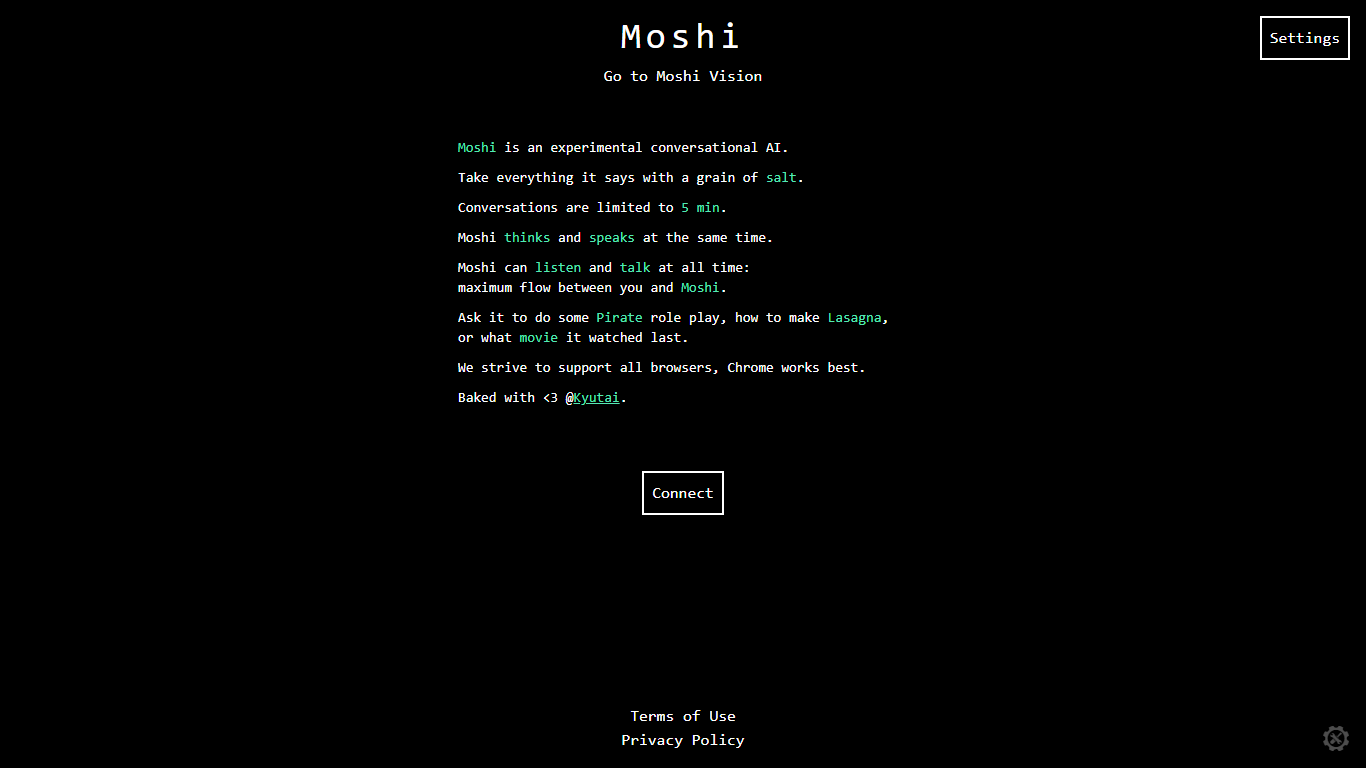

What is Moshi AI?
Moshi AI is a speech-native conversational model from Kyutai, a Paris-based open-science research lab. Instead of chaining speech recognition, text generation, and text-to-speech, Moshi processes audio directly and holds full-duplex voice conversations with minimal latency.
Its multi-stream design runs separate channels for the user, Moshi's spoken output, and an Inner Monologue text stream that improves coherence. That setup lets Moshi listen and talk at the same time, handle overlaps, interruptions, and backchanneling like a real conversation rather than rigid speaker turns.
Moshi is built on Helium, a 7B language model, and Mimi, Kyutai's neural audio codec. Weights and inference code ship for PyTorch, Rust, and MLX, and you can try it in the browser at moshi-chat.kyutai.org. Researchers, voice AI developers, and anyone building real-time spoken interfaces will find the most value here.
AUDOIR

What is AUDOIR?
AUDOIR publishes a suite of AI web and mobile apps from Audoir, LLC, a company founded in 2016 in the SF Bay Area. Melodea generates melody and harmony ideas for songwriting, while Lyricai drafts lyrics on demand. The portfolio also includes Resunet for AI-tailored resumes, Reflexion for AI journaling, Vocali for language conversation practice, and Youhan for personalized Chinese learning.
Compared with all-in-one generators like Suno that output finished songs from a text prompt, AUDOIR splits songwriting into separate melody and lyric tools you can export into a DAW. The company trains its custom models only on AI-generated datasets, which it states keeps the tools clear of copyrighted training material. Several older songwriting apps, including Quick Lyrics AI and AI Music Builder, are no longer supported.
Songwriters reach for Melodea and Lyricai when they want starting ideas rather than a complete track. Educators and language learners use Vocali and Youhan for conversational practice. The site reports more than 1,500 daily users across the app lineup.
Moshi AI Upvotes
AUDOIR Upvotes
Moshi AI Top Features
Processes speech directly without a text pipeline in the middle
Listens and talks simultaneously with overlap and interruption support
Inner Monologue text stream improves speech quality and reasoning
Runs real-time on an L4 GPU or M3 MacBook Pro via the Mimi codec
Open weights on Hugging Face with PyTorch, Rust, and MLX inference code
AUDOIR Top Features
Melodea generates unique melody and harmony ideas to kickstart songwriting sessions
Lyricai drafts lyrics on demand to help writers break through creative blocks
Vocali simulates native-speaker audio conversations for language practice
Youhan adapts Chinese lessons with flashcards, contextual sentences, and pronunciation audio
Resunet tailors resumes and cover letters to specific job postings with AI
Reflexion analyzes journal entries and offers personalized insights through an AI assistant
Moshi AI Category
- Audio Generation
AUDOIR Category
- Audio Generation
Moshi AI Pricing Type
- Free
AUDOIR Pricing Type
- Free