Moshi AI vs brain.fm
In the face-off between Moshi AI vs brain.fm, which AI Audio Generation tool takes the crown? We scrutinize features, alternatives, upvotes, reviews, pricing, and more.
When we put Moshi AI and brain.fm head to head, which one emerges as the victor?
If we were to analyze Moshi AI and brain.fm, both of which are AI-powered audio generation tools, what would we find? The upvote count is neck and neck for both Moshi AI and brain.fm. The power is in your hands! Cast your vote and have a say in deciding the winner.
Don't agree with the result? Cast your vote and be a part of the decision-making process!
Moshi AI
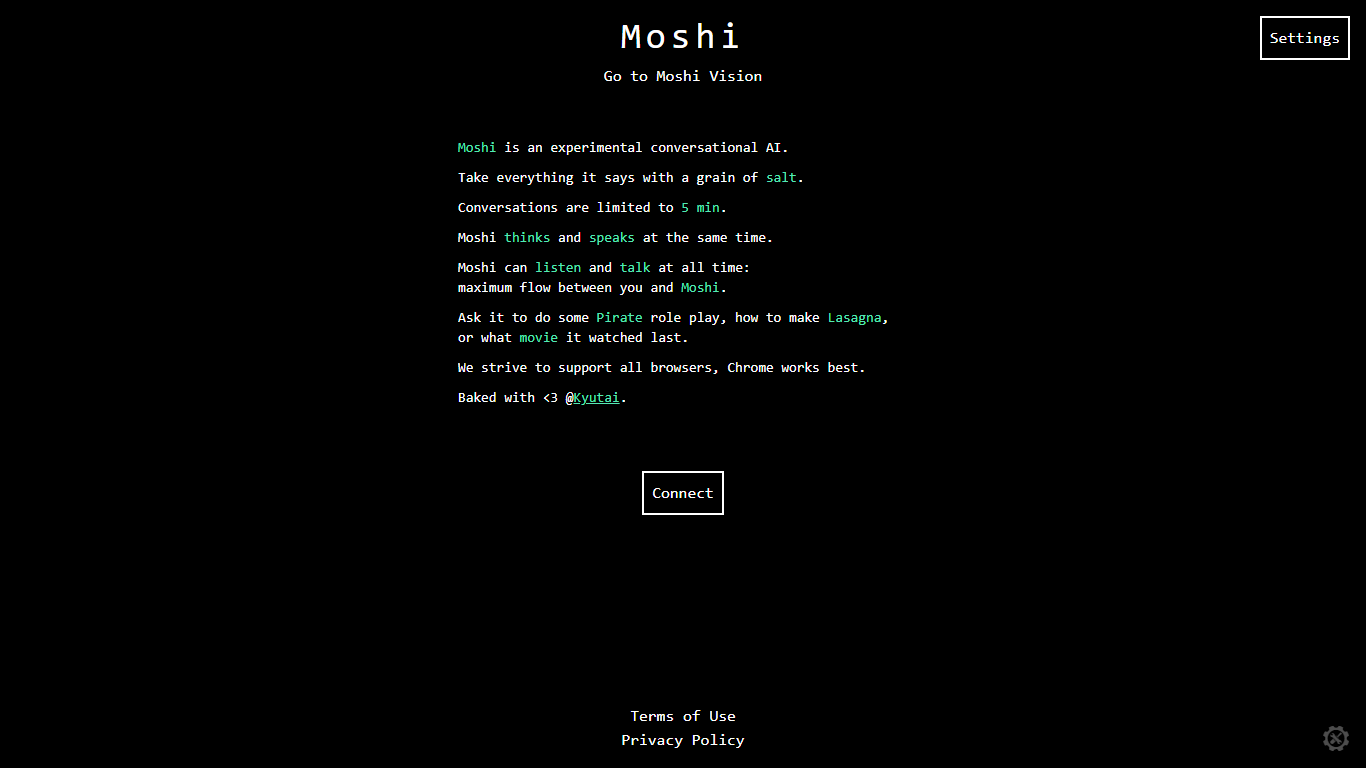

What is Moshi AI?
Moshi AI is a speech-native conversational model from Kyutai, a Paris-based open-science research lab. Instead of chaining speech recognition, text generation, and text-to-speech, Moshi processes audio directly and holds full-duplex voice conversations with minimal latency.
Its multi-stream design runs separate channels for the user, Moshi's spoken output, and an Inner Monologue text stream that improves coherence. That setup lets Moshi listen and talk at the same time, handle overlaps, interruptions, and backchanneling like a real conversation rather than rigid speaker turns.
Moshi is built on Helium, a 7B language model, and Mimi, Kyutai's neural audio codec. Weights and inference code ship for PyTorch, Rust, and MLX, and you can try it in the browser at moshi-chat.kyutai.org. Researchers, voice AI developers, and anyone building real-time spoken interfaces will find the most value here.
brain.fm
What is brain.fm?
brain.fm streams functional music built to steer your brain toward focus, sleep, relaxation, or meditation. Unlike a playlist app, each stream is composed for a specific mental state, with modes like Deep Work, Guided Sleep, Power Nap, and Guided Meditation. The player lives at my.brain.fm and also runs on iOS, Android, and desktop apps. You pick an activity, hit play, and the music starts without digging through genres.
Most focus playlists on Spotify or YouTube are curated from existing songs, which means lyrics, hooks, and attention-grabbing moments still compete with your work. brain.fm takes a different route: human composers work with neuroscientists to embed patented phase-locking modulation that targets coordinated neural activity, and the company publishes placebo-controlled studies comparing its tracks to binaural beats and ordinary background music. The site says this approach reaches the prefrontal cortex rather than relying on the older binaural-beat technique that needs matched headphones in both ears.
The product is aimed at knowledge workers, students, and anyone who struggles to stay on task, with a dedicated ADHD mode backed by a National Science Foundation grant and peer-reviewed papers in Nature Communications Biology. Timers built into the player track work blocks and breaks, which pairs well with Pomodoro-style workflows. If you need quiet recovery time, sleep and relax modes use delta and alpha wave-enhanced audio with guided and unguided options.
Moshi AI Upvotes
brain.fm Upvotes
Moshi AI Top Features
Processes speech directly without a text pipeline in the middle
Listens and talks simultaneously with overlap and interruption support
Inner Monologue text stream improves speech quality and reasoning
Runs real-time on an L4 GPU or M3 MacBook Pro via the Mimi codec
Open weights on Hugging Face with PyTorch, Rust, and MLX inference code
brain.fm Top Features
Patented phase-locking neural modulation, tested in placebo-controlled studies against binaural beats and standard playlists
Monthly plan is $14.99; yearly plan is $99.99, both with a free trial before billing
Activity modes include Deep Work, Guided Sleep, Power Nap, Guided Meditation, and 10+ other task streams
Peer-reviewed Nature Communications Biology study reports a 119% boost in focus brainwaves for ADHD listeners
Desktop apps for Mac (Intel and Apple Silicon) and Windows 10+ ship at version 0.0.279
Built-in Infinite, Timer, and Interval modes track work duration and break periods inside the player
NSF STTR grant NSF-STTR#1720698 funds the auditory entrainment research program
Moshi AI Category
- Audio Generation
brain.fm Category
- Audio Generation
Moshi AI Pricing Type
- Free
brain.fm Pricing Type
- Paid