Moshi AI vs CassetteAi
In the face-off between Moshi AI vs CassetteAi, which AI Audio Generation tool takes the crown? We scrutinize features, alternatives, upvotes, reviews, pricing, and more.
In a face-off between Moshi AI and CassetteAi, which one takes the crown?
If we were to analyze Moshi AI and CassetteAi, both of which are AI-powered audio generation tools, what would we find? The community has spoken, CassetteAi leads with more upvotes. CassetteAi has garnered 8 upvotes, and Moshi AI has garnered 6 upvotes.
Think we got it wrong? Cast your vote and show us who's boss!
Moshi AI

What is Moshi AI?
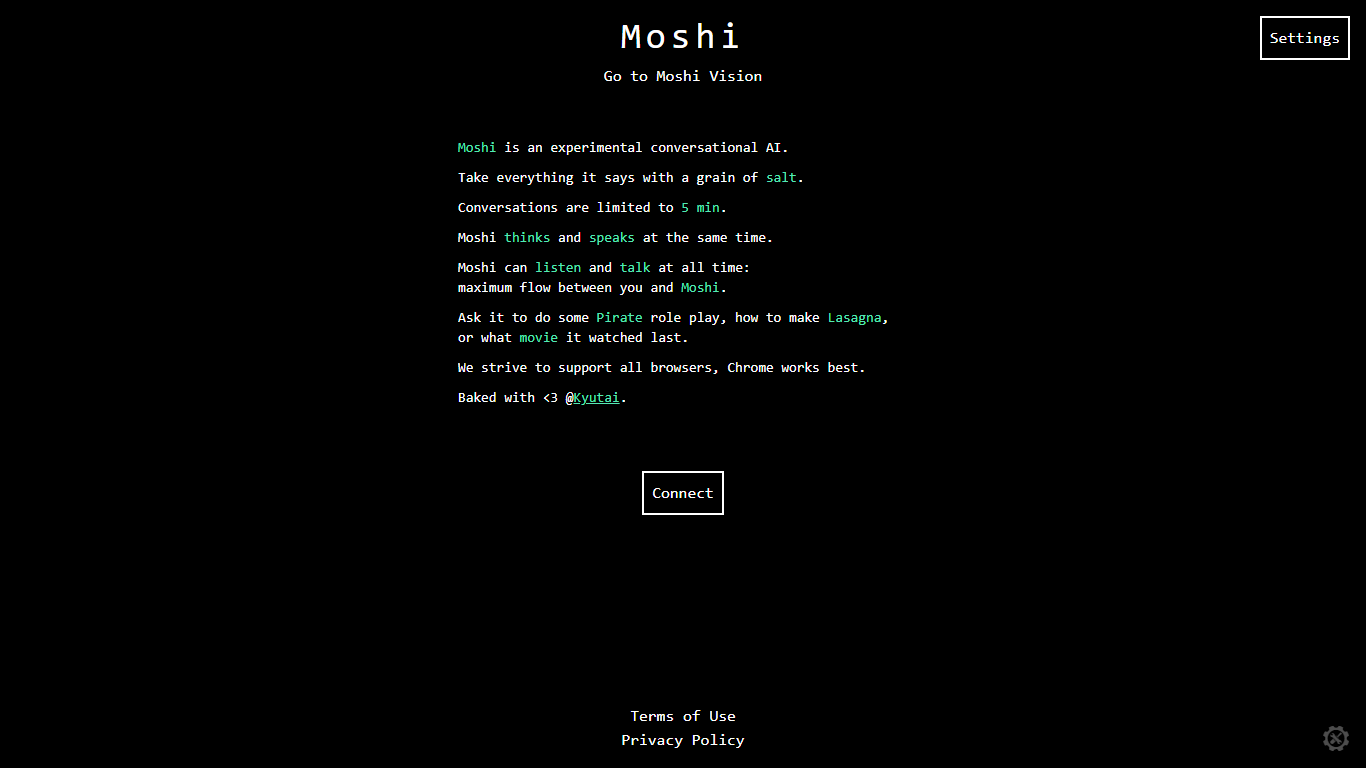
Moshi AI is a speech-native conversational model from Kyutai, a Paris-based open-science research lab. Instead of chaining speech recognition, text generation, and text-to-speech, Moshi processes audio directly and holds full-duplex voice conversations with minimal latency.
Its multi-stream design runs separate channels for the user, Moshi's spoken output, and an Inner Monologue text stream that improves coherence. That setup lets Moshi listen and talk at the same time, handle overlaps, interruptions, and backchanneling like a real conversation rather than rigid speaker turns.
Moshi is built on Helium, a 7B language model, and Mimi, Kyutai's neural audio codec. Weights and inference code ship for PyTorch, Rust, and MLX, and you can try it in the browser at moshi-chat.kyutai.org. Researchers, voice AI developers, and anyone building real-time spoken interfaces will find the most value here.
CassetteAi
What is CassetteAi?
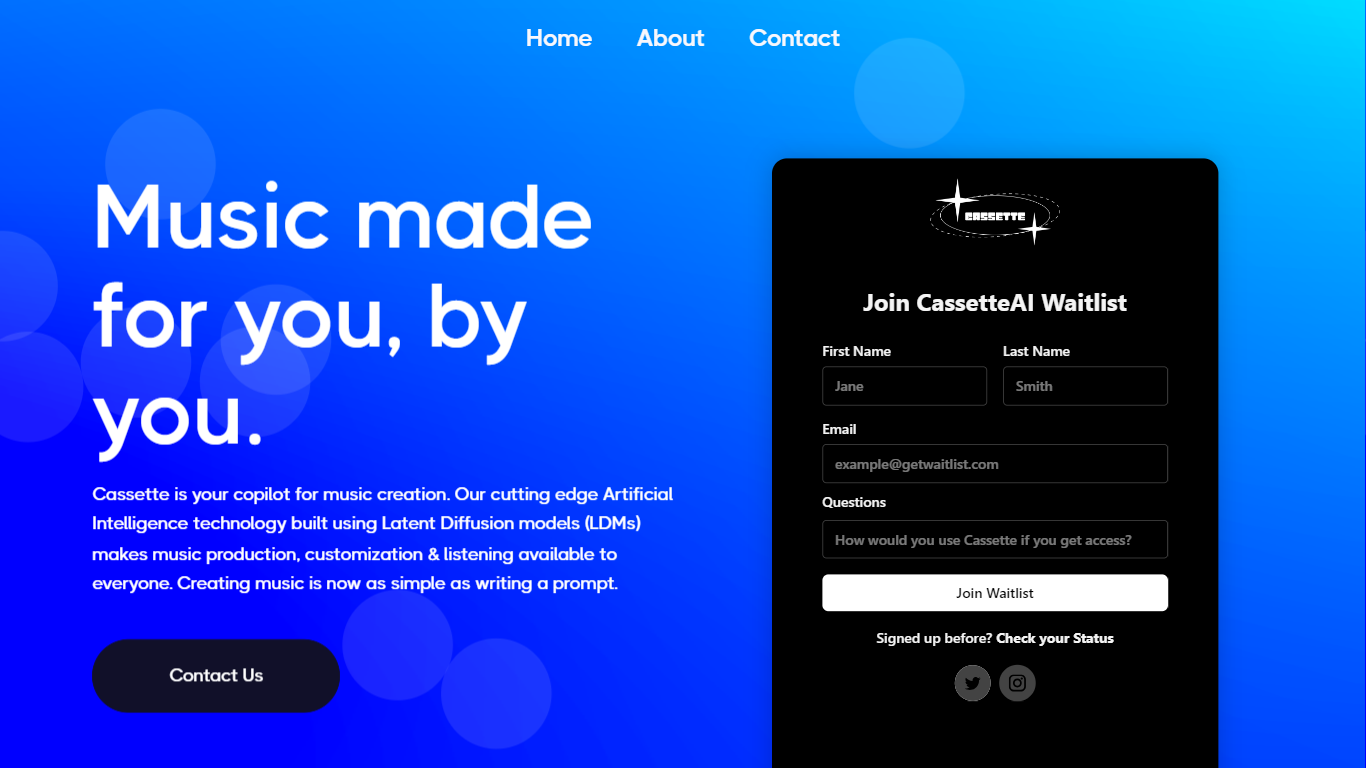
CassetteAi is a real-time audio generation API for developers who need music, sound effects, or speech inside apps and games. Its models render a 30-second music sample in under 2 seconds and a full 3-minute track in under 10, at 44.1 kHz stereo. One SDK covers all three modalities through the same call shape.
Cloud audio APIs usually add round-trip latency that breaks interactive experiences. CassetteAi targets on-device inference with sub-50 millisecond time-to-first-audio and pay-per-second billing instead of monthly seats. The homepage cites 23 ms first-sample latency and deterministic seeds so game loops can re-roll SFX per frame without drift.
Music costs $0.02 per output minute and SFX costs $0.01 per generation, with no tier commitments. You call the models through fal.ai using JavaScript, Python, or cURL. Text-to-speech with zero-shot voice cloning is listed as launching soon.
Game studios, creator tools, and real-time media pipelines are the stated audience. Pixl Technologies runs the company from Salt Lake City, with engineering spread across North America and Europe.
Moshi AI Upvotes
CassetteAi Upvotes
Moshi AI Top Features
Processes speech directly without a text pipeline in the middle
Listens and talks simultaneously with overlap and interruption support
Inner Monologue text stream improves speech quality and reasoning
Runs real-time on an L4 GPU or M3 MacBook Pro via the Mimi codec
Open weights on Hugging Face with PyTorch, Rust, and MLX inference code
CassetteAi Top Features
30-second music sample renders in under 2 seconds at 44.1 kHz stereo
SFX generator produces up to 30 seconds of sound in roughly 1 second
Music pricing is $0.02 per output minute with 10 to 180 second durations
SFX pricing is a flat $0.01 per generation with loop-safe outputs
300M parameter music model with deterministic seeds for reproducible tracks
Same fal.subscribe() call shape for music, SFX, and upcoming TTS models
Moshi AI Category
- Audio Generation
CassetteAi Category
- Audio Generation
Moshi AI Pricing Type
- Free
CassetteAi Pricing Type
- Paid