Parallel AI vs Cleora.AI
Dive into the comparison of Parallel AI vs Cleora.AI and discover which AI Data Science tool stands out. We examine alternatives, upvotes, features, reviews, pricing, and beyond.
When comparing Parallel AI and Cleora.AI, which one rises above the other?
When we compare Parallel AI and Cleora.AI, two exceptional data science tools powered by artificial intelligence, and place them side by side, several key similarities and differences come to light. Both tools are equally favored, as indicated by the identical upvote count. Your vote matters! Help us decide the winner among aitools.fyi users by casting your vote.
Does the result make you go "hmm"? Cast your vote and turn that frown upside down!
Parallel AI

What is Parallel AI?
Parallel AI is a business data and automation platform that bundles sales, marketing, support, and operations into one workspace. You build AI employees on OpenAI, Claude, Gemini, Grok, and DeepSeek models, connect them to 1,000+ integrations, and schedule autonomous heartbeats so they qualify leads, enrich contact data, draft campaigns, answer calls, and publish content overnight.
Most GTM stacks split outbound, content, and support across separate subscriptions. Parallel AI runs all four layers in one place: Smart Lists for prospecting, multi-channel sequences, a content engine, and omni-channel receptionist agents across phone, SMS, WhatsApp, chat, and email. Agencies can also resell the platform under their own brand with custom pricing through Stripe.
Marketing agencies, B2B startups, real estate teams, and e-commerce brands use it to replace fragmented tool sprawl. Free onboarding builds your ICP, lead list, outreach sequence, content calendar, and website chat agent on signup with no credit card required.
Cleora.AI
What is Cleora.AI?
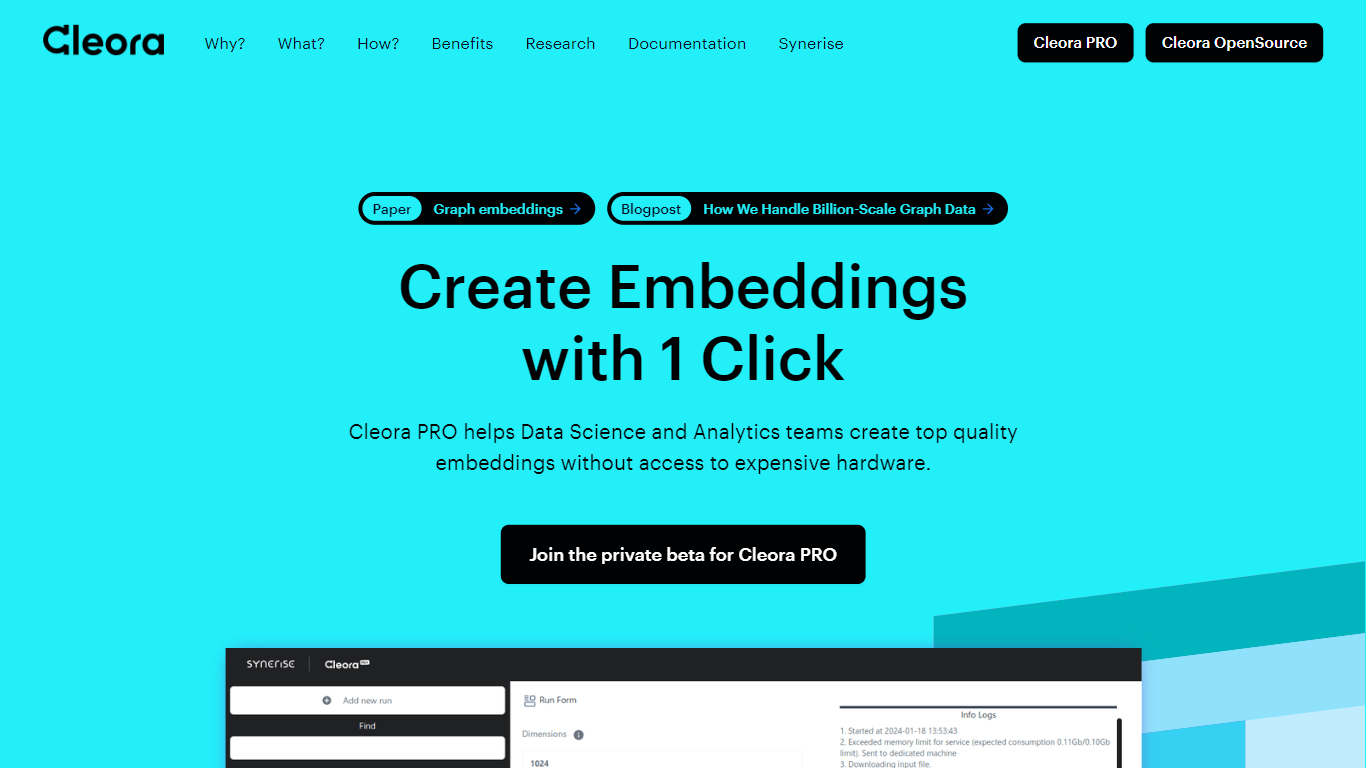
Cleora turns edge lists into dense vector embeddings for every node in a graph, without GPUs or random walk sampling. The pycleora Python library ships a Rust core that computes full walk distributions through sparse Markov matrix powers, then exposes classification, similarity search, and link prediction helpers. It targets recommendation systems, fraud graphs, knowledge triples, and other jobs where relational structure matters more than text features.
Walk-based libraries like DeepWalk and Node2Vec approximate neighborhoods by sampling paths and training skip-gram models. Cleora skips both steps and aggregates every k-hop neighborhood in one deterministic pass, which is why Zomato reported embedding a customer-restaurant graph in under five minutes after GraphSAGE took about twenty hours on the same setup. The trade-off is scope: it is a graph-structure toolkit, not a general feature store for unstructured data.
Data science teams install pycleora with pip and only need NumPy and SciPy alongside the roughly 5 MB package. The MIT-licensed library includes eight baseline algorithms, heterogeneous graph support, MLP and label-propagation classifiers, and a CLI for batch jobs. Published benchmarks on SNAP, Planetoid, and DGL datasets report top accuracy on graphs up to about two million nodes while competitor methods time out or run out of memory.
Parallel AI Upvotes
Cleora.AI Upvotes
Parallel AI Top Features
Build unlimited AI employees on OpenAI, Claude, Gemini, Grok, and DeepSeek with new models added within days of release
Smart Lists search multiple databases, enrich contacts, and sync qualified leads to your CRM around the clock
Multi-channel sequences reach prospects via email, LinkedIn, SMS, and WhatsApp with personalized outreach per contact
Business plan includes 9,000 credits per month across 10 companies with 1M token context windows
Headless GTM control lets your Executive Assistant run Smart Lists, sequences, content, and workflows over text or any MCP client
White-label option lets agencies launch a branded platform with their own domain, logo, and Stripe billing
Cleora.AI Top Features
pip install pycleora pulls a ~5 MB package that needs only NumPy and SciPy, no GPU drivers or CUDA stack
Sparse Markov matrix powers compute all walk distributions exactly, with no random walks or negative sampling
Eight embedding algorithms in one API: Cleora, DeepWalk, Node2Vec, ProNE, RandNE, HOPE, NetMF, and GraRep
Zomato cut customer-restaurant embedding time from about 20 hours with GraphSAGE to under five minutes on the same data
Benchmarks on roadNet-CA embed 1,965,206 nodes in 31.5 seconds using about 4.1 GB RAM on one CPU core
Heterogeneous hypergraphs accept TSV edge files with typed columns like complex::reflexive::product
Parallel AI Category
- Data Science
Cleora.AI Category
- Data Science
Parallel AI Pricing Type
- Freemium
Cleora.AI Pricing Type
- Free