seo.ing vs Talk to Books
In the face-off between seo.ing vs Talk to Books, which AI Search Engine tool takes the crown? We scrutinize features, alternatives, upvotes, reviews, pricing, and more.
When we put seo.ing and Talk to Books head to head, which one emerges as the victor?
If we were to analyze seo.ing and Talk to Books, both of which are AI-powered search engine tools, what would we find? The users have made their preference clear, Talk to Books leads in upvotes. The number of upvotes for Talk to Books stands at 23, and for seo.ing it's 6.
Feeling rebellious? Cast your vote and shake things up!
seo.ing

What is seo.ing?
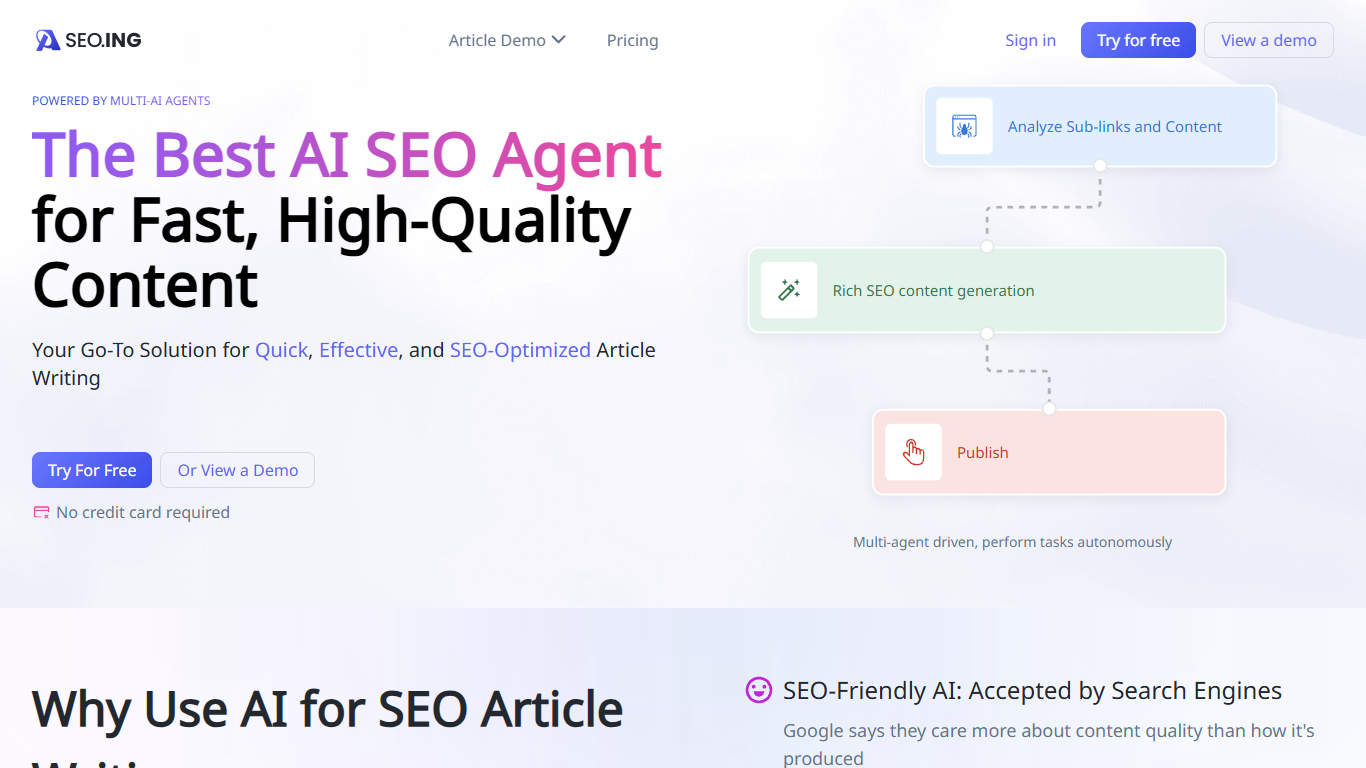
seo.ing turns product URLs and site lists into long-form review posts and top 10 roundup articles using coordinated crawler, outline, writing, and image agents. Marketers and site owners use it to publish comparison content without hiring freelancers for every draft.
Most AI writing tools hand you a blank editor and expect you to supply the research. seo.ing starts with crawling: you feed it one product URL or a list of sites, then outline and title agents propose structure you can edit before writing and image steps finish the piece. That narrow focus on review and roundup formats is the trade-off. It is not a general blog generator for arbitrary topics.
Plans are credit-based with monthly article caps on the public pricing page, from two free articles up to 120 on Enterprise. The interface is available in English plus nine additional languages, including Simplified Chinese, Traditional Chinese, Korean, Japanese, Portuguese, Spanish, German, French, and Vietnamese.
seo.ing runs on a Nuxt.js front end with Tailwind CSS styling and Cloudflare delivery. The company identifies itself as SEO.ING, Inc. on the site footer and lists [email protected] for privacy and support requests.
Talk to Books
What is Talk to Books?
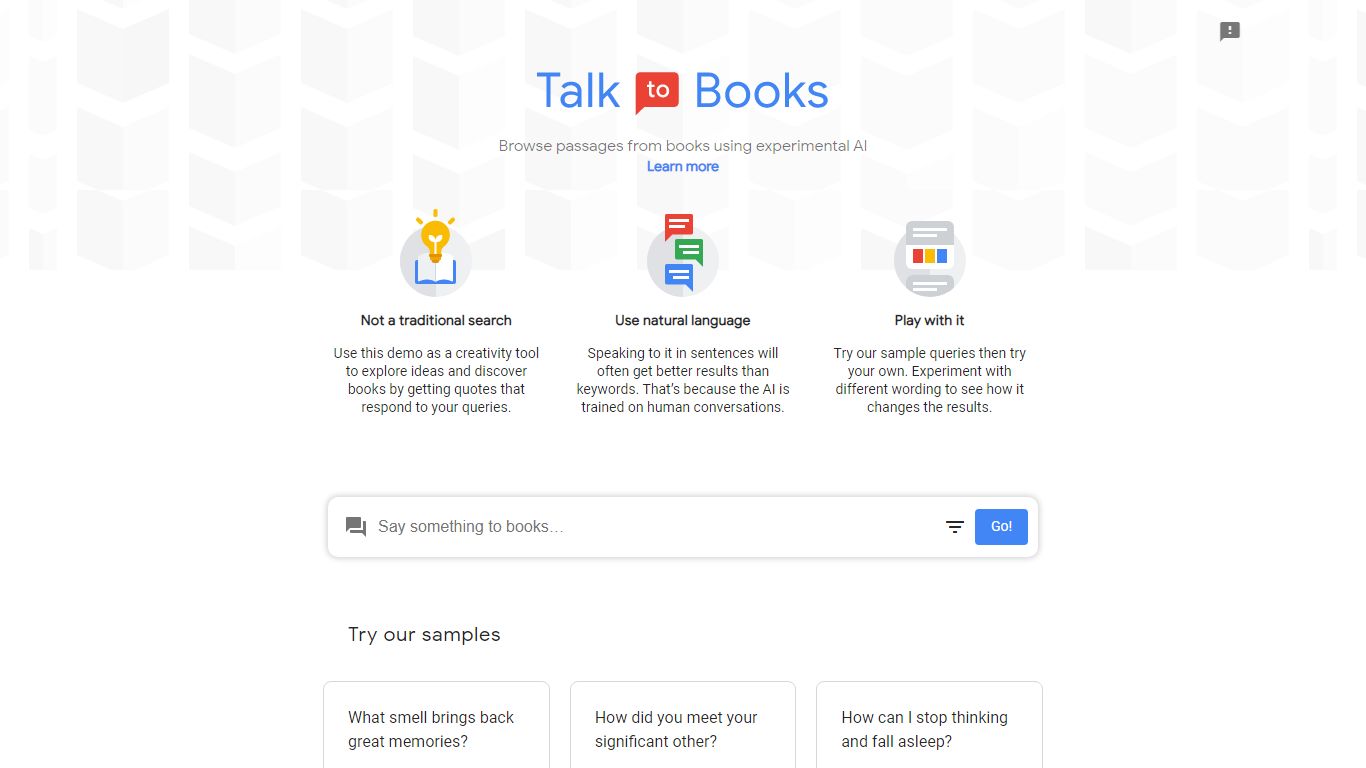
Talk to Books was a Google Research experiment that let you ask natural-language questions and get answers pulled from passages across a large collection of books. You typed a question or statement, and the system returned relevant book excerpts instead of standard web search results. Google has shut the service down, but the site still hosts an archive of sample queries.
The project launched in 2018 as part of Google's Semantic Experiences initiative. It used neural language models for semantic matching and retrieval, showing how conversational queries could surface ideas buried in published books rather than blog posts or forums.
Researchers, students, and curious readers used Talk to Books to explore topics through book-length context. The experiment informed later semantic search features inside Google products such as Shopping, Maps, Gmail, and Hangouts.
seo.ing Upvotes
Talk to Books Upvotes
seo.ing Top Features
Outline, crawler, writing, and image agents collaborate to produce full articles from a URL or site list
Website review mode turns a product URL into a structured review with sub-link research
Top 10 mode builds comparison roundups with featured products, anchor links, text, images, and tables
Preset article structures with manual control over intro hooks, length, and outline sections
Localized site and content options across ten languages on the marketing site
Talk to Books Top Features
Ask questions in plain English and get book passages back, not web links
Searches across a large corpus of published books using semantic matching
Archived sample queries still viewable on the shutdown notice page
Part of Google's 2018 Semantic Experiences research alongside Semantris
Demonstrated neural retrieval models that later shaped other Google products
seo.ing Category
- Search Engine
Talk to Books Category
- Search Engine
seo.ing Pricing Type
- Freemium
Talk to Books Pricing Type
- Free