spaCy vs Stellaris AI
Explore the showdown between spaCy vs Stellaris AI and find out which AI Large Language Model (LLM) tool wins. We analyze upvotes, features, reviews, pricing, alternatives, and more.
In a face-off between spaCy and Stellaris AI, which one takes the crown?
When we contrast spaCy with Stellaris AI, both of which are exceptional AI-operated large language model (llm) tools, and place them side by side, we can spot several crucial similarities and divergences. There's no clear winner in terms of upvotes, as both tools have received the same number. Since other aitools.fyi users could decide the winner, the ball is in your court now to cast your vote and help us determine the winner.
Feeling rebellious? Cast your vote and shake things up!
spaCy

What is spaCy?
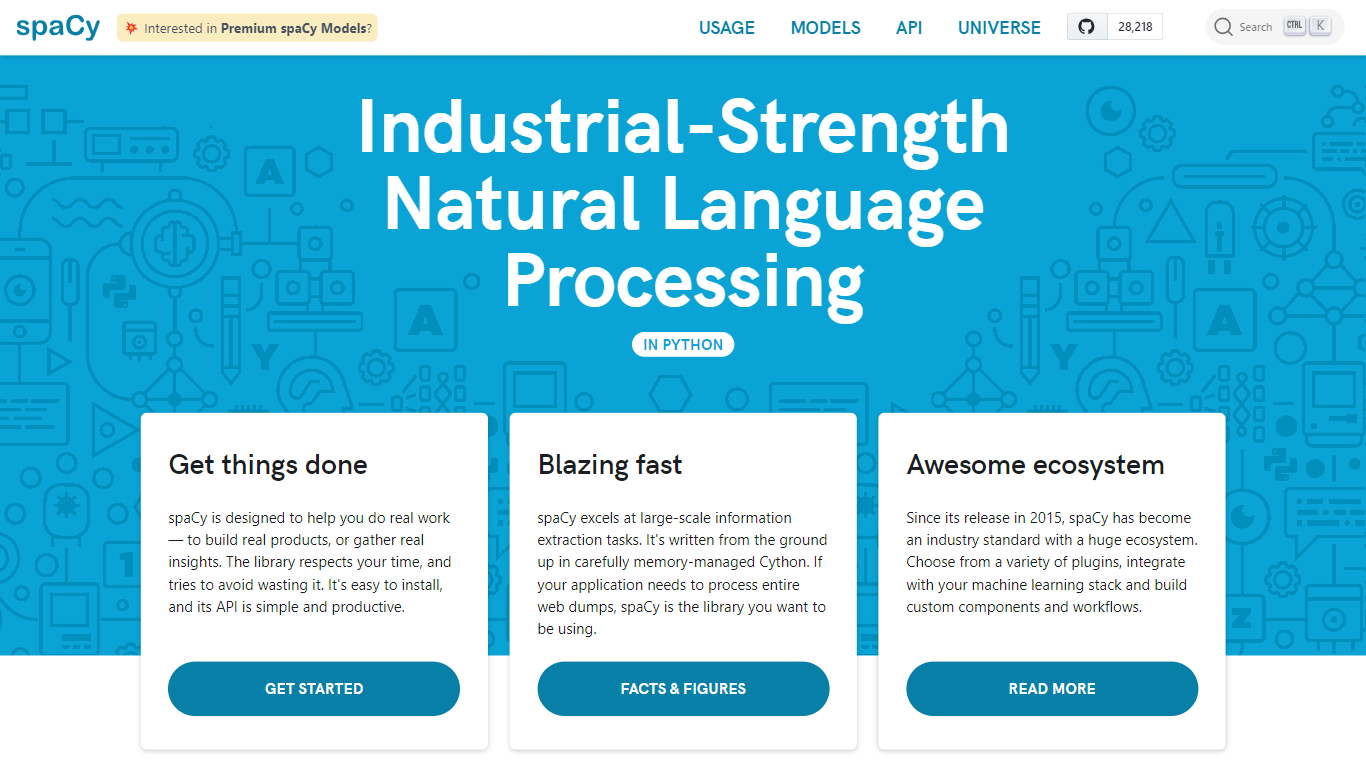
spaCy is a Python library designed for practical, real-world Natural Language Processing (NLP) tasks. It provides fast and efficient processing of large text datasets, supporting over 75 languages with 84 trained pipelines. The library is built with Cython for optimized speed and memory management, making it suitable for production environments. The core of spaCy revolves around the Language class, which processes text into Doc objects containing tokens and annotations.
Its modular pipeline architecture allows users to add or customize components such as tokenization, part-of-speech tagging, dependency parsing, named entity recognition, text classification, and more. spaCy also supports integration with machine learning frameworks like PyTorch and TensorFlow, enabling custom model training and deployment. Recent updates include the spacy-llm package, which integrates Large Language Models (LLMs) into spaCy pipelines for tasks requiring advanced language understanding without needing training data. The library also offers a project system to manage end-to-end workflows from prototyping to production, including data transformation, training, and deployment steps.
spaCy emphasizes reproducible training with detailed configuration files that capture all training parameters, facilitating experiment tracking and reruns. It also provides built-in visualizers for syntax and entity recognition, and an extensive ecosystem of plugins and community resources. For users needing annotation tools, spaCy's creators offer Prodigy, a separate efficient machine teaching tool that accelerates data labeling and model iteration. Overall, spaCy balances performance, extensibility, and ease of use, making it a preferred choice for developers and data scientists working on NLP applications.
Stellaris AI
What is Stellaris AI?
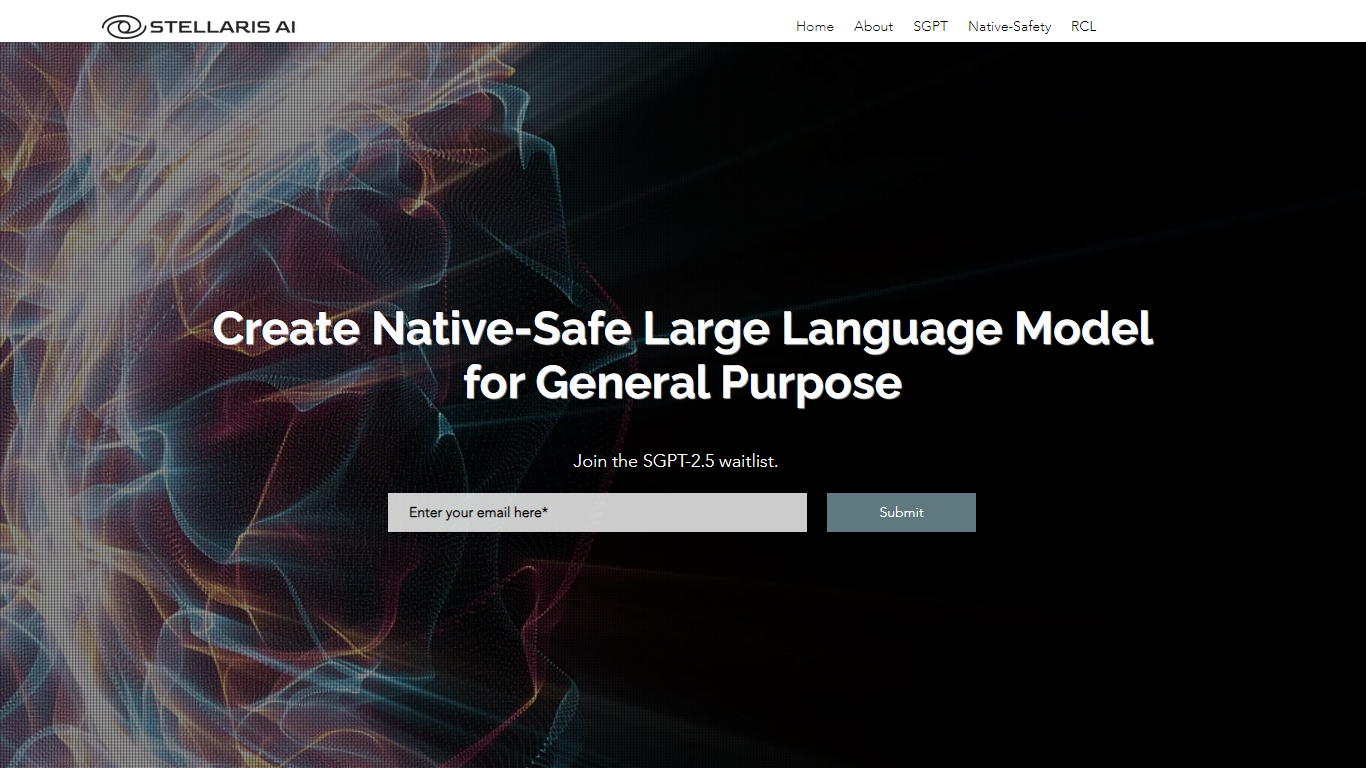
Stellaris AI builds large language models marketed around native safety and human-like reasoning for real-world tasks. Its flagship SGPT line targets text and code generation, knowledge Q&A, logical reasoning, and analytics at a scale the company describes as hundreds of billions of parameters. The public site centers on a waitlist for SGPT-4.5 rather than a self-serve chat product you can open today.
Where many LLM labs bolt safety filters on after training, Stellaris AI frames safety as part of the model stack through strict source referencing and harm minimization in the architecture. It also highlights Real-time Context Learning (RCL) for adapting answers with live knowledge, a combination aimed at teams that want cited outputs instead of unchecked generation.
Researchers, enterprise AI teams, and early adopters join the SGPT-4.5 waitlist for first access. The company cites 10+ years of research and three core product pillars: Stellaris GPT, Native Safety, and RCL.
spaCy Upvotes
Stellaris AI Upvotes
spaCy Top Features
⚡ Blazing fast processing with Cython optimization for large-scale text data
🌐 Supports 75+ languages with 84 pretrained pipelines for diverse NLP tasks
🧩 Modular pipeline components for tokenization, tagging, parsing, NER, and classification
🤖 Integrates Large Language Models (LLMs) via spacy-llm for advanced language understanding
📦 Project system for managing end-to-end NLP workflows from prototype to production
Stellaris AI Top Features
SGPT models described at 100B+ parameters for text, code, and reasoning tasks
Native Safety framework with strict source referencing and harm minimization
Real-time Context Learning (RCL) for live knowledge integration
Three product pillars: Stellaris GPT, Native Safety, and RCL
SGPT-4.5 waitlist open for early access signups on the homepage
spaCy Category
- Large Language Model (LLM)
Stellaris AI Category
- Large Language Model (LLM)
spaCy Pricing Type
- Freemium
Stellaris AI Pricing Type
- Freemium