Sqlephant vs Kvery
In the clash of Sqlephant vs Kvery, which AI SQL tool emerges victorious? We assess reviews, pricing, alternatives, features, upvotes, and more.
When we put Sqlephant and Kvery head to head, which one emerges as the victor?
Let's take a closer look at Sqlephant and Kvery, both of which are AI-driven sql tools, and see what sets them apart. The upvote count favors Kvery, making it the clear winner. Kvery has attracted 7 upvotes from aitools.fyi users, and Sqlephant has attracted 6 upvotes.
Want to flip the script? Upvote your favorite tool and change the game!
Sqlephant

What is Sqlephant?
Sqlephant is a desktop SQL development companion from Kawansoft that turns short schema definitions into typed database code. You describe tables with a compact notation, and it predicts column types, builds DTOs, fixes broken SQL statements, and generates language-specific wrappers plus CRUD functions for C#, Java, PHP, and Python.
Where most SQL assistants stop at query completion, Sqlephant focuses on the codegen layer around your schema. Its patent-pending SQL injection fixer runs in Batch Mode so you can submit every application file in one click, and the tool works only on metadata so corporate row data never leaves your machine.
Backend and full-stack developers who maintain multi-language codebases get the most from Sqlephant. Windows, macOS, and Linux builds install without admin or root privileges, and the full-featured version is free with no credit card required.
Kvery
What is Kvery?
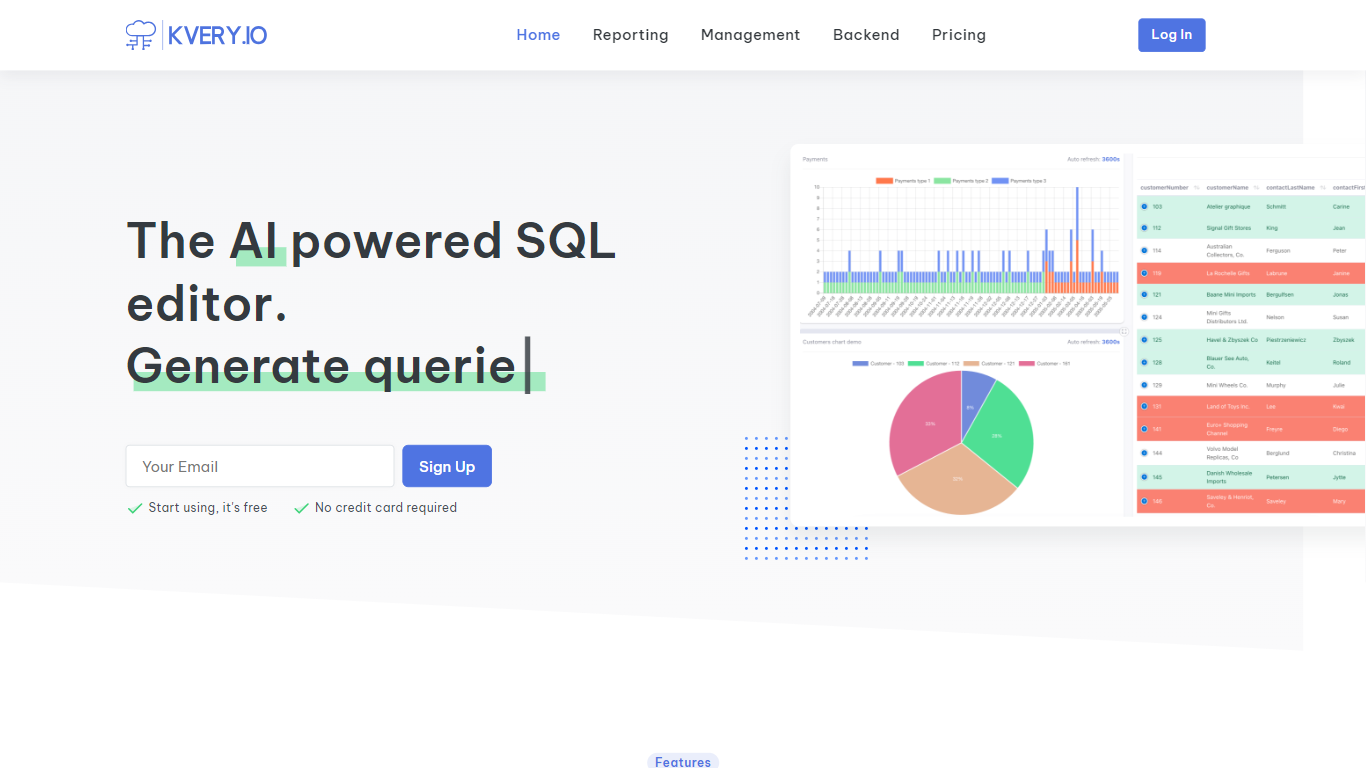
Kvery is an SQL workspace that turns a written query into live tables, charts, REST endpoints, and shareable dashboards without you writing backend code. You connect MySQL, PostgreSQL, SQL Server, or MariaDB, write or generate SQL, and the platform builds the data views and APIs around that query in minutes instead of a multi-week sprint.
Most SQL clients stop at query results. Kvery ships the query as a product surface: auto-generated REST routes, drag-and-drop dashboards, scheduled runs with email or webhook delivery, and a built-in Model Context Protocol server so Claude, Cursor, or n8n can search and execute your saved queries with scoped tokens. That combination targets teams who want SQL-first delivery rather than a separate BI suite or hand-built API layer.
Developers, data analysts, and small product teams use Kvery to prototype internal tools, client reporting, and ops dashboards. Role-based workspaces, AES-256 encrypted connections, and native iOS and Android apps make it workable for production data when you need mobile access or tight permission boundaries.
Sqlephant Upvotes
Kvery Upvotes
Sqlephant Top Features
Compact schema language uses t for CREATE TABLE, * for primary keys, and nn for NOT NULL while inferring column types automatically
Generates SQL wrappers with DTO mapping for C#, Java, PHP, and Python from queries dropped into the editor
Patent-pending SQL injection fixer includes Batch Mode to scan all application files with one click
CRUD generation produces Create, Read, Update, and Delete functions plus matching DTOs from a selected SQL table
Runs on Windows, macOS, and Linux without admin or root privileges
Processes only database metadata; requests are discarded after completion and corporate data is not sent
Kvery Top Features
Free plan includes 3 saved SQL queries with full API and dashboard generation
Natural language prompts convert to SQL inside the multi-tab query editor
Built-in MCP server exposes six tools for listing, searching, and executing queries
Team plan supports 100 queries, 10 users, and 3 editors at $1499 per year
Schedule queries with CRON syntax and deliver results via email or webhooks
Connect MySQL, PostgreSQL, SQL Server, and MariaDB over direct or SSH tunnels
Native iOS and Android apps save dashboards with auto-refresh and deep-link sharing
Sqlephant Category
- SQL
Kvery Category
- SQL
Sqlephant Pricing Type
- Free
Kvery Pricing Type
- Freemium