SQLFlash vs SDF
Compare SQLFlash vs SDF and see which AI SQL tool is better when we compare features, reviews, pricing, alternatives, upvotes, etc.
Which one is better? SQLFlash or SDF?
When we compare SQLFlash with SDF, which are both AI-powered sql tools, The upvote count shows a clear preference for SQLFlash. The upvote count for SQLFlash is 8, and for SDF it's 6.
Disagree with the result? Upvote your favorite tool and help it win!
SQLFlash

What is SQLFlash?
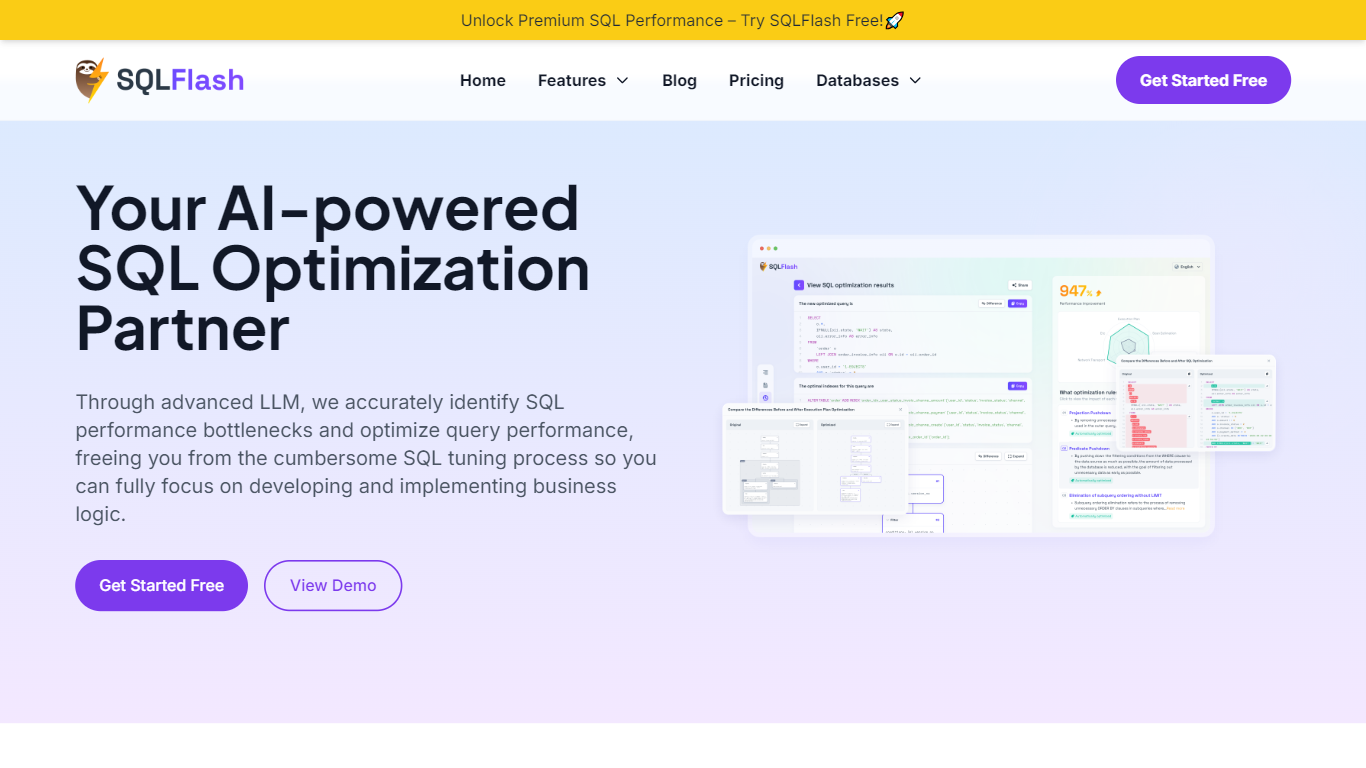
SQLFlash rewrites slow queries, recommends indexes, and explains every change in plain language. You paste a statement or upload a MyBatis XML mapping, and it returns an optimized version with a diff viewer, query plan breakdown, and performance score. It supports MySQL, PostgreSQL, Oracle, SQL Server, MariaDB, TiDB, and other relational engines without needing database credentials.
Most SQL tuners either need live access to your database or hand you a rewritten query with no context. SQLFlash takes the opposite approach: it works on the text alone, uses a two-stage rule filter to match optimization patterns, and documents each rewrite step in a journal you can audit. That trade-off means you validate results in your own test environment, but you never grant read access to production data.
Developers, DBAs, and platform teams use SQLFlash when legacy queries slow down apps, when MyBatis XML files pile up without review, or when a database migration changes execution plans overnight. Case studies on the site cover e-commerce product pages, banking dashboards, restaurant order history, and school course progress queries.
SDF
What is SDF?
SDF is a SQL comprehension engine that reads warehouse SQL, builds intermediate representations of each query, and flags mistakes before anything runs. It sits in the analytics stack between raw SQL text and the database, giving teams compile-time insight into syntax, types, and downstream column shapes.
Most SQL linters stop at surface syntax. SDF works through three stacked levels: parsing into a syntax tree, compiling a logical plan with function signatures and return types, and executing a physical plan when data-level checks matter. That ladder catches wrong argument order on Snowflake dateadd calls and impossible cast dates that parsers alone would miss, which is why dbt Labs bought SDF Labs to embed the engine inside dbt rather than bolt on another string preprocessor.
Analytics engineers and dbt developers use SDF to harden large warehouse projects, trace column-level lineage, and ship transformations with fewer surprise runtime failures. Since the mid-2024 GA launch, sdf.com routes visitors to dbt Labs pages explaining how the acquisition folds SDF into the next dbt engine.
SQLFlash Upvotes
SDF Upvotes
SQLFlash Top Features
Optimize any SQL statement in two steps with zero database configuration
Two-stage intelligent filter applies 31+ optimization rules across MySQL, PostgreSQL, Oracle, and SQL Server
Dual-pane SQL diff viewer with query plan explainer and optimization step journal
MyBatis XML auto-rewrite for teams running Java persistence layers
Starter plan covers 20 SQL queries and 10 XML files per month at $18.80
Free tier includes 1 SQL query and 1 XML file per month with no credit card
SDF Top Features
Three SQL comprehension levels: parsing syntax trees, compiling logical plans, and executing physical plans
Level 2 compilation validates Snowflake function signatures and catches wrong dateadd argument order before runtime
dbt Labs acquisition targets true column-level lineage inside dbt projects
Static analysis flags impossible casts such as January 32 dates that parsers approve
Logical plans infer column return types without executing warehouse queries
SQLFlash Category
- SQL
SDF Category
- SQL
SQLFlash Pricing Type
- Freemium
SDF Pricing Type
- Paid