Summify vs SciSpace (formerly Typeset)
Dive into the comparison of Summify vs SciSpace (formerly Typeset) and discover which AI Summarizer tool stands out. We examine alternatives, upvotes, features, reviews, pricing, and beyond.
In a comparison between Summify and SciSpace (formerly Typeset), which one comes out on top?
When we compare Summify and SciSpace (formerly Typeset), two exceptional summarizer tools powered by artificial intelligence, and place them side by side, several key similarities and differences come to light. With more upvotes, SciSpace (formerly Typeset) is the preferred choice. SciSpace (formerly Typeset) has 24 upvotes, and Summify has 6 upvotes.
Want to flip the script? Upvote your favorite tool and change the game!
Summify
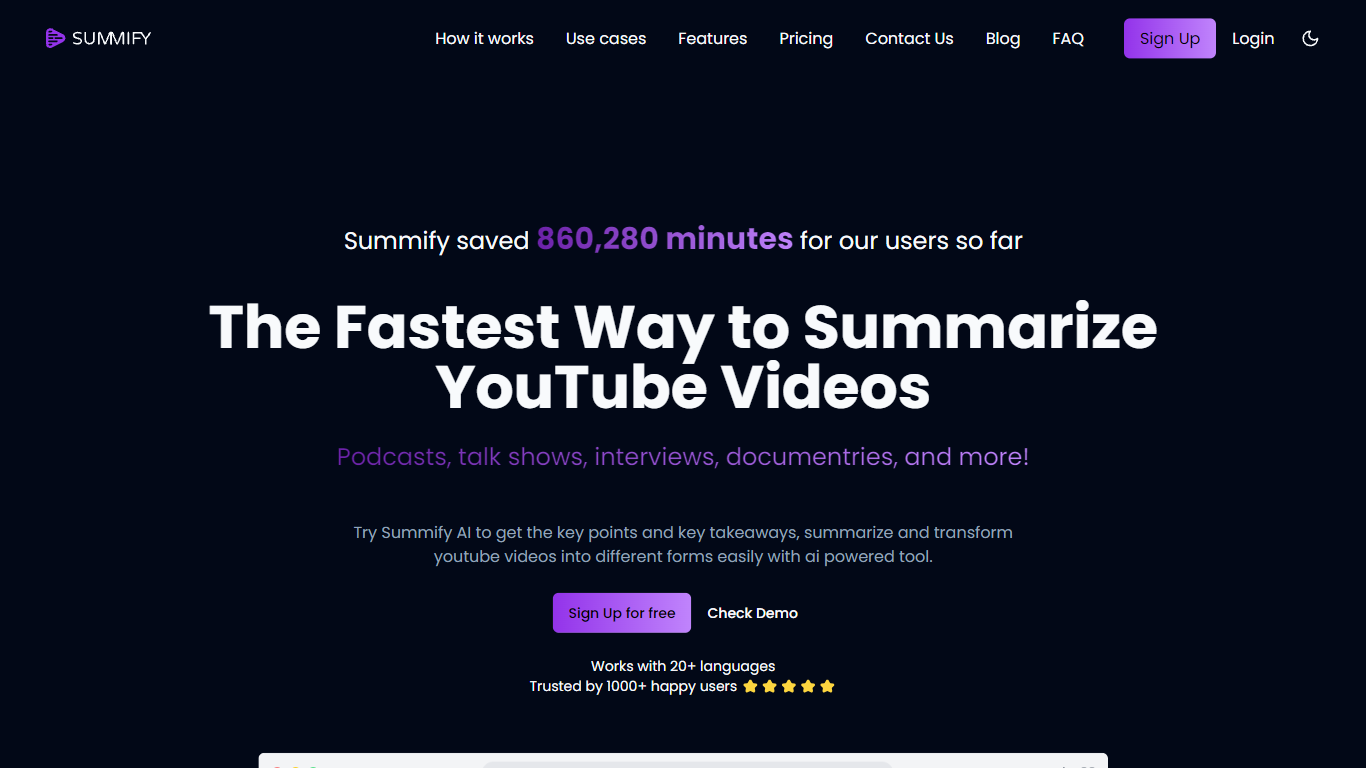

What is Summify?
Summify turns videos, podcasts, PDFs, articles, and voice notes into searchable knowledge pods you can query with citations. It still summarizes YouTube with TL;DR takeaways and timestamps, but the core pitch now is one curated library that follows you across Claude, ChatGPT, and any MCP-compatible AI instead of re-uploading the same files to every chat window.
Generic chatbots answer from the open web. Summify indexes your trusted sources, groups them into scoped pods by client or project, and exposes that context through built-in AI chat or MCP connections with daily limits on paid tiers. That makes it closer to a personal RAG layer than a single-purpose YouTube summarizer, though capture tools for PDFs, voice notes, and 130-plus languages remain central.
Researchers, content creators, consultants, and students are the stated audience. The site reports 50,000 plus users and 30 million minutes summarized. Pro and Max plans connect pods to external AI tools, while Starter focuses on summaries and uploads with tighter transcription and pod caps.
SciSpace (formerly Typeset)
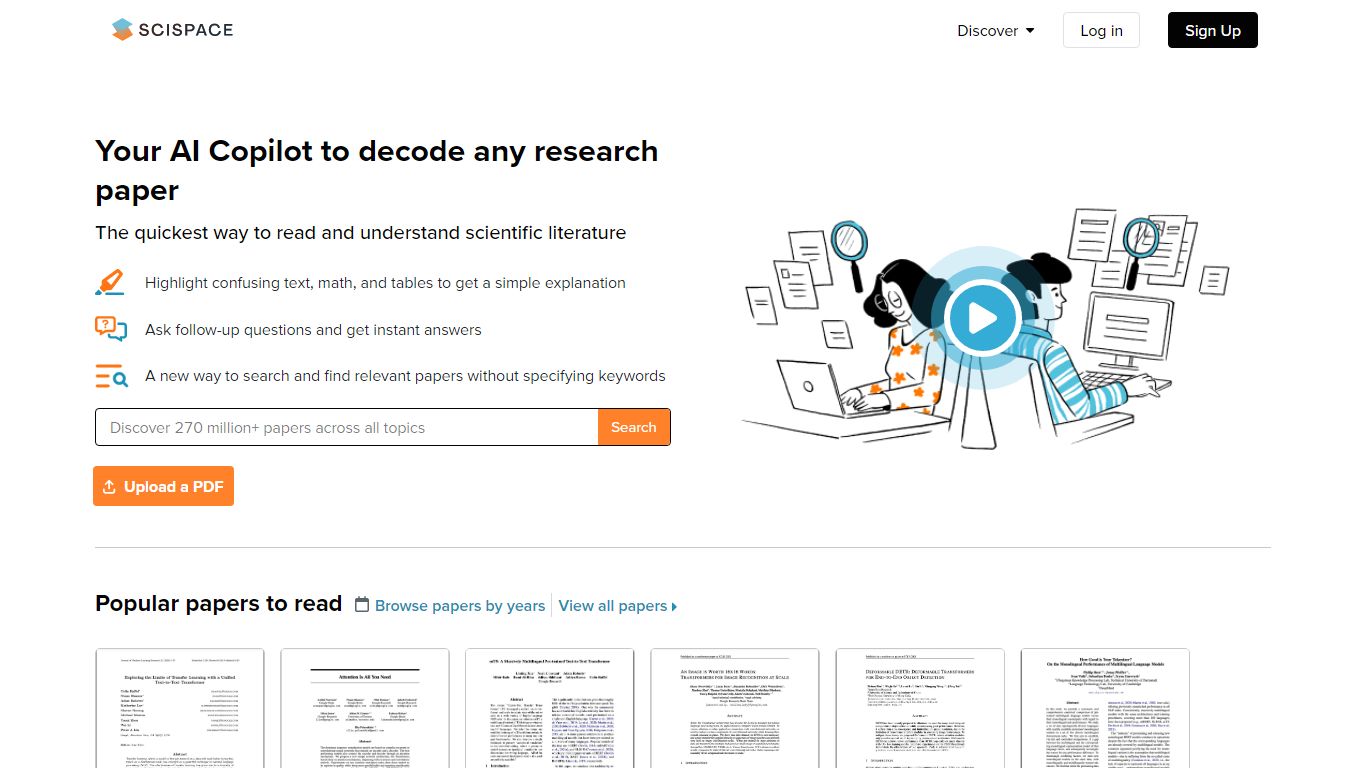
What is SciSpace (formerly Typeset)?
SciSpace, formerly Typeset, is a research workspace where you search a large academic paper index, chat with PDFs, and draft literature reviews with cited sources. The typeset.io URL now lands on scispace.com, which bundles an AI agent, literature review search, paraphraser, citation generator, data extraction, and AI detection in one interface.
General AI chat tools answer from the open web. SciSpace centers the workflow on papers: you can run systematic reviews across 280M+ indexed works, highlight passages for explanations, and move from reading into AI Writer drafts with references. Biomedical Agent, enterprise recruiting, and Chrome or mobile apps extend the same stack for labs and R&D teams.
Graduate students, PhD researchers, and pharma or biotech analysts use SciSpace to screen literature faster, unpack dense PDFs, and produce summaries or manuscripts with traceable citations. The platform reports adoption by 9.6 million researchers and lists SOC 2 compliance on its site.
Summify Upvotes
SciSpace (formerly Typeset) Upvotes
Summify Top Features
Starter plan includes 800 transcription minutes per month and 5 knowledge pods at $8 per month
Pro plan offers 1,800 minutes, 20 pods, and 100 MCP connections per day at $16 per month
Max plan includes 8,000 minutes, unlimited pods, and 300 MCP connections per day at $33 per month
Supports 11 summary styles including Deep Dive, Q&A, Academic, Blog, and Action List formats
Translates and summarizes content in 130 plus languages with automatic detection
MCP integration connects pods to Claude, ChatGPT, Cursor, Windsurf, and other compatible AI tools
Free trial grants full access to all features before choosing a paid plan
SciSpace (formerly Typeset) Top Features
Search and review literature across 280M+ indexed research papers
Chat with PDF highlights for plain-language explanations of dense sections
SciSpace Agent plus Biomedical Agent for guided research tasks
Built-in paraphraser, citation generator, AI detector, and data extraction tools
AI Writer and templates for drafting papers with cited sources
Chrome extension and mobile app for reading outside the browser tab
Premium plans with a 24-hour money-back guarantee on subscriptions
Summify Category
- Summarizer
SciSpace (formerly Typeset) Category
- Summarizer
Summify Pricing Type
- Freemium
SciSpace (formerly Typeset) Pricing Type
- Freemium