TableSprint vs Open Interpreter
Compare TableSprint vs Open Interpreter and see which AI Code Assistant tool is better when we compare features, reviews, pricing, alternatives, upvotes, etc.
Which one is better? TableSprint or Open Interpreter ?
When we compare TableSprint with Open Interpreter , which are both AI-powered code assistant tools, There's no clear winner in terms of upvotes, as both tools have received the same number. Every vote counts! Cast yours and contribute to the decision of the winner.
Does the result make you go "hmm"? Cast your vote and turn that frown upside down!
TableSprint
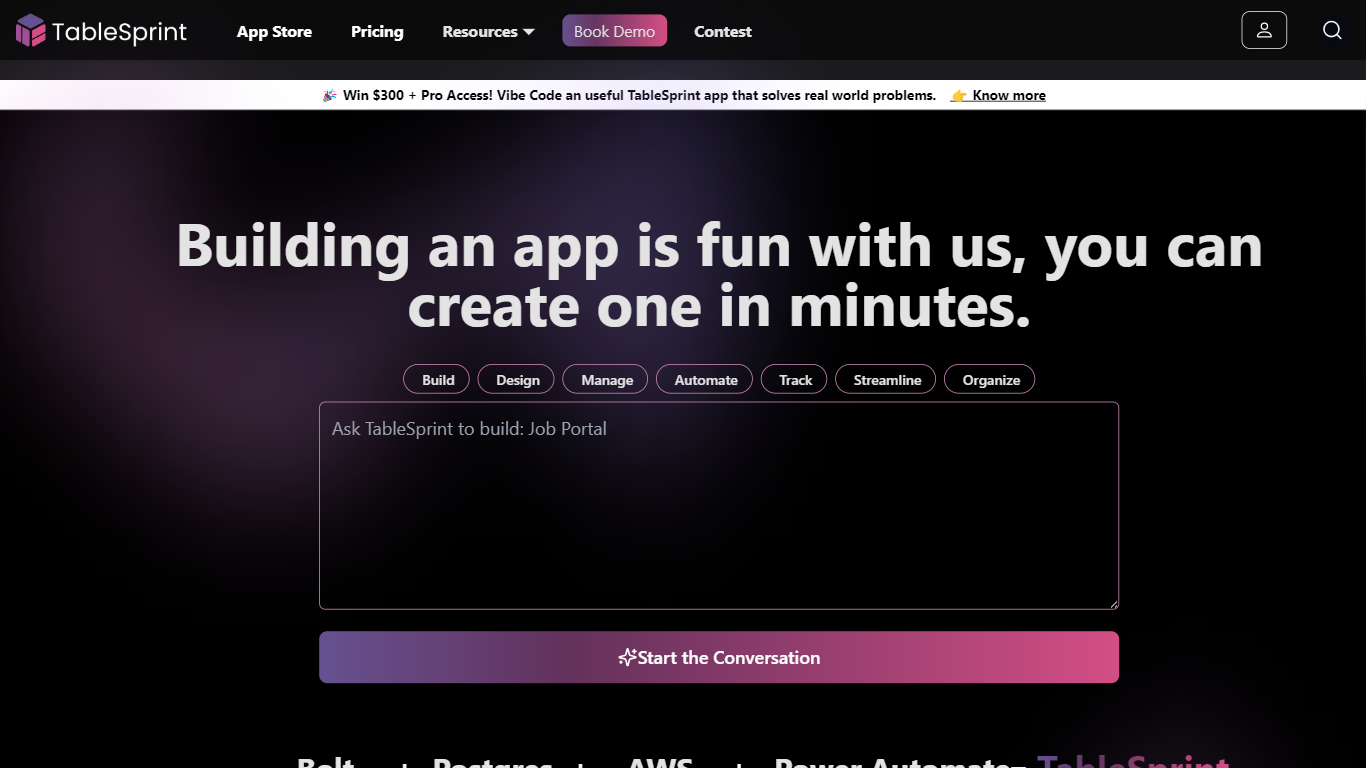

What is TableSprint?
TableSprint lets founders, sales, ops, and enterprise teams deploy voice, chat, email, and workflow agents without engineering bandwidth. The workspace also includes worksheets, forms, live dashboards, admin panels, and mobile views so custom internal apps and agents share one database. The app store ships ready-made agents for outbound SDR calls, chat support, invoicing, and media editing, each tagged free or premium.
Most teams buy a low-code builder and bolt on agent tools later. TableSprint merges agent deployment with worksheets, forms, permissions, and instant deploy in the same stack. Docs pitch replacing five tools and building an operations platform in two weeks instead of six months, with one chat agent claiming up to 60% fewer support tickets.
Founders, sales, ops, and enterprise teams that need agents in production fast fit TableSprint best. It targets teams without spare engineering bandwidth who still want voice and chat automation beside internal apps and live dashboards.
Open Interpreter
What is Open Interpreter ?
Open Interpreter is an open-source coding agent that runs in your terminal or as a desktop app. Open a project, type interpreter, and it reads your files, edits code, and runs commands with sandbox guardrails. It is built on a fork of OpenAI's Codex CLI and stays provider agnostic, so you can plug in OpenAI, Anthropic, Kimi, Qwen, DeepSeek, or local models.
The project targets low-cost and open-weight models rather than frontier-only agents. Model-specific harnesses emulate the tool interfaces each provider trained on, which the team reports improves benchmark scores on models like Kimi K2.5 and DeepSeek V4 Flash compared to generic agent loops.
Developers get a familiar Codex-style terminal with AGENTS.md support, skills, MCP servers, and session management. The separate desktop app brings the same agent workflow to Word, Excel, PDFs, and the browser for knowledge workers who do not live in a code editor.
TableSprint Upvotes
Open Interpreter Upvotes
TableSprint Top Features
App store lists free and premium agents for sales calls, support, and media editing
Chat Support Agent claims up to 60% fewer support tickets with 24/7 FAQ handling
Customer testimonial cites replacing 5 tools and shipping an ops platform in 2 weeks
Funding data lists $1 million raised, founded 2024, and about 10 employees
Outbound Calling SDR agent runs proactive sales calls and books demos into your calendar
Open Interpreter Top Features
Model-specific harnesses tuned for Kimi, Qwen, DeepSeek, and other open models
OS-level sandbox on macOS, Linux, and Windows with approval gates before network access
Swap providers and models from the terminal with
/modelwithout reinstalling anythingKeeps Codex skills, MCP servers, AGENTS.md, and slash commands from the upstream fork
Desktop app fills PDF forms, edits Word docs, and builds Excel sheets with built-in editors
TableSprint Category
- Code Assistant
Open Interpreter Category
- Code Assistant
TableSprint Pricing Type
- Freemium
Open Interpreter Pricing Type
- Freemium