TLM Playground vs OpenHermes-13B
When comparing TLM Playground vs OpenHermes-13B, which AI Model Generation tool shines brighter? We look at pricing, alternatives, upvotes, features, reviews, and more.
In a comparison between TLM Playground and OpenHermes-13B, which one comes out on top?
When we put TLM Playground and OpenHermes-13B side by side, both being AI-powered model generation tools, Both tools are equally favored, as indicated by the identical upvote count. Since other aitools.fyi users could decide the winner, the ball is in your court now to cast your vote and help us determine the winner.
Want to flip the script? Upvote your favorite tool and change the game!
TLM Playground

What is TLM Playground?
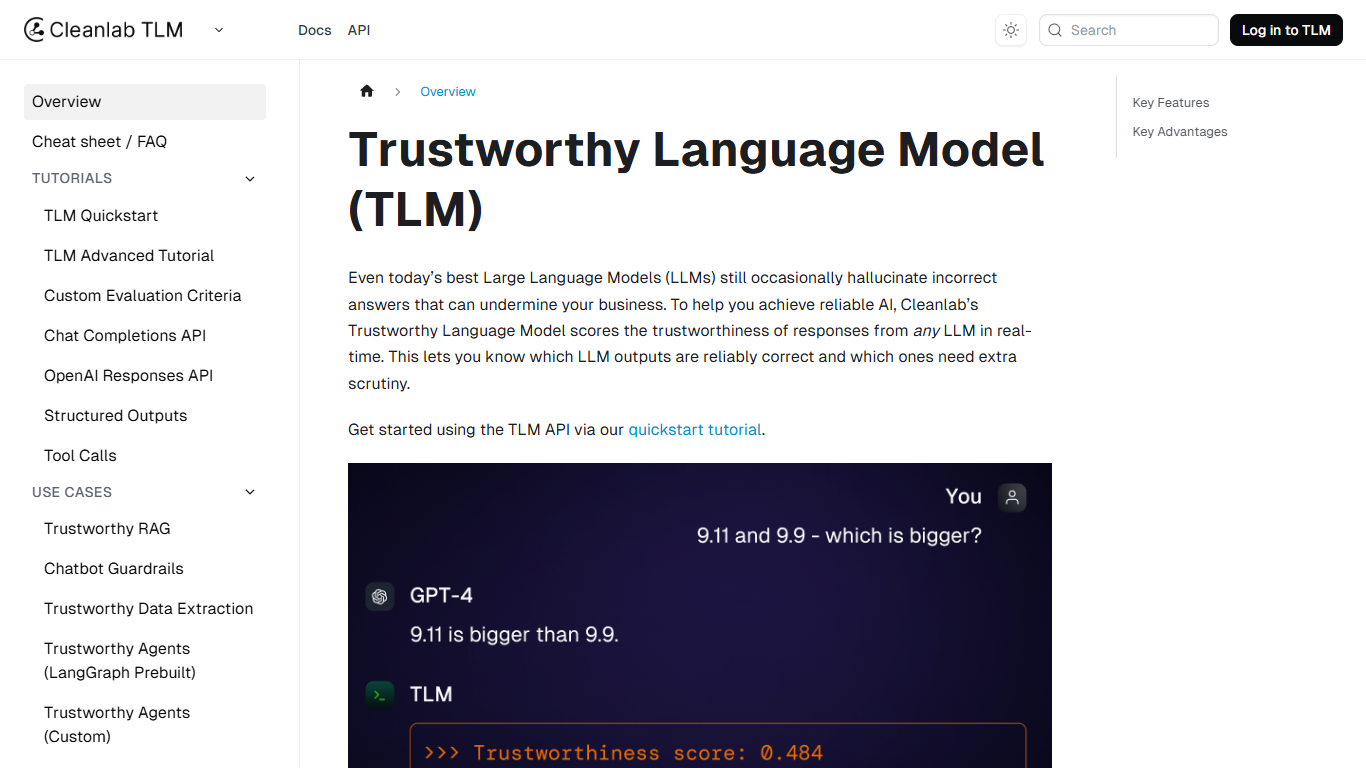
TLM Playground is Cleanlab's documentation hub for the Trustworthy Language Model (TLM), a model generation API that scores how reliable any LLM response is in real time. Each answer gets a trustworthiness score between 0 and 1, flagging hallucinations and reasoning errors before they reach users. Install the Python client with pip install cleanlab-tlm, set a CLEANLAB_TLM_API_KEY, and call TLM.prompt() to generate scored responses or get_trustworthiness_score() to audit outputs from your existing stack.
Most hallucination detectors focus on faithfulness to retrieved context. Metrics like RAGAS check whether an answer matches source documents but miss factual errors when the context is thin or confusing. TLM uses model uncertainty estimation rather than LLM-as-judge prompting, and Cleanlab publishes benchmarks showing 3x greater precision than RAGAS in RAG workflows. It needs no labeled training data on your domain, which sidesteps the drift problem that breaks custom evaluators.
ML and AI engineers building RAG pipelines, chatbots, and agent systems use TLM to gate low-confidence outputs, route them to humans, or swap in fallback answers. The API covers structured outputs, tool calls, classification labels, and multi-turn conversations, not just plain text completions.
OpenHermes-13B
What is OpenHermes-13B?
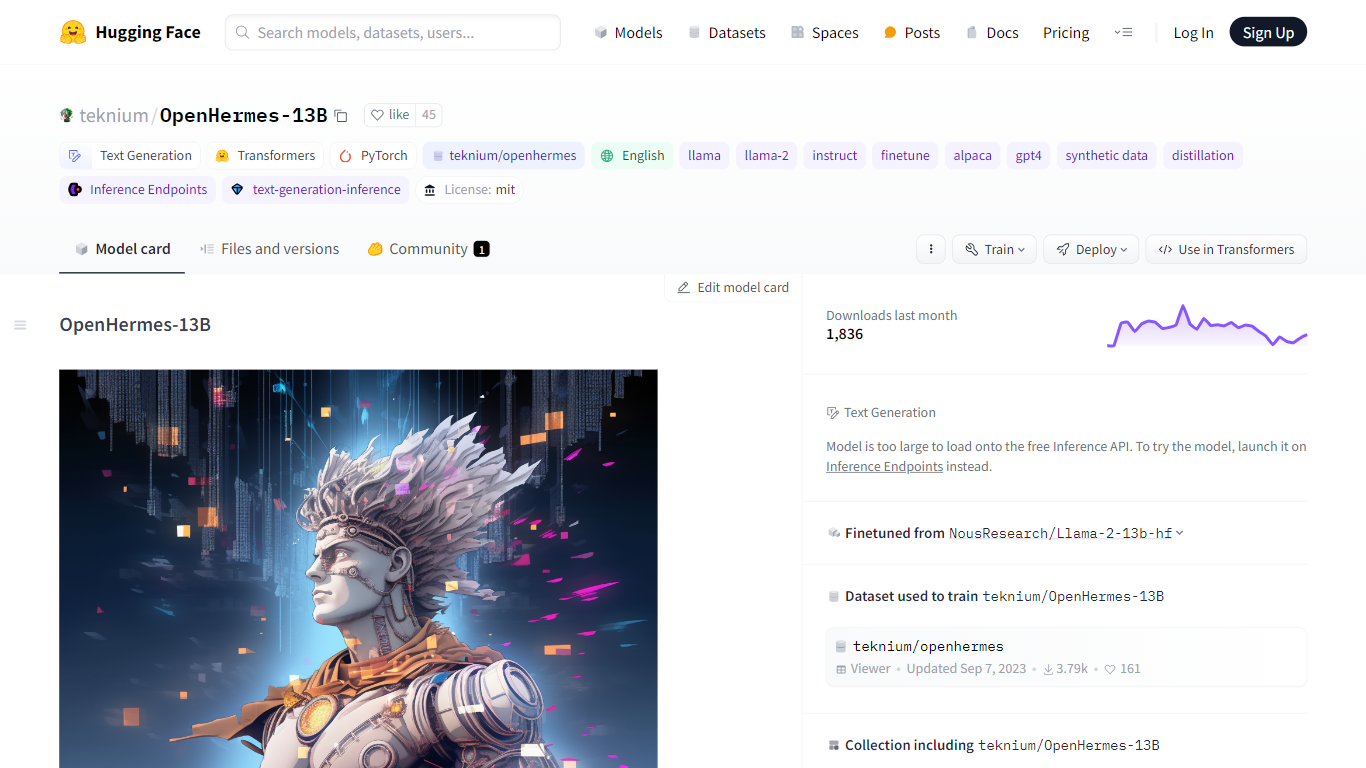
OpenHermes-13B is a fine-tuned language model built on a fully open-source dataset of 242,000 entries, primarily generated by GPT-4 and curated from various open AI datasets. It was developed to improve text generation by removing AI disclaimers and refusals, aiming for clearer and more direct communication outputs. The model incorporates data from multiple contributors, including Teknium, WizardLM Team, Microsoft, and others, ensuring a diverse and comprehensive training base.
This model is designed for developers and researchers who want an open-source alternative for advanced text generation tasks without the typical AI safety disclaimers. It supports integration with popular machine learning libraries like Transformers and can be deployed locally or via Docker, making it accessible for experimentation and production use.
OpenHermes-13B offers transparency in its training process, with public access to its WANDB project logs and detailed benchmark results. It shows competitive performance on benchmarks like GPT4All and BigBench, with slight improvements over similar models, although it has some trade-offs in AGI-Eval scores.
Technically, it was trained using multi-GPU setups with Adam optimizer and cosine learning rate scheduling, emphasizing reproducibility and open collaboration. The model is compatible with various inference tools and quantizations, allowing use in environments like llama.cpp and LM Studio.
Overall, OpenHermes-13B provides a valuable resource for those seeking a powerful, open-source language model fine-tuned for instruction following and text generation without restrictive AI disclaimers, suitable for research, development, and deployment in diverse AI applications.
TLM Playground Upvotes
OpenHermes-13B Upvotes
TLM Playground Top Features
Every response returns a 0 to 1 trustworthiness score computed via uncertainty estimation
get_trustworthiness_score() scores outputs from any LLM without changing your inference code
TLM.prompt() returns both a response and score in one API call, defaulting to gpt-4.1-mini as the base model
Benchmarks report 27% fewer incorrect GPT-4o responses and 3x better RAG error detection than RAGAS
Quality presets from low to high, plus TLM Lite, let you trade latency and cost against scoring depth
TrustworthyRAG Evals score groundedness, abstention, and context sufficiency alongside trustworthiness
OpenHermes-13B Top Features
📚 Open-Source Dataset: Trained on 242,000 GPT-4 generated entries for diverse and rich language understanding.
⚙️ Easy Integration: Compatible with popular ML libraries like Transformers and supports local and Docker deployment.
🔍 Transparent Training: Public WANDB logs provide insight into training and performance metrics.
🚀 Competitive Performance: Shows strong benchmark results on GPT4All and BigBench datasets.
🛠️ Flexible Usage: Supports quantizations and works with tools like llama.cpp and LM Studio for varied deployment scenarios.
TLM Playground Category
- Model Generation
OpenHermes-13B Category
- Model Generation
TLM Playground Pricing Type
- Freemium
OpenHermes-13B Pricing Type
- Freemium