VALL-E vs Google Flow Music (formerly Riffusion)
Explore the showdown between VALL-E vs Google Flow Music (formerly Riffusion) and find out which AI Audio Generation tool wins. We analyze upvotes, features, reviews, pricing, alternatives, and more.
When comparing VALL-E and Google Flow Music (formerly Riffusion), which one rises above the other?
When we contrast VALL-E with Google Flow Music (formerly Riffusion), both of which are exceptional AI-operated audio generation tools, and place them side by side, we can spot several crucial similarities and divergences. Google Flow Music (formerly Riffusion) stands out as the clear frontrunner in terms of upvotes. Google Flow Music (formerly Riffusion) has attracted 8 upvotes from aitools.fyi users, and VALL-E has attracted 5 upvotes.
Does the result make you go "hmm"? Cast your vote and turn that frown upside down!
VALL-E
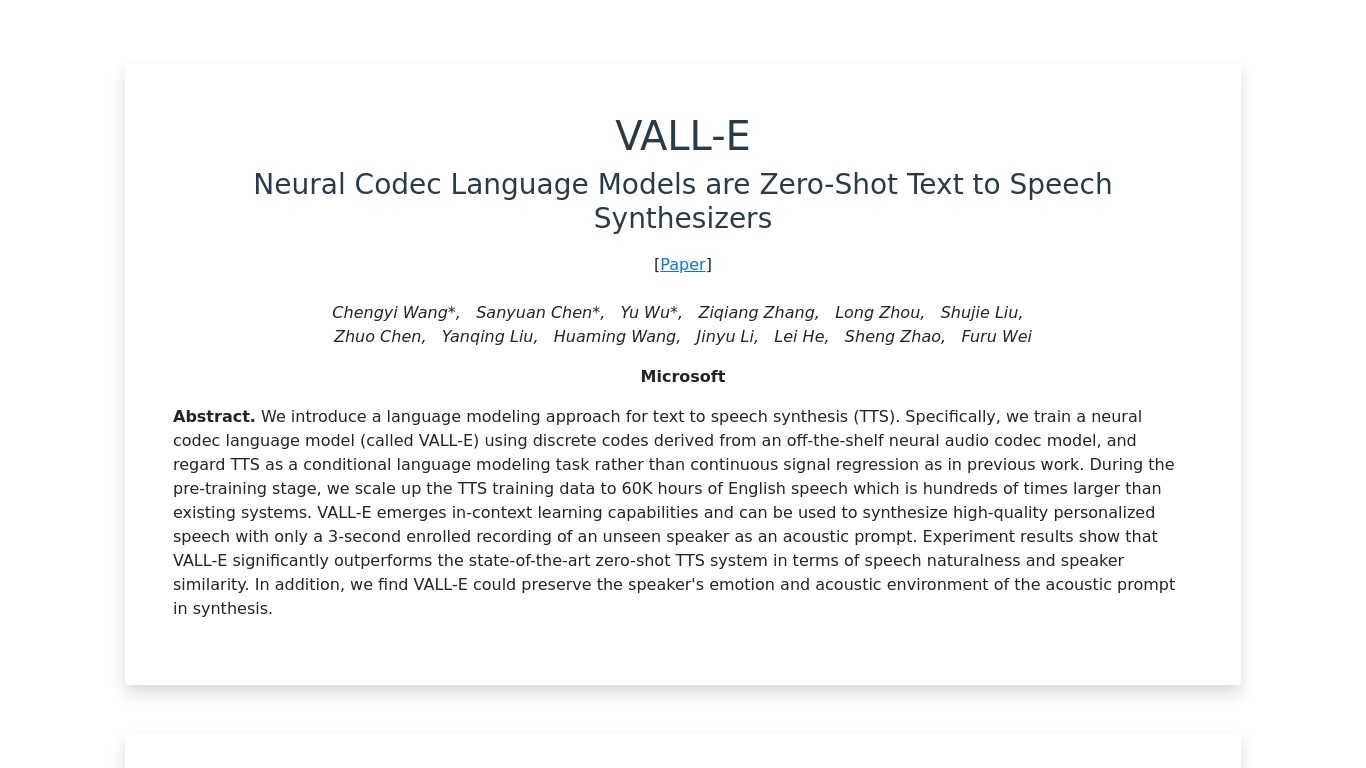

What is VALL-E?
VALL-E is a Microsoft Research text-to-speech model that clones a speaker's voice from a short audio clip and generates new speech from text. It belongs to the audio generation category because it synthesizes natural speech rather than editing existing recordings. The project page hosts sample audio for the original VALL-E model and later variants in the same research family.
Most TTS systems regress continuous waveforms or mel-spectrograms directly. VALL-E instead treats speech as a conditional language modeling task over discrete codes from a neural audio codec. Microsoft trained it on about 60,000 hours of English speech, far larger than typical TTS datasets. A 3-second enrolled recording of an unseen speaker is enough to drive zero-shot synthesis, and the model can keep the emotion and room tone present in that prompt.
The VALL-E family grew beyond the first paper. VALL-E X handles cross-lingual zero-shot TTS, VALL-E R adds phoneme monotonic alignment for more stable speech generation, and VALL-E 2 pairs repetition-aware sampling with grouped code modeling to reach human parity on LibriSpeech and VCTK benchmarks. Related lines like MELLE, FELLE, and PALLE explore continuous mel tokens and hybrid autoregressive plus parallel decoding.
Researchers, speech engineers, and curious listeners use VALL-E to hear what large-scale codec language models can do before building their own pipelines. The public samples are research demos, not a hosted API you can plug into a product without separate licensing and ethics review.
Google Flow Music (formerly Riffusion)
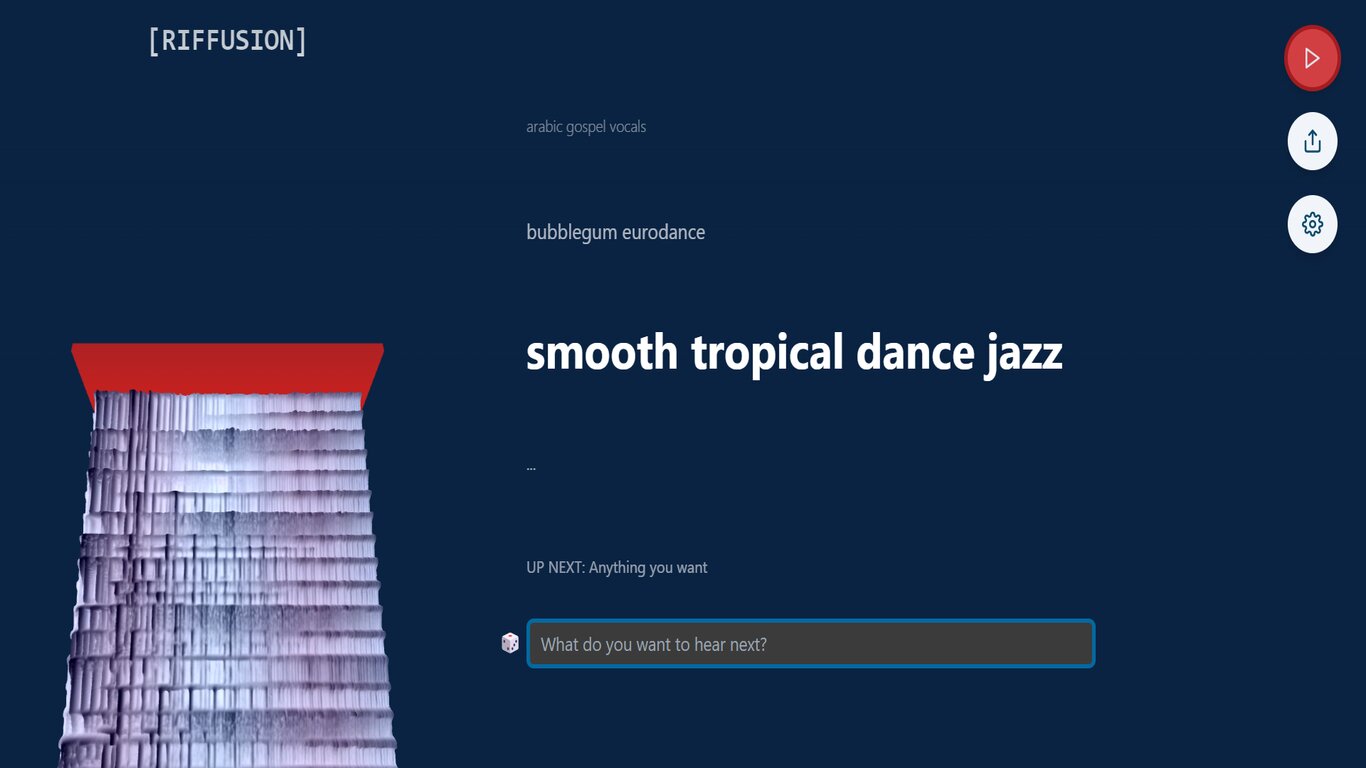
What is Google Flow Music (formerly Riffusion)?
Google Flow Music lets you create full-length songs, remix tracks, and publish music through a conversational studio built on Google's Lyria 3.5 model. riffusion.com now redirects to flowmusic.app, where you chat with Producer like you are in a session, iterate on vocals and arrangement, and export finished tracks.
Unlike one-shot music generators that spit out a clip and stop, Flow Music focuses on iterative editing. Replace and Extend let you swap specific sections or continue a song past its endpoint without regenerating the whole track. You can also direct Veo-powered music videos, split stems, apply audio effects, and vibe-code custom instruments or mini apps inside Spaces.
The free tier includes daily top-up credits and two concurrent generations with no credit card required. Paid plans raise monthly credits, concurrent generation limits, and add member perks. Google acquired the Riffusion team in 2026 and folded the product into Google Labs alongside Lyria and Veo.
VALL-E Upvotes
Google Flow Music (formerly Riffusion) Upvotes
VALL-E Top Features
Clones an unseen speaker from a 3-second enrolled audio prompt
Pre-trained on about 60,000 hours of English speech data
VALL-E 2 reports human parity on LibriSpeech and VCTK zero-shot benchmarks
Preserves speaker emotion and acoustic environment from the prompt clip
VALL-E X extends zero-shot synthesis to cross-lingual scenarios
Sample pages cover seven model lines including MELLE, FELLE, and PALLE
Google Flow Music (formerly Riffusion) Top Features
Lyria 3.5 generates full-length songs with rich vocals and arrangement through a conversational Producer chat
Replace and Extend remix tools edit specific sections or continue tracks without full regeneration
Veo integration creates directed music videos with custom characters and aesthetics
Free plan includes daily top-up credits and 2 concurrent generations at $0 per month
Starter plan offers 3,000 monthly credits (~600 songs) and 8 concurrent generations for $6 per month
Spaces let you vibe-code audio plugins, music games, and custom DAW tools on flowmusic.app
Stem split, audio effects, mp3/wav/m4a downloads, and playlist publishing ship in all core plans
VALL-E Category
- Audio Generation
Google Flow Music (formerly Riffusion) Category
- Audio Generation
VALL-E Pricing Type
- Free
Google Flow Music (formerly Riffusion) Pricing Type
- Freemium