Website Summary AI vs SciSpace (formerly Typeset)
In the face-off between Website Summary AI vs SciSpace (formerly Typeset), which AI Summarizer tool takes the crown? We scrutinize features, alternatives, upvotes, reviews, pricing, and more.
When we put Website Summary AI and SciSpace (formerly Typeset) head to head, which one emerges as the victor?
If we were to analyze Website Summary AI and SciSpace (formerly Typeset), both of which are AI-powered summarizer tools, what would we find? The upvote count shows a clear preference for SciSpace (formerly Typeset). SciSpace (formerly Typeset) has attracted 24 upvotes from aitools.fyi users, and Website Summary AI has attracted 8 upvotes.
Feeling rebellious? Cast your vote and shake things up!
Website Summary AI

What is Website Summary AI?
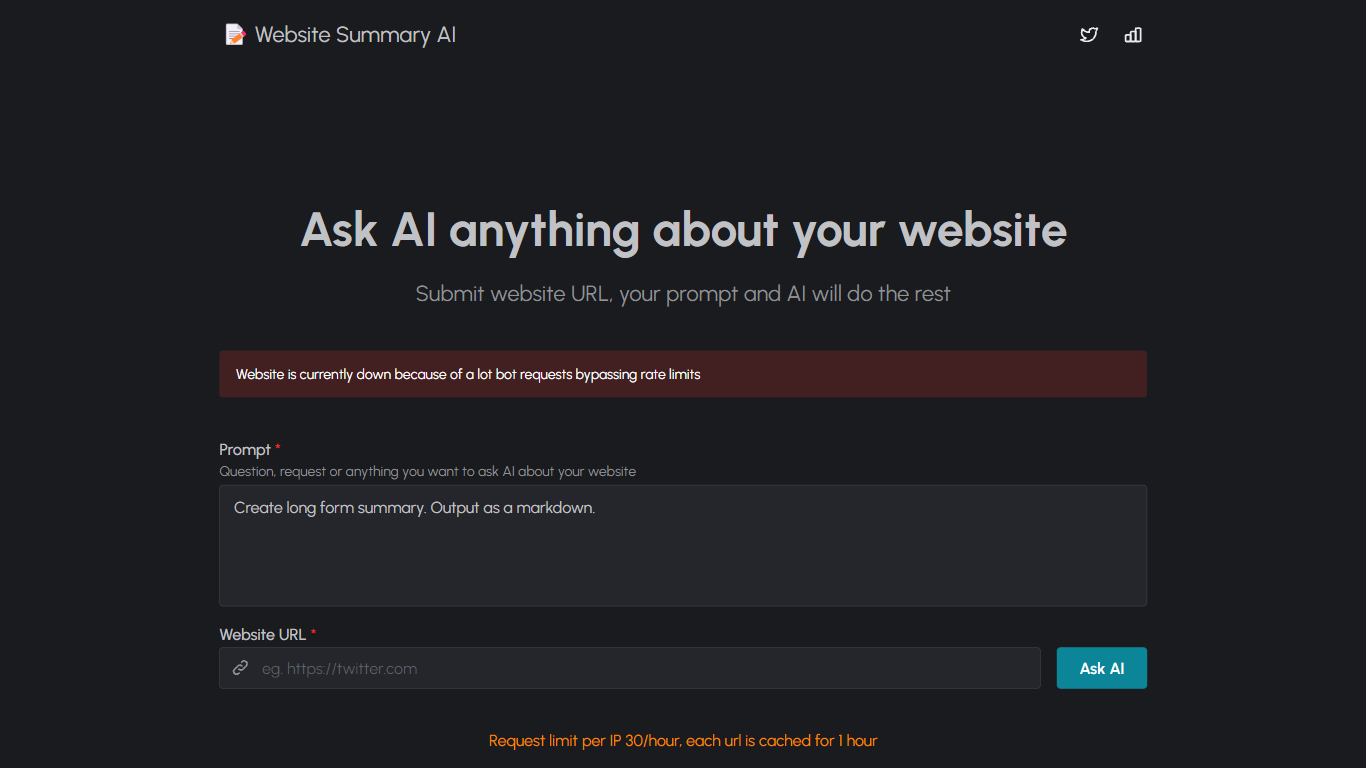
Website Summary AI lets you paste a site URL and a prompt, then get answers about that page's content without reading it yourself. The homepage positions it for questions like "summarize this landing page" or any custom request about what a website says. Rate limits cap usage at 30 requests per IP per hour, and each URL result is cached for one hour.
Compared with general-purpose chatbots, this tool is scoped to a single URL per request. You supply the link and the question, and the service fetches and interprets that page for you. That narrow focus keeps the workflow to two fields, though it also means the homepage warns the service was taken offline temporarily after bot traffic bypassed rate limits.
Researchers, marketers auditing competitor pages, and developers sanity-checking documentation fit the use case. The project is built by Dobroslav and links to a public Pirsch analytics dashboard. When the site is online, there is no signup step on the homepage form.
SciSpace (formerly Typeset)
What is SciSpace (formerly Typeset)?
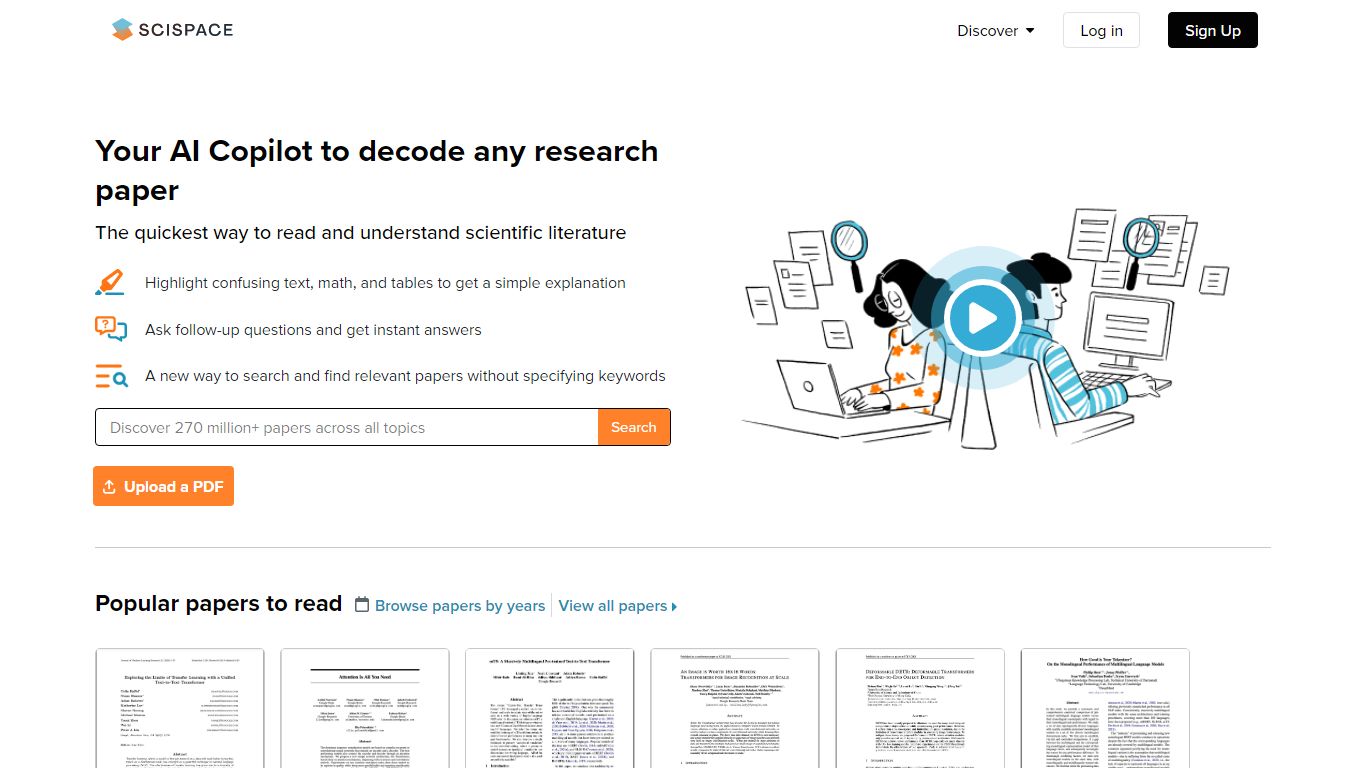
SciSpace, formerly Typeset, is a research workspace where you search a large academic paper index, chat with PDFs, and draft literature reviews with cited sources. The typeset.io URL now lands on scispace.com, which bundles an AI agent, literature review search, paraphraser, citation generator, data extraction, and AI detection in one interface.
General AI chat tools answer from the open web. SciSpace centers the workflow on papers: you can run systematic reviews across 280M+ indexed works, highlight passages for explanations, and move from reading into AI Writer drafts with references. Biomedical Agent, enterprise recruiting, and Chrome or mobile apps extend the same stack for labs and R&D teams.
Graduate students, PhD researchers, and pharma or biotech analysts use SciSpace to screen literature faster, unpack dense PDFs, and produce summaries or manuscripts with traceable citations. The platform reports adoption by 9.6 million researchers and lists SOC 2 compliance on its site.
Website Summary AI Upvotes
SciSpace (formerly Typeset) Upvotes
Website Summary AI Top Features
Two-field workflow: enter a website URL and a custom prompt about that page
30 requests per IP per hour with 1-hour caching per URL
Public Pirsch analytics dashboard linked from the homepage
Built by Dobroslav with a linked Twitter profile for support context
No account signup shown on the main ask form
SciSpace (formerly Typeset) Top Features
Search and review literature across 280M+ indexed research papers
Chat with PDF highlights for plain-language explanations of dense sections
SciSpace Agent plus Biomedical Agent for guided research tasks
Built-in paraphraser, citation generator, AI detector, and data extraction tools
AI Writer and templates for drafting papers with cited sources
Chrome extension and mobile app for reading outside the browser tab
Premium plans with a 24-hour money-back guarantee on subscriptions
Website Summary AI Category
- Summarizer
SciSpace (formerly Typeset) Category
- Summarizer
Website Summary AI Pricing Type
- Free
SciSpace (formerly Typeset) Pricing Type
- Freemium