
Last updated 08-09-2026
Category:
Reviews:
Join thousands of AI enthusiasts in the World of AI!
Abridge
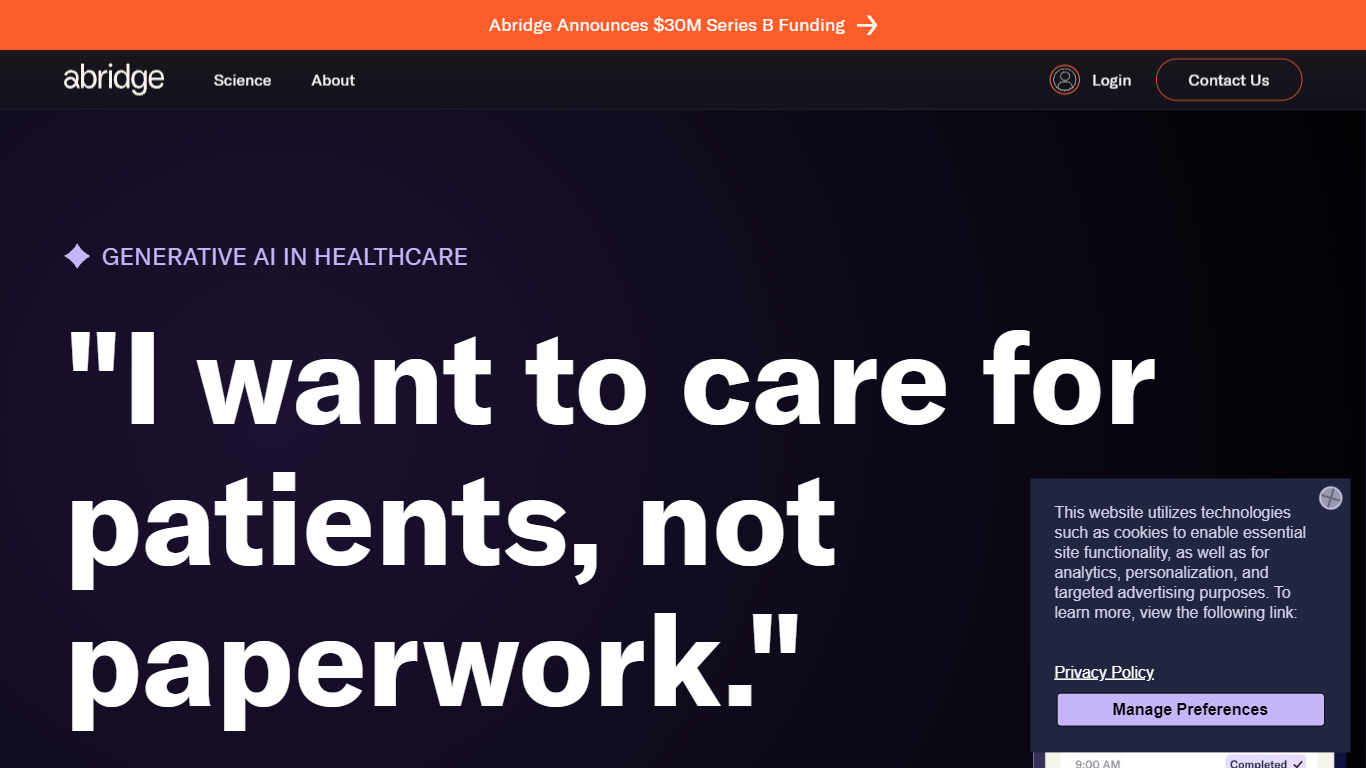
Abridge listens to clinician-patient conversations and drafts the chart work that usually follows: visit notes, nursing flowsheets, coding support, and patient summaries. The medical documentation platform runs across pre-visit prep, the live encounter, and post-visit billing for hospitals and health systems. Abridge reports powering more than 100 million clinical conversations per year for 300+ health systems.
Most ambient scribe tools stop at physician notes. Abridge ships separate modules for clinicians, nursing flowsheet charting, and revenue cycle documentation on one platform, with clinical decision support and Care Signals layered in during the visit. That wider scope means IT teams buy one vendor for documentation, nursing workflows, and downstream billing rather than stitching together point tools.
The product targets enterprise hospitals rolling out ambient documentation at scale. Case studies cite outcomes like 30 minutes saved per provider per day at UW Health, 86% less documentation effort at Reid Health, and 1,000+ clinicians onboarded in 10 months at Geisinger. Deployments integrate with major EMRs including Epic, Cerner, and Athena through a contact-sales onboarding process.
Powers 100M+ clinical conversations per year across 300+ health systems
Separate clinician, nursing, and revenue cycle modules on one platform
Clinical decision support pulls context from UpToDate, NEJM, and JAMA during visits
Nursing module drafts flowsheet rows from bedside conversations for nurse verification
HIPAA-compliant platform with SSO and 256-bit encryption in transit and at rest
EMR integrations listed for Epic, Cerner, Athena, AllScripts, and Meditech
Named 2025 and 2026 Best in KLAS market leader for ambient AI
Covers clinician, nursing, and revenue cycle documentation on one enterprise platform.
Named Best in KLAS ambient AI market leader for 2025 and 2026.
Pre-visit, in-encounter, and post-visit workflow reduces after-hours charting.
Clinical decision support surfaces UpToDate, NEJM, and JAMA evidence during visits.
Case studies report measurable time savings, including 30 minutes per provider per day at UW Health.
No public pricing or self-serve signup; health systems must go through sales.
Focused on enterprise hospitals, not individual clinicians or small practices.
Requires EMR integration and organizational rollout rather than a quick standalone install.
What does Abridge do?
Abridge captures clinical conversations and generates structured documentation for clinicians, nurses, and revenue cycle teams. The platform covers pre-visit chart prep, ambient documentation during encounters, and post-visit notes, coding, and patient summaries. Abridge reports powering 100M+ conversations annually for 300+ health systems.
How much does Abridge cost?
Abridge does not publish list pricing. Health systems request access through the contact form at abridge.com/contact, which asks for organization details, EMR, role, and physician count. Pricing is negotiated per enterprise deployment rather than sold as self-serve subscriptions.
Which EMRs does Abridge support?
Abridge's contact form lists Epic, Athena, AllScripts, Cerner, eClinicalWorks, Greenway, Meditech, and NextGen as EMR options during onboarding. The nursing product page states workflows are designed to operate alongside existing EHR nursing documentation.
Does Abridge work for nurses?
Yes. Abridge for Nurses turns nurse-patient conversations into draft flowsheet rows that nurses review and verify before charting. The nursing page cites 27 minutes saved per nurse per shift at Reid Health and highlights KLAS's first nursing AI evaluation featuring Abridge deployments.
Is Abridge HIPAA compliant?
Yes. Abridge markets HIPAA-compliant, enterprise-grade security with 256-bit encryption in transit and at rest, single sign-on, U.S.-based secure cloud storage, and custom governance controls for health system compliance teams.
How do clinicians access Abridge?
Clinicians at customer organizations sign in through notes.abridge.com. The public marketing site directs new health systems to the contact form for sales onboarding rather than offering direct self-service signup for clinical users.