
Last updated 08-21-2026
Category:
Reviews:
Join thousands of AI enthusiasts in the World of AI!
Cerebrium
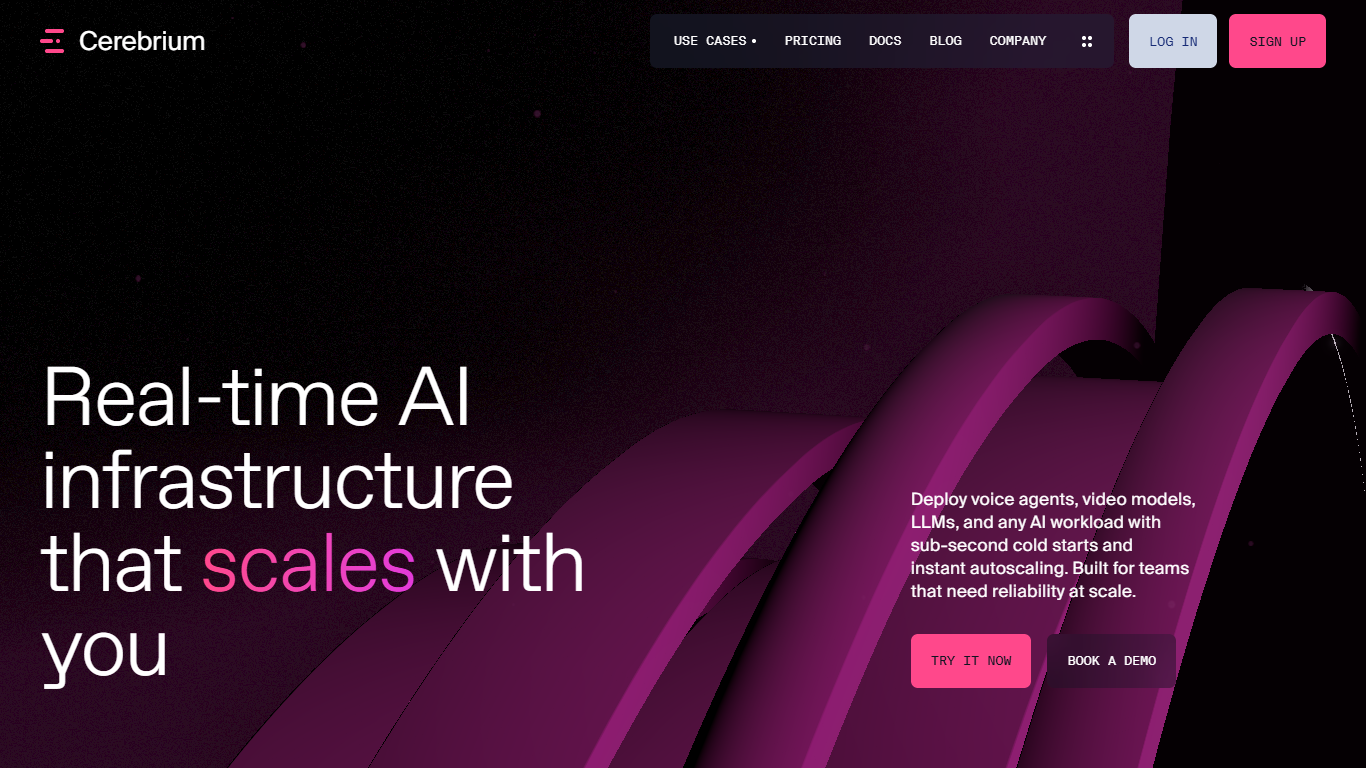
Cerebrium runs voice agents, LLM inference, and image or video pipelines on autoscaling serverless GPUs. You point it at a Python entry point or Dockerfile, and it handles deployment across multiple clouds without Kubernetes setup. Cold starts land in the 2 to 4 second range thanks to memory and GPU snapshotting, and billing runs per second of actual compute time.
Where raw AWS or GCP instance pricing looks cheaper on paper, Cerebrium's pitch is that you stop paying for idle warm-up and over-provisioned capacity. Containers scale up and down in 1 to 3 seconds, and a global orchestrator routes workloads across us-east-1, eu-west-2, eu-north-1, and ap-south-1 to whichever provider has available GPUs. That trade-off favors bursty production traffic over steady 24/7 reserved clusters.
ML engineers and AI product teams use Cerebrium when they need production inference without hiring an infra team. Customers cited on the site include Tavus, Deepgram, and Resemble AI, mostly for voice, digital avatars, and generative workloads that spike unpredictably.
Cold starts in 2 to 4 seconds with GPU and memory snapshotting
H100 GPUs billed at $0.000944 per second; T4 at $0.000164 per second
12+ GPU types including B200, H100, AMD MI300X, and TPU v5e
Deploy across us-east-1, eu-west-2, eu-north-1, and ap-south-1
Hobby plan includes 3 deployed apps and 5 concurrent GPUs at no platform fee
SOC 2 Type II, HIPAA, GDPR, and ISO 27001 compliance on paid tiers
Native OpenTelemetry support for logs, metrics, and scaling events
Per-second billing means you only pay while workloads actively run.
No Kubernetes setup; deploy from a Python entry point or Dockerfile.
Cold starts in 2 to 4 seconds via GPU snapshotting, faster than typical cloud provisioning.
Access H100, B200, and AMD MI300X without long-term GPU reservations.
Multi-region routing across four AWS regions reduces latency for global users.
Standard plan requires $100 per month before any compute charges.
Hobby tier caps you at 3 deployed apps and 5 concurrent GPUs.
AWS and GCP cloud credits cannot be applied to Cerebrium usage.
What is Cerebrium used for?
Cerebrium is a serverless GPU hosting platform for deploying real-time AI workloads. Teams use Cerebrium to run voice agents, LLM inference with vLLM or SGLang, image generation, and video pipelines without managing Kubernetes or reserving GPU capacity.
How much does Cerebrium cost?
Cerebrium bills per second of compute. An H100 costs $0.000944 per second and a T4 costs $0.000164 per second. The Hobby plan is free plus compute, while the Standard plan is $100 per month plus compute with up to 30 concurrent GPUs.
Does Cerebrium have a free tier?
Yes. Cerebrium's Hobby plan has no platform fee and you pay only for compute seconds used. Hobby includes 3 user seats, up to 3 deployed apps, 500 CPU containers, and 5 concurrent GPUs.
What GPU hardware does Cerebrium support?
Cerebrium offers 12 or more GPU types including NVIDIA B200, H200, H100, A100, L40s, L4, T4, RTX PRO 6000, AMD MI300X, and Google TPU v5e. Cerebrium Flex auto-matches hardware to workload needs in real time.
Can Cerebrium run voice AI pipelines?
Yes. Cerebrium co-locates STT, LLM, and TTS workloads on shared infrastructure to cut network hops. The platform integrates with LiveKit, Pipecat, Deepgram, AssemblyAI, and Resemble AI for sub-500ms voice agent deployments.
Do I need to rewrite code for Cerebrium?
No. Cerebrium runs your application from a Python entry point or custom Dockerfile without decorators or a proprietary SDK. You deploy with the CLI using commands like cerebrium run, and Cerebrium handles versioning and autoscaling.
What compliance certifications does Cerebrium have?
Cerebrium meets SOC 2 Type II, HIPAA, GDPR, and ISO 27001 standards on paid plans. Cerebrium also supports regional data residency and runs workloads in gVisor-isolated containers for stronger tenant separation.