ALBERT vs Stellaris AI
In the contest of ALBERT vs Stellaris AI, which AI Large Language Model (LLM) tool is the champion? We evaluate pricing, alternatives, upvotes, features, reviews, and more.
If you had to choose between ALBERT and Stellaris AI, which one would you go for?
When we examine ALBERT and Stellaris AI, both of which are AI-enabled large language model (llm) tools, what unique characteristics do we discover? There's no clear winner in terms of upvotes, as both tools have received the same number. Your vote matters! Help us decide the winner among aitools.fyi users by casting your vote.
Feeling rebellious? Cast your vote and shake things up!
ALBERT
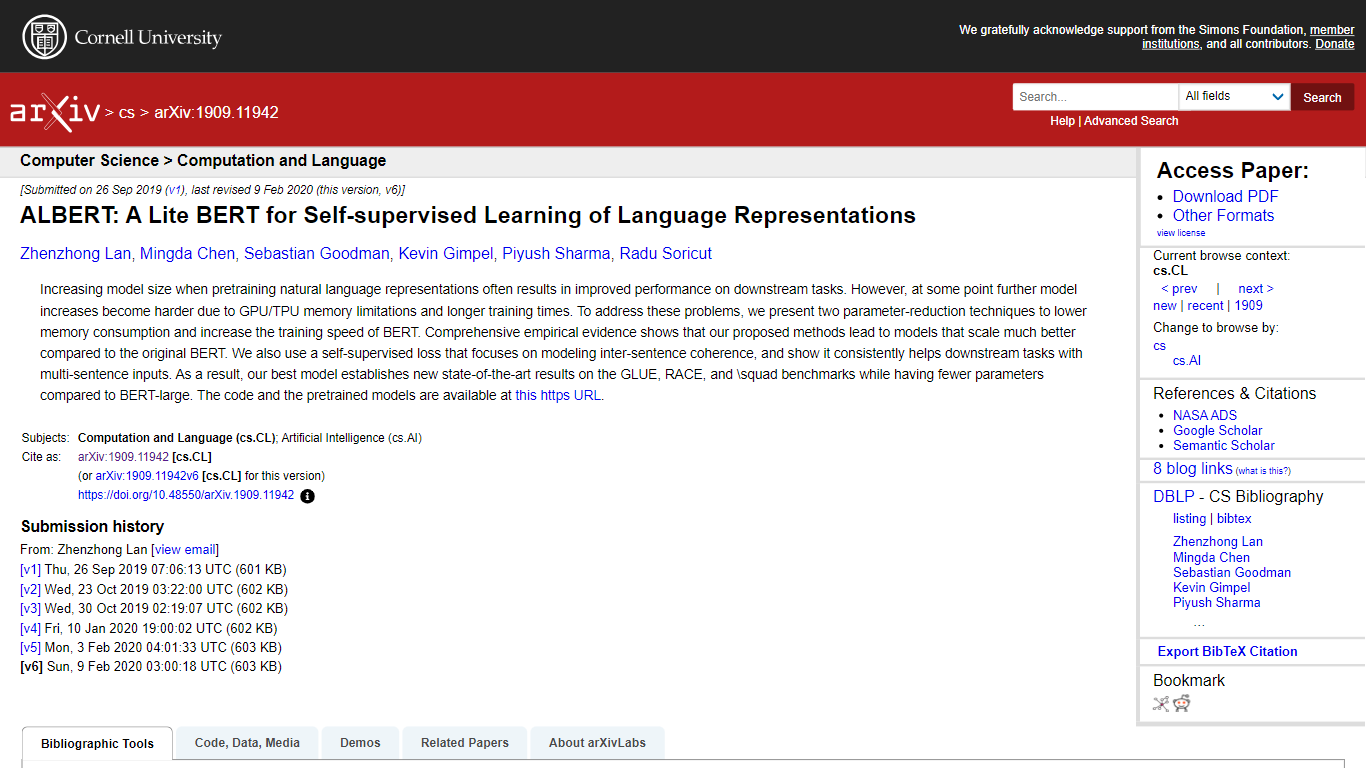

What is ALBERT?
ALBERT is an open source language model from Google Research that shrinks BERT's parameter count while matching or beating its benchmark scores. The name stands for A Lite BERT, and the architecture uses two tricks: factorized embedding parameterization splits the vocabulary matrix into smaller pieces, and cross-layer parameter sharing reuses weights across transformer layers.
Where BERT-large hits GPU memory walls during pretraining, ALBERT scales to larger hidden sizes with fewer total parameters. It also swaps BERT's next-sentence prediction loss for sentence-order prediction (SOP), which the authors found more effective for multi-sentence downstream tasks. The best ALBERT configuration set records on GLUE (89.4), RACE (89.4% accuracy), and SQuAD 2.0 (92.2 F1) at the time of publication.
Pretrained models and training code ship free on GitHub and load through Hugging Face Transformers. Researchers and NLP engineers use ALBERT when they need BERT-level performance on limited hardware or want a lighter model for fine-tuning on classification, question answering, and token-level tasks.
Stellaris AI
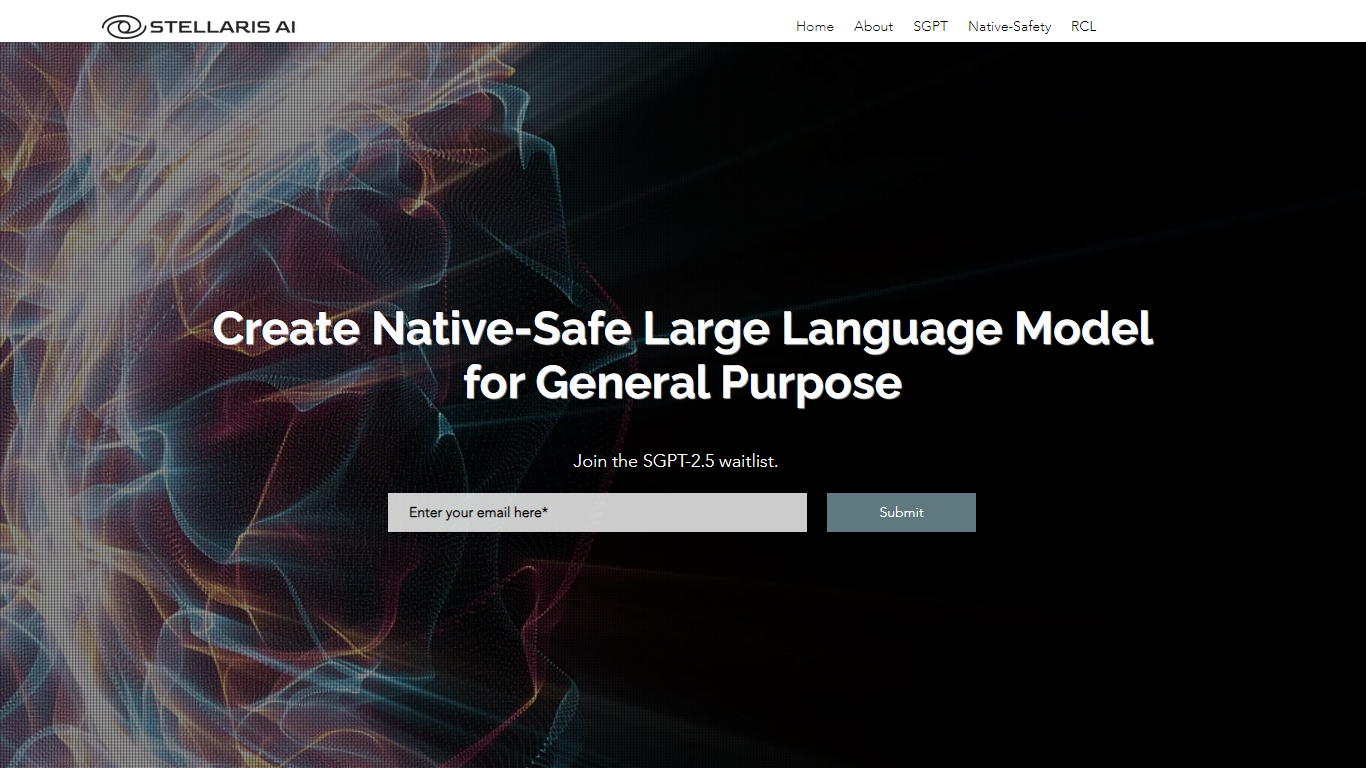
What is Stellaris AI?
Stellaris AI builds large language models marketed around native safety and human-like reasoning for real-world tasks. Its flagship SGPT line targets text and code generation, knowledge Q&A, logical reasoning, and analytics at a scale the company describes as hundreds of billions of parameters. The public site centers on a waitlist for SGPT-4.5 rather than a self-serve chat product you can open today.
Where many LLM labs bolt safety filters on after training, Stellaris AI frames safety as part of the model stack through strict source referencing and harm minimization in the architecture. It also highlights Real-time Context Learning (RCL) for adapting answers with live knowledge, a combination aimed at teams that want cited outputs instead of unchecked generation.
Researchers, enterprise AI teams, and early adopters join the SGPT-4.5 waitlist for first access. The company cites 10+ years of research and three core product pillars: Stellaris GPT, Native Safety, and RCL.
ALBERT Upvotes
Stellaris AI Upvotes
ALBERT Top Features
Factorized embedding parameterization reduces memory vs standard BERT vocabulary matrices
Cross-layer parameter sharing cuts learnable weights across transformer layers
Sentence-order prediction (SOP) loss replaces BERT's next-sentence prediction
89.4% accuracy on RACE and 92.2 F1 on SQuAD 2.0 benchmark results
Pretrained models and code available on GitHub and Hugging Face Transformers
Stellaris AI Top Features
SGPT models described at 100B+ parameters for text, code, and reasoning tasks
Native Safety framework with strict source referencing and harm minimization
Real-time Context Learning (RCL) for live knowledge integration
Three product pillars: Stellaris GPT, Native Safety, and RCL
SGPT-4.5 waitlist open for early access signups on the homepage
ALBERT Category
- Large Language Model (LLM)
Stellaris AI Category
- Large Language Model (LLM)
ALBERT Pricing Type
- Free
Stellaris AI Pricing Type
- Freemium