APIPark vs wav2vec 2.0
When comparing APIPark vs wav2vec 2.0, which AI Large Language Model (LLM) tool shines brighter? We look at pricing, alternatives, upvotes, features, reviews, and more.
Between APIPark and wav2vec 2.0, which one is superior?
When we put APIPark and wav2vec 2.0 side by side, both being AI-powered large language model (llm) tools, Both tools have received the same number of upvotes from aitools.fyi users. Every vote counts! Cast yours and contribute to the decision of the winner.
Think we got it wrong? Cast your vote and show us who's boss!
APIPark

What is APIPark?
APIPark is an open-source LLM gateway and API developer portal for enterprises that need one place to call, govern, and bill AI models and internal APIs. It routes traffic to 200+ large language models through a single OpenAI-compatible endpoint, so teams stop wiring separate vendor SDKs for every model they add.
Where most API gateways only forward requests, APIPark also treats models and APIs as tradable assets. It bundles unified authentication, approval workflows, recharge billing, multi-level distribution, and profit reporting so platform teams can sell surplus model capacity or package business APIs without building a separate marketplace stack.
Platform engineers and AI teams use it to set per-tenant quotas, rate limits, and masking rules before production traffic hits upstream models. API managers get portals for publishing APIs, tracking usage, and approving access requests. The Community Edition covers core gateway and portal features; the Enterprise Edition adds advanced governance, runtime statistics, and premium support.
wav2vec 2.0
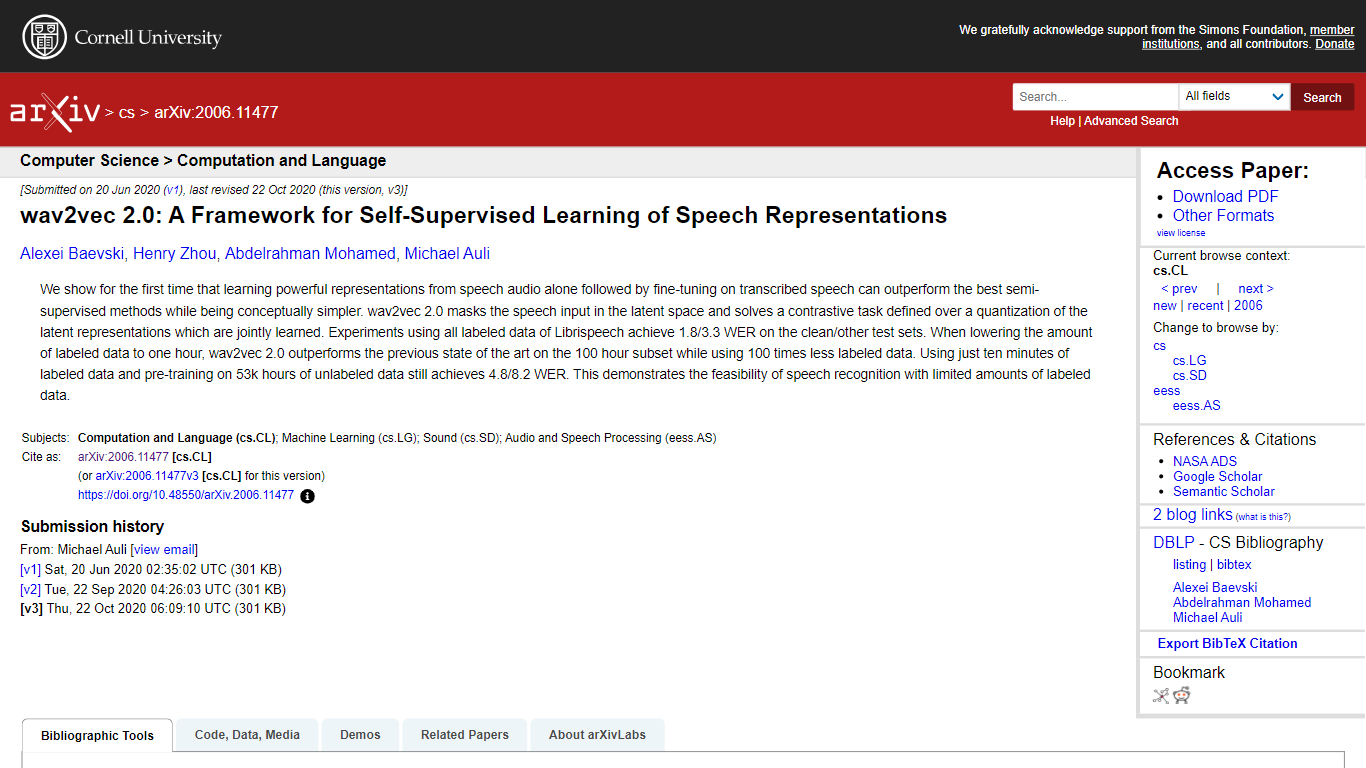
What is wav2vec 2.0?
wav2vec 2.0 is a self-supervised learning framework that learns speech representations directly from raw audio. It masks portions of the speech input in a latent space and solves a contrastive task over quantized latent representations, which are learned jointly with the model. This approach allows the model to leverage large amounts of unlabeled speech data effectively. After pre-training, wav2vec 2.0 can be fine-tuned on small amounts of labeled speech data to achieve state-of-the-art speech recognition performance. The model has demonstrated strong results even when fine-tuned with just minutes of labeled audio, making it highly efficient for low-resource scenarios.
The framework simplifies speech recognition by removing the need for complex semi-supervised pipelines, relying instead on a single end-to-end model. It achieves impressive word error rates on standard benchmarks like Librispeech and TIMIT, outperforming previous methods that require much more labeled data. The quantization of latent speech representations enables the model to learn discrete speech units, which improves robustness and generalization.
wav2vec 2.0 targets researchers and developers working on speech recognition, especially those interested in leveraging unlabeled audio data to reduce annotation costs. Its ability to perform well with limited labeled data opens opportunities for building speech systems in low-resource languages or domains. The model architecture is based on convolutional feature encoders and Transformer networks, allowing it to capture both local and global speech patterns.
Technically, wav2vec 2.0 combines contrastive learning with a masking strategy applied in the latent space, which differs from previous approaches that mask input audio directly. This design choice improves the quality of learned representations. The model is trained on large unlabeled datasets, such as 53,000 hours of speech, and fine-tuned on smaller labeled subsets. This two-stage training process balances scalability and accuracy.
Overall, wav2vec 2.0 represents a significant advance in self-supervised speech representation learning. It reduces reliance on labeled data, simplifies training pipelines, and achieves competitive or superior performance compared to fully supervised or semi-supervised methods. The release of code and pretrained models supports adoption and further research in speech technology.
APIPark Upvotes
wav2vec 2.0 Upvotes
APIPark Top Features
Routes 200+ LLMs through one OpenAI-compatible API signature so existing client code needs no vendor-specific rewrites
Deploy the gateway and developer portal in about 5 minutes with a single command-line install
Load balancing distributes requests across LLM instances to keep failover and throughput predictable under load
Built-in API billing tracks per-user consumption so teams can meter and monetize internal or partner API access
Fine-grained quotas cap daily or monthly spend by amount, tokens, or call counts to block runaway model usage
Data masking engine flags and masks sensitive fields in request and response payloads for compliance workflows
wav2vec 2.0 Top Features
Self-supervised pretraining on raw audio 🎧 enables learning from unlabeled speech data
Latent space masking 🎭 improves model focus on context and robustness
Contrastive task over quantized representations 🔄 helps learn discrete speech units
Fine-tuning with minimal labeled data 📝 achieves strong speech recognition accuracy
Transformer-based architecture 🔗 captures long-range speech dependencies effectively
APIPark Category
- Large Language Model (LLM)
wav2vec 2.0 Category
- Large Language Model (LLM)
APIPark Pricing Type
- Freemium
wav2vec 2.0 Pricing Type
- Freemium