Atmo AI vs Avian
Compare Atmo AI vs Avian and see which AI Data Science tool is better when we compare features, reviews, pricing, alternatives, upvotes, etc.
Which one is better? Atmo AI or Avian?
When we compare Atmo AI with Avian, which are both AI-powered data science tools, The upvote count reveals a draw, with both tools earning the same number of upvotes. Join the aitools.fyi users in deciding the winner by casting your vote.
Does the result make you go "hmm"? Cast your vote and turn that frown upside down!
Atmo AI


What is Atmo AI?
Atmo AI builds deep learning weather forecasting systems for governments, militaries, and large enterprises that need sharper predictions than legacy numerical models deliver. The company ingests real-time data from satellites, ground stations, radars, and ocean buoys, then runs neural network models that cover nowcasts out to 14-day medium-range outlooks. It sits in the data science stack for organizations where a missed storm or wind shift has operational consequences, not just a ruined picnic.
Where traditional numerical weather prediction leans on supercomputers and fixed grid resolutions, Atmo claims forecasts up to 40,000 times faster and up to 50% more accurate on major variables, with grids as fine as 1 km by 1 km for microclimate detail. That resolution gap matters for launch sites, island nations, and defense bases where a county-level forecast hides the local wind shear. The trade-off is access: Atmo sells custom deployments, not a consumer app you open for tomorrow's rain.
National weather agencies, defense commands, and enterprise risk teams use Atmo when they need site-specific forecasts backed by live production contracts. Deployments cited on Atmo's site include the U.S. Air Force, U.S. Navy, the Philippines national government, Cape Canaveral launch operations, and Tuvalu's national forecasting rollout.
Avian
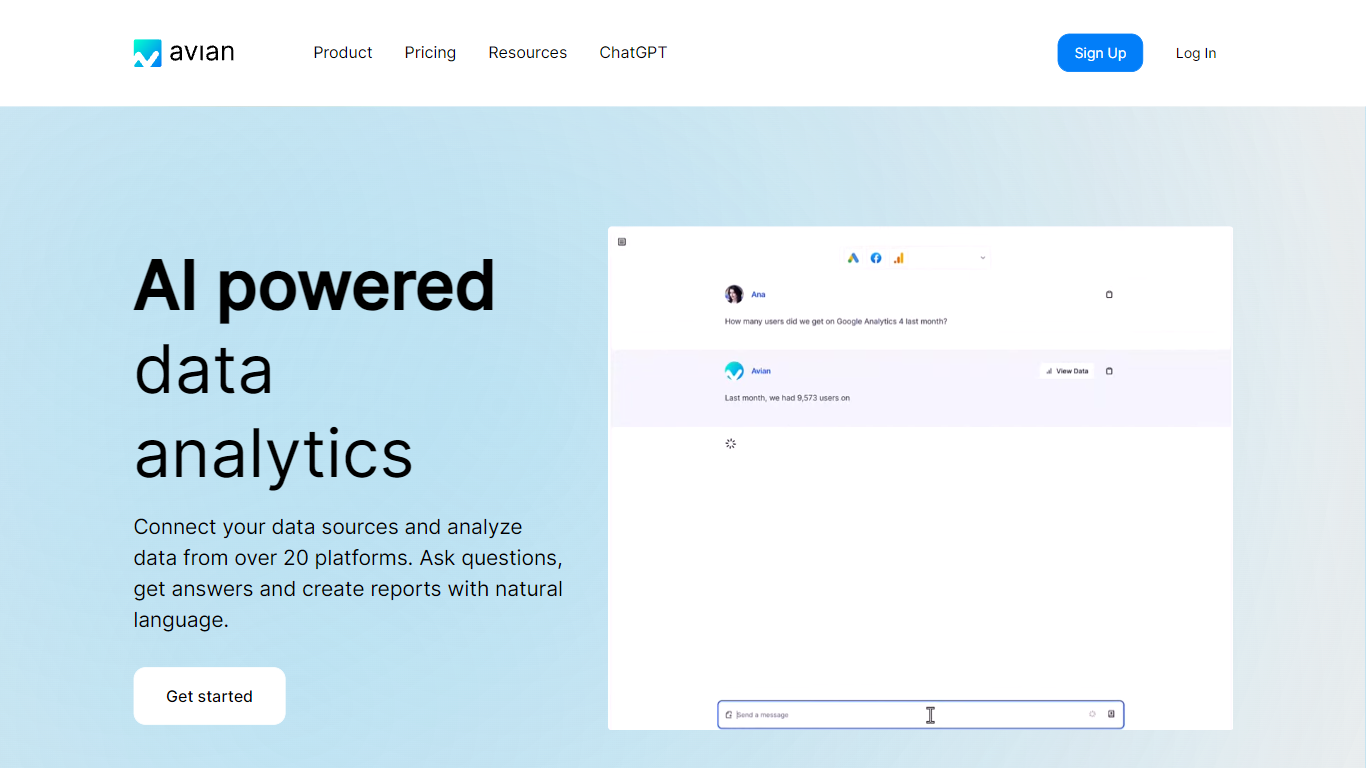
What is Avian?
Avian sells access to open weight frontier models through an OpenAI compatible API, billed by the token. Point an OpenAI SDK client at the https://api.avian.io/v1 base URL and name a model like DeepSeek-V3.2, and the rest of the code stays as it was. Everything runs on NVIDIA B200 GPUs with speculative decoding, and Avian measures 489 tokens per second on DeepSeek V3.2.
The argument against OpenAI here is arithmetic rather than features. A million output tokens on DeepSeek V3.2 costs $0.33, against the $10.00 Avian quotes for GPT-4o, with no rate limits, no monthly minimum, and prepaid credits that never expire. What you give up is model choice, since the catalog is entirely open weight families, DeepSeek, Kimi, GLM, and MiniMax, with no GPT, Claude, or Gemini anywhere.
Developers wiring up coding agents get the clearest win, because Cursor, Claude Code, Cline, Windsurf, and Kilo Code all accept a custom OpenAI base URL. Teams with data handling rules will care that prompts and completions are processed in memory and never written to persistent storage, with only timestamps, model name, and token counts kept for billing.
One claim deserves a closer read. The homepage advertises SOC/2 approved infrastructure while the security page says Avian is still in the process of obtaining SOC 2 Type II, so that badge is work in progress rather than a finished audit.
Atmo AI Upvotes
Avian Upvotes
Atmo AI Top Features
Pulls real-time weather data from satellites, ground stations, radars, and ocean buoys worldwide
Delivers forecasts up to 40,000 times faster than traditional numerical weather models
Reports up to 50% higher accuracy on major variables from 24-hour nowcasts to 14-day outlooks
Resolves microclimates with grid detail down to 1 km by 1 km
Runs live production deployments for the U.S. Air Force, Navy, and Philippines national government
Avian Top Features
OpenAI compatible endpoint at https://api.avian.io/v1 turns moving an existing integration into a one line base URL change
Catalog covers DeepSeek V4 Flash and Pro, DeepSeek V3.2, Kimi K2.5 and K2.6, GLM-5, GLM-5.1, and MiniMax M2.5
Rates start at $0.0945 per million input tokens on DeepSeek V4 Flash, with cached input as low as $0.012 per million on V3.2
Measured 489 output tokens per second on DeepSeek V3.2, running on NVIDIA B200 GPUs with speculative decoding and no cold start
Prepaid credits in $50, $100, $150, and $250 top ups that never expire, with no rate limits while a balance remains
Prompts and completions are processed in memory only, with timestamps, model name, and token counts the sole logged metadata
Dedicated deployments on reserved NVIDIA H200 or H100 GPUs are quoted through sales
Atmo AI Category
- Data Science
Avian Category
- Data Science
Atmo AI Pricing Type
- Paid
Avian Pricing Type
- Paid