AudioDoc vs VALL-E
In the contest of AudioDoc vs VALL-E, which AI tool is the champion? We evaluate pricing, alternatives, upvotes, features, reviews, and more.
If you had to choose between AudioDoc and VALL-E, which one would you go for?
When we examine AudioDoc and VALL-E, both of which are AI-enabled tools, what unique characteristics do we discover? The users have made their preference clear, AudioDoc leads in upvotes. AudioDoc has garnered 6 upvotes, and VALL-E has garnered 5 upvotes.
Don't agree with the result? Cast your vote and be a part of the decision-making process!
AudioDoc
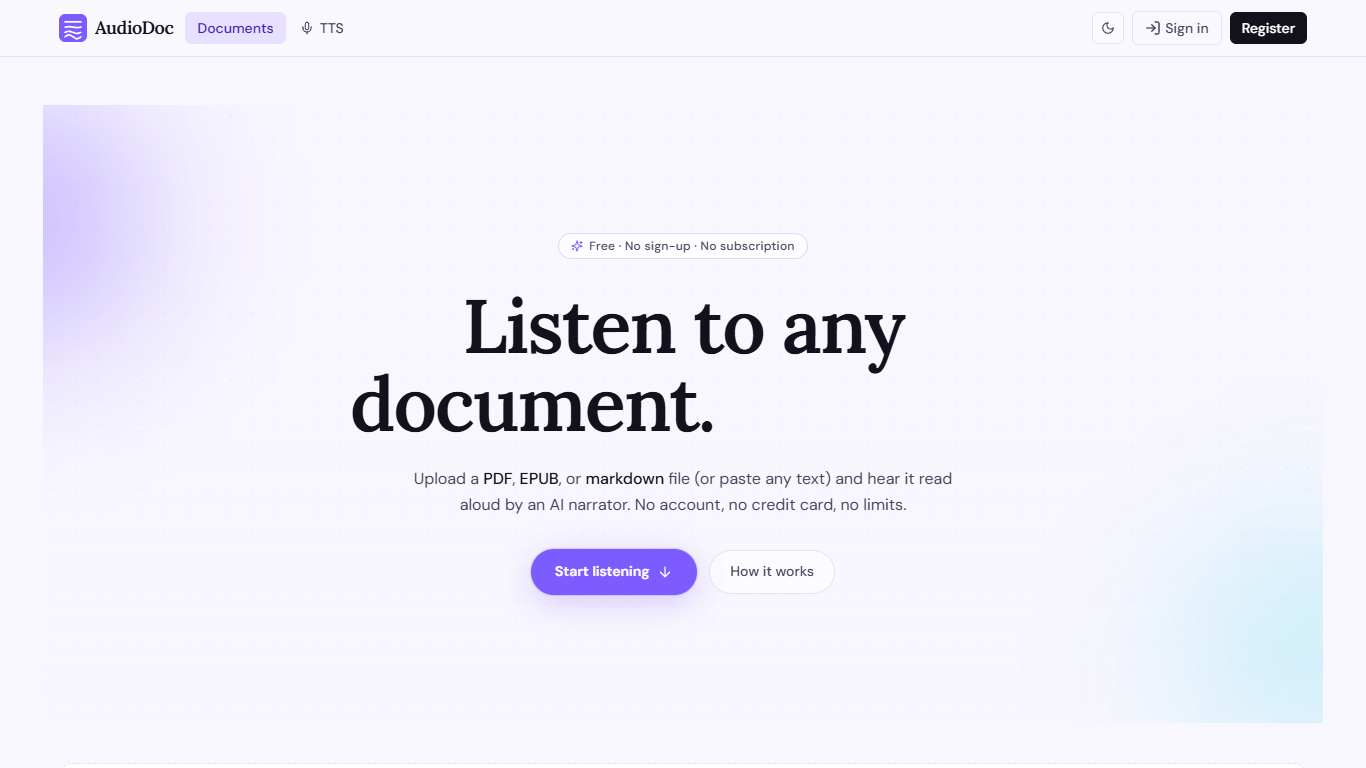

What is AudioDoc?
AudioDoc turns documents and pasted text into listenable audio in your browser. Upload a PDF, EPUB, or markdown file, or drop raw text into the TTS studio, and hear it read by natural narrators. There is no account requirement, no subscription, and no credit card gate to start.
The document library streams long files chapter by chapter as audio is generated, so you are not waiting on a full book conversion before playback begins. A separate TTS studio handles quick paste-and-listen jobs with downloadable clips and no watermarks.
It fits commuters who want articles read aloud, students reviewing coursework, writers proofreading drafts by ear, and anyone who needs hands-free or accessibility-friendly access to written material. Guest sessions last 24 hours; a free registered account keeps your library and listening progress beyond that window.
VALL-E
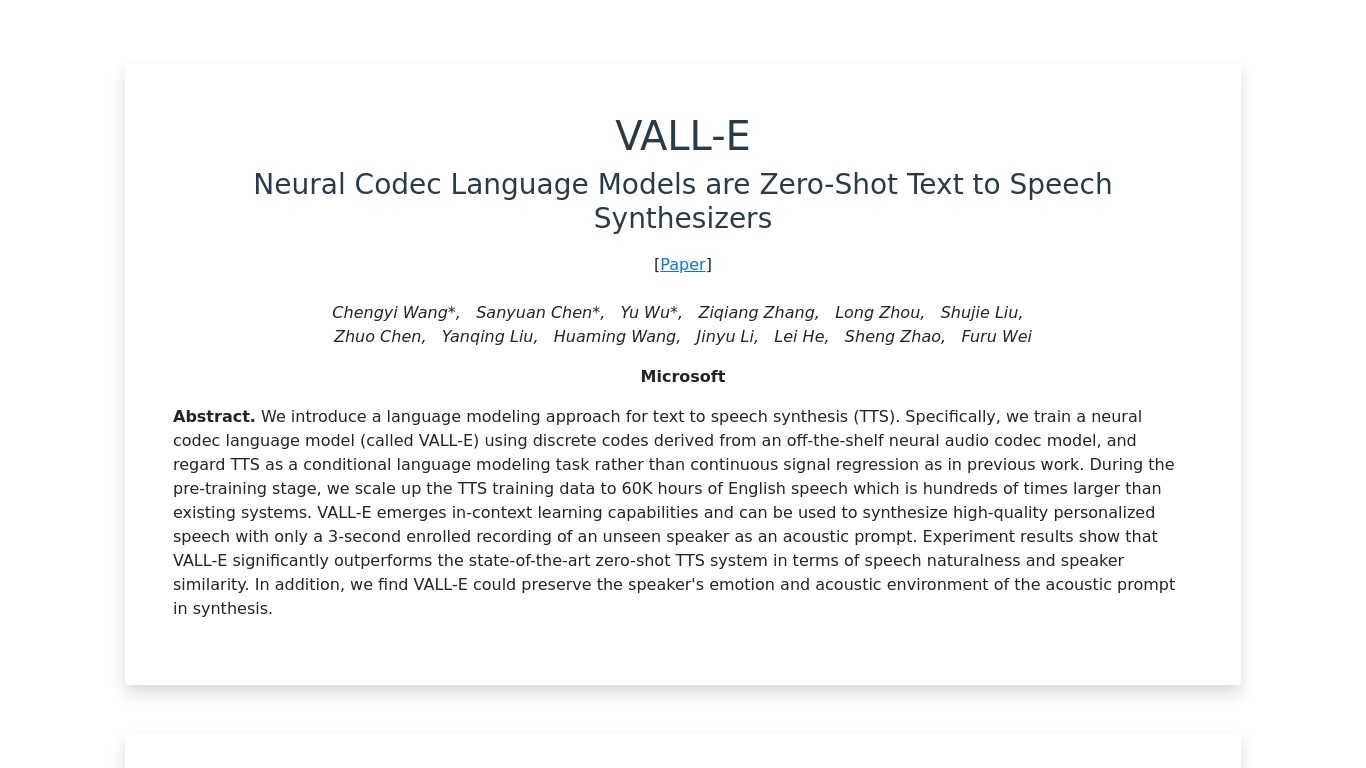
What is VALL-E?
VALL-E is a Microsoft Research text-to-speech model that clones a speaker's voice from a short audio clip and generates new speech from text. It belongs to the audio generation category because it synthesizes natural speech rather than editing existing recordings. The project page hosts sample audio for the original VALL-E model and later variants in the same research family.
Most TTS systems regress continuous waveforms or mel-spectrograms directly. VALL-E instead treats speech as a conditional language modeling task over discrete codes from a neural audio codec. Microsoft trained it on about 60,000 hours of English speech, far larger than typical TTS datasets. A 3-second enrolled recording of an unseen speaker is enough to drive zero-shot synthesis, and the model can keep the emotion and room tone present in that prompt.
The VALL-E family grew beyond the first paper. VALL-E X handles cross-lingual zero-shot TTS, VALL-E R adds phoneme monotonic alignment for more stable speech generation, and VALL-E 2 pairs repetition-aware sampling with grouped code modeling to reach human parity on LibriSpeech and VCTK benchmarks. Related lines like MELLE, FELLE, and PALLE explore continuous mel tokens and hybrid autoregressive plus parallel decoding.
Researchers, speech engineers, and curious listeners use VALL-E to hear what large-scale codec language models can do before building their own pipelines. The public samples are research demos, not a hosted API you can plug into a product without separate licensing and ethics review.
AudioDoc Upvotes
VALL-E Upvotes
AudioDoc Top Features
Upload PDF, EPUB, or markdown and stream audio chapter by chapter
Paste up to 1,000 words in the TTS studio for instant playback
American, British, Japanese, and Chinese narrator voices included
Download generated audio files with no watermarks
Start as a guest with no sign-up or credit card
Remembers your spot and works in mobile browsers without an app
VALL-E Top Features
Clones an unseen speaker from a 3-second enrolled audio prompt
Pre-trained on about 60,000 hours of English speech data
VALL-E 2 reports human parity on LibriSpeech and VCTK zero-shot benchmarks
Preserves speaker emotion and acoustic environment from the prompt clip
VALL-E X extends zero-shot synthesis to cross-lingual scenarios
Sample pages cover seven model lines including MELLE, FELLE, and PALLE
AudioDoc Category
- Text to Speech (TTS)
VALL-E Category
- Audio Generation
AudioDoc Pricing Type
- Free
VALL-E Pricing Type
- Free