BIG-bench vs Stellaris AI
In the face-off between BIG-bench vs Stellaris AI, which AI Large Language Model (LLM) tool takes the crown? We scrutinize features, alternatives, upvotes, reviews, pricing, and more.
In a face-off between BIG-bench and Stellaris AI, which one takes the crown?
If we were to analyze BIG-bench and Stellaris AI, both of which are AI-powered large language model (llm) tools, what would we find? Neither tool takes the lead, as they both have the same upvote count. Join the aitools.fyi users in deciding the winner by casting your vote.
Does the result make you go "hmm"? Cast your vote and turn that frown upside down!
BIG-bench
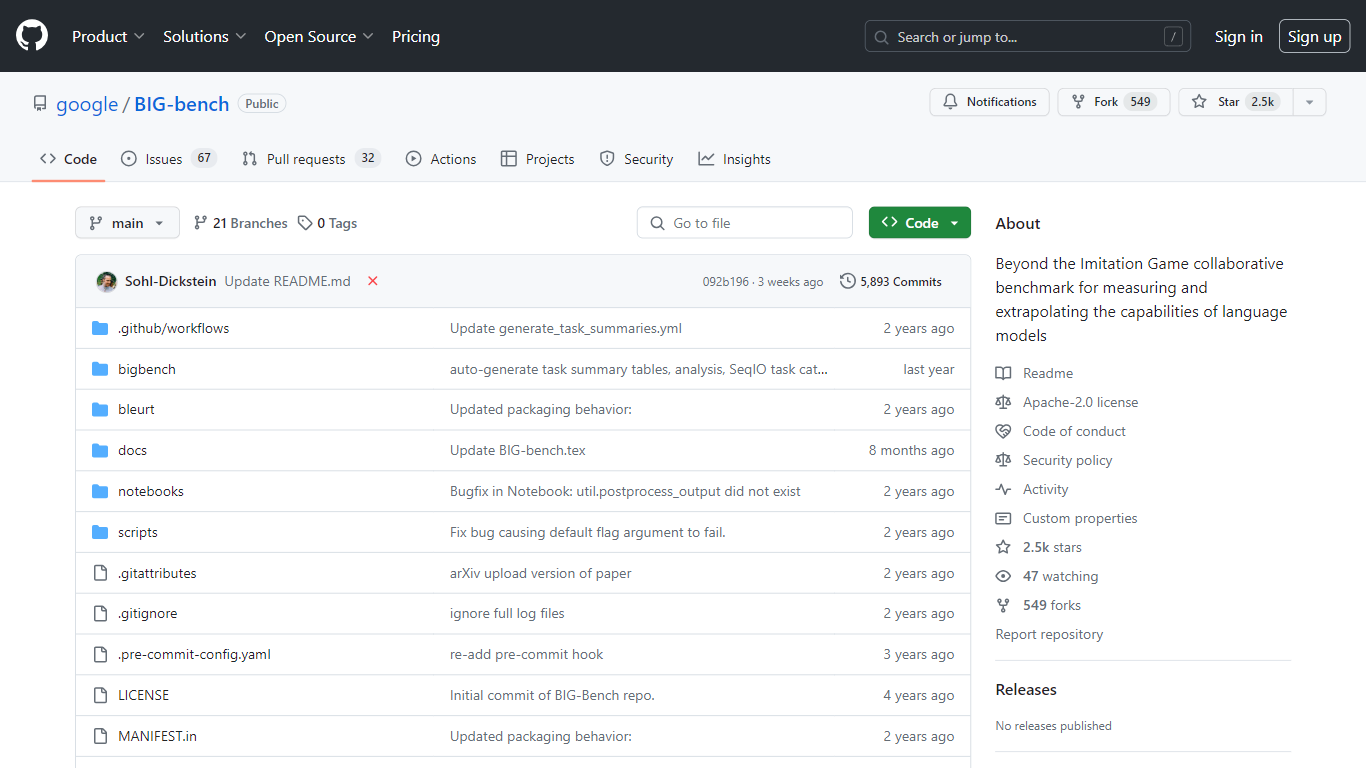

What is BIG-bench?
BIG-bench measures how well large language models handle reasoning, math, bias, and multilingual tasks across more than 200 community-written evaluation challenges. Google hosts the open source repository on GitHub, where researchers contributed tasks through pull requests and published comparative model scores on the leaderboard. Each task scores models through text generation or log-probability queries, using metrics like BLEU, BLEURT, and exact string match.
Unlike fixed benchmarks such as GLUE or SuperGLUE, BIG-bench grew through community pull requests, so task authors could submit challenges designed to exceed what existing models could solve. The suite also ships BIG-bench Lite, a 24-task subset that gives a cheaper canonical score across the full collection of 200+ tasks. Programmatic tasks support multi-turn model interaction, while JSON tasks work through a simpler task.json format with built-in scoring rules.
ML researchers use BIG-bench to compare model scaling trends and publish leaderboard results. Model developers run evaluations locally with HuggingFace models or through Docker scripts, then submit score files via pull request. The benchmark is archived and read-only as of April 2026, but the tasks, code, and published TMLR 2023 analysis paper remain available for reproducible research.
Stellaris AI
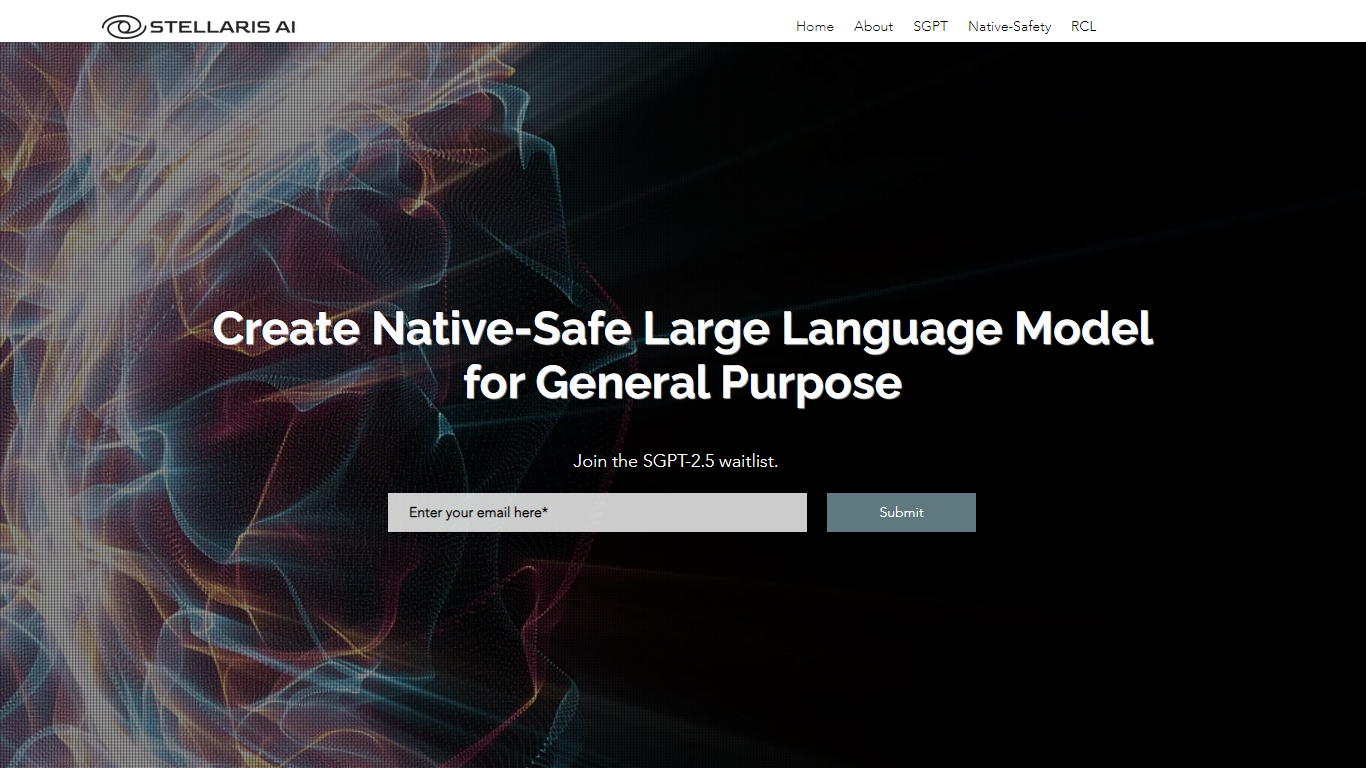
What is Stellaris AI?
Stellaris AI builds large language models marketed around native safety and human-like reasoning for real-world tasks. Its flagship SGPT line targets text and code generation, knowledge Q&A, logical reasoning, and analytics at a scale the company describes as hundreds of billions of parameters. The public site centers on a waitlist for SGPT-4.5 rather than a self-serve chat product you can open today.
Where many LLM labs bolt safety filters on after training, Stellaris AI frames safety as part of the model stack through strict source referencing and harm minimization in the architecture. It also highlights Real-time Context Learning (RCL) for adapting answers with live knowledge, a combination aimed at teams that want cited outputs instead of unchecked generation.
Researchers, enterprise AI teams, and early adopters join the SGPT-4.5 waitlist for first access. The company cites 10+ years of research and three core product pillars: Stellaris GPT, Native Safety, and RCL.
BIG-bench Upvotes
Stellaris AI Upvotes
BIG-bench Top Features
More than 200 benchmark tasks across JSON and programmatic formats, contributed via open pull requests
BIG-bench Lite packs 24 diverse tasks for a cheaper canonical model comparison score
Built-in metrics include BLEU, BLEURT, ROUGE, exact string match, and multiple-choice grading
SeqIO integration loads JSON tasks with 0-shot through 3-shot evaluation presets
Python 3.5 through 3.8 required; install with pip install -e . from the GitHub repository
Stellaris AI Top Features
SGPT models described at 100B+ parameters for text, code, and reasoning tasks
Native Safety framework with strict source referencing and harm minimization
Real-time Context Learning (RCL) for live knowledge integration
Three product pillars: Stellaris GPT, Native Safety, and RCL
SGPT-4.5 waitlist open for early access signups on the homepage
BIG-bench Category
- Large Language Model (LLM)
Stellaris AI Category
- Large Language Model (LLM)
BIG-bench Pricing Type
- Free
Stellaris AI Pricing Type
- Freemium