Catching Unicorns with GLTR vs Atmo AI
In the contest of Catching Unicorns with GLTR vs Atmo AI, which AI Data Science tool is the champion? We evaluate pricing, alternatives, upvotes, features, reviews, and more.
If you had to choose between Catching Unicorns with GLTR and Atmo AI, which one would you go for?
When we examine Catching Unicorns with GLTR and Atmo AI, both of which are AI-enabled data science tools, what unique characteristics do we discover? Interestingly, both tools have managed to secure the same number of upvotes. Since other aitools.fyi users could decide the winner, the ball is in your court now to cast your vote and help us determine the winner.
You don't agree with the result? Cast your vote to help us decide!
Catching Unicorns with GLTR
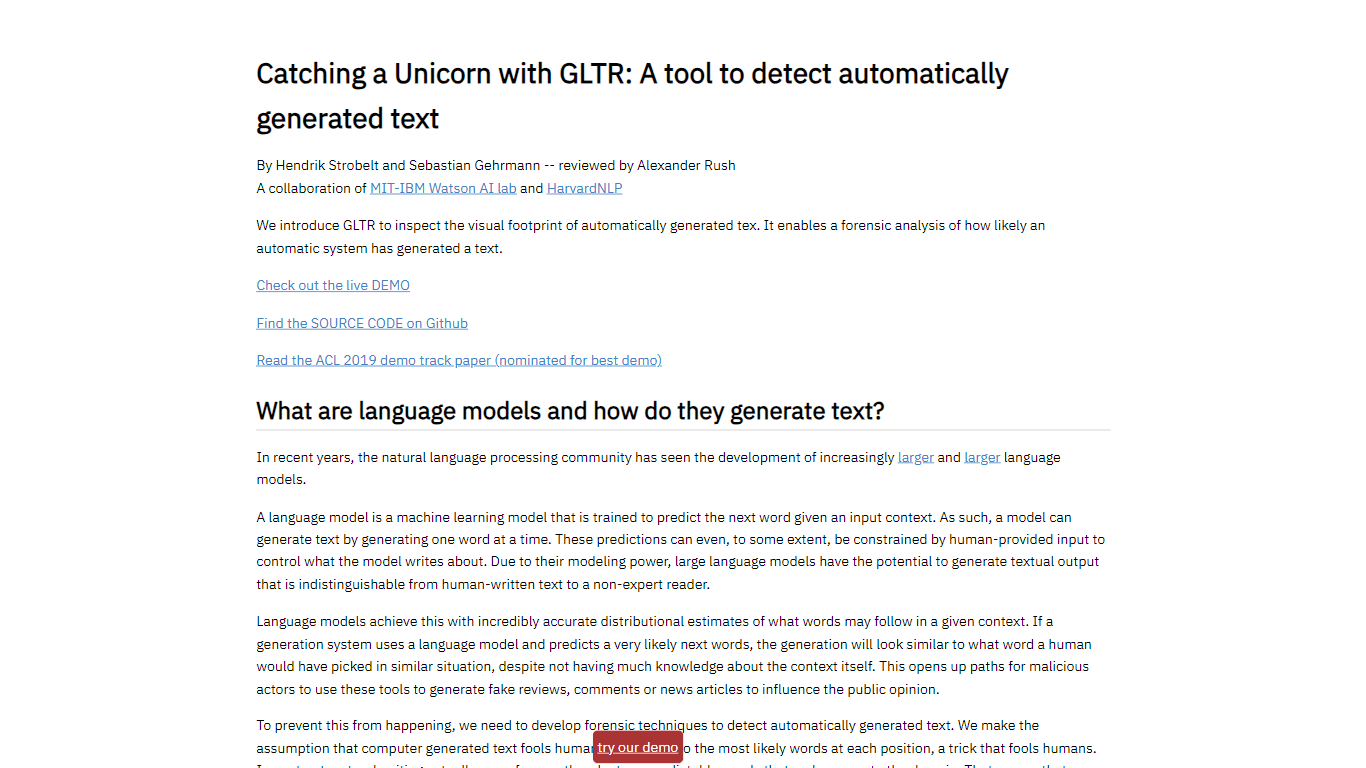

What is Catching Unicorns with GLTR?
GLTR is a forensic text analysis demo that highlights how predictable each word in a passage looks to a language model and colors the text so you can spot machine-written prose at a glance. Paste a sample into the live demo, and GLTR ranks every next-word prediction from GPT-2 117M, painting likely picks green or yellow and surprising human choices purple.
Unlike black-box AI detectors that return a single score, GLTR shows the forensic footprint word by word, plus histograms for top-k counts, probability ratios, and prediction entropy across the passage. That makes it useful for teaching how generative models stick to safe, high-probability wording while human writers reach for rarer terms that still fit the topic.
Researchers, journalists, and educators use GLTR to compare sample texts, explore model behavior, and sanity-check suspicious copy. The project is free, open source, and backed by an ACL 2019 demo paper from MIT-IBM Watson AI Lab and Harvard NLP, though the maintainers note it was built for GPT-2 era text and may struggle with newer models like ChatGPT.
Atmo AI

What is Atmo AI?
Atmo AI builds deep learning weather forecasting systems for governments, militaries, and large enterprises that need sharper predictions than legacy numerical models deliver. The company ingests real-time data from satellites, ground stations, radars, and ocean buoys, then runs neural network models that cover nowcasts out to 14-day medium-range outlooks. It sits in the data science stack for organizations where a missed storm or wind shift has operational consequences, not just a ruined picnic.
Where traditional numerical weather prediction leans on supercomputers and fixed grid resolutions, Atmo claims forecasts up to 40,000 times faster and up to 50% more accurate on major variables, with grids as fine as 1 km by 1 km for microclimate detail. That resolution gap matters for launch sites, island nations, and defense bases where a county-level forecast hides the local wind shear. The trade-off is access: Atmo sells custom deployments, not a consumer app you open for tomorrow's rain.
National weather agencies, defense commands, and enterprise risk teams use Atmo when they need site-specific forecasts backed by live production contracts. Deployments cited on Atmo's site include the U.S. Air Force, U.S. Navy, the Philippines national government, Cape Canaveral launch operations, and Tuvalu's national forecasting rollout.
Catching Unicorns with GLTR Upvotes
Atmo AI Upvotes
Catching Unicorns with GLTR Top Features
Colors each word green, yellow, red, or purple based on GPT-2 117M top 10, 100, 1,000, or rarer predictions
Live demo at demo.gltr.io accepts custom text plus bundled real and fake samples
Hover overlays show the top 5 predicted next words with probabilities for any token
Three histograms chart top-k counts, probability ratios, and prediction entropy across a passage
Open-source code lives on GitHub under detecting-fake-text for local deployment
ACL 2019 demo paper reports human fake-text detection rising from 54% to 72% with GLTR overlays
Maintainers link to the newer RADAR demo for testing text from recent large models
Atmo AI Top Features
Pulls real-time weather data from satellites, ground stations, radars, and ocean buoys worldwide
Delivers forecasts up to 40,000 times faster than traditional numerical weather models
Reports up to 50% higher accuracy on major variables from 24-hour nowcasts to 14-day outlooks
Resolves microclimates with grid detail down to 1 km by 1 km
Runs live production deployments for the U.S. Air Force, Navy, and Philippines national government
Catching Unicorns with GLTR Category
- Data Science
Atmo AI Category
- Data Science
Catching Unicorns with GLTR Pricing Type
- Free
Atmo AI Pricing Type
- Paid