ChatTTS vs VALL-E
In the battle of ChatTTS vs VALL-E, which AI Audio Generation tool comes out on top? We compare reviews, pricing, alternatives, upvotes, features, and more.
Between ChatTTS and VALL-E, which one is superior?
Upon comparing ChatTTS with VALL-E, which are both AI-powered audio generation tools, The users have made their preference clear, ChatTTS leads in upvotes. ChatTTS has garnered 6 upvotes, and VALL-E has garnered 5 upvotes.
Think we got it wrong? Cast your vote and show us who's boss!
ChatTTS

What is ChatTTS?
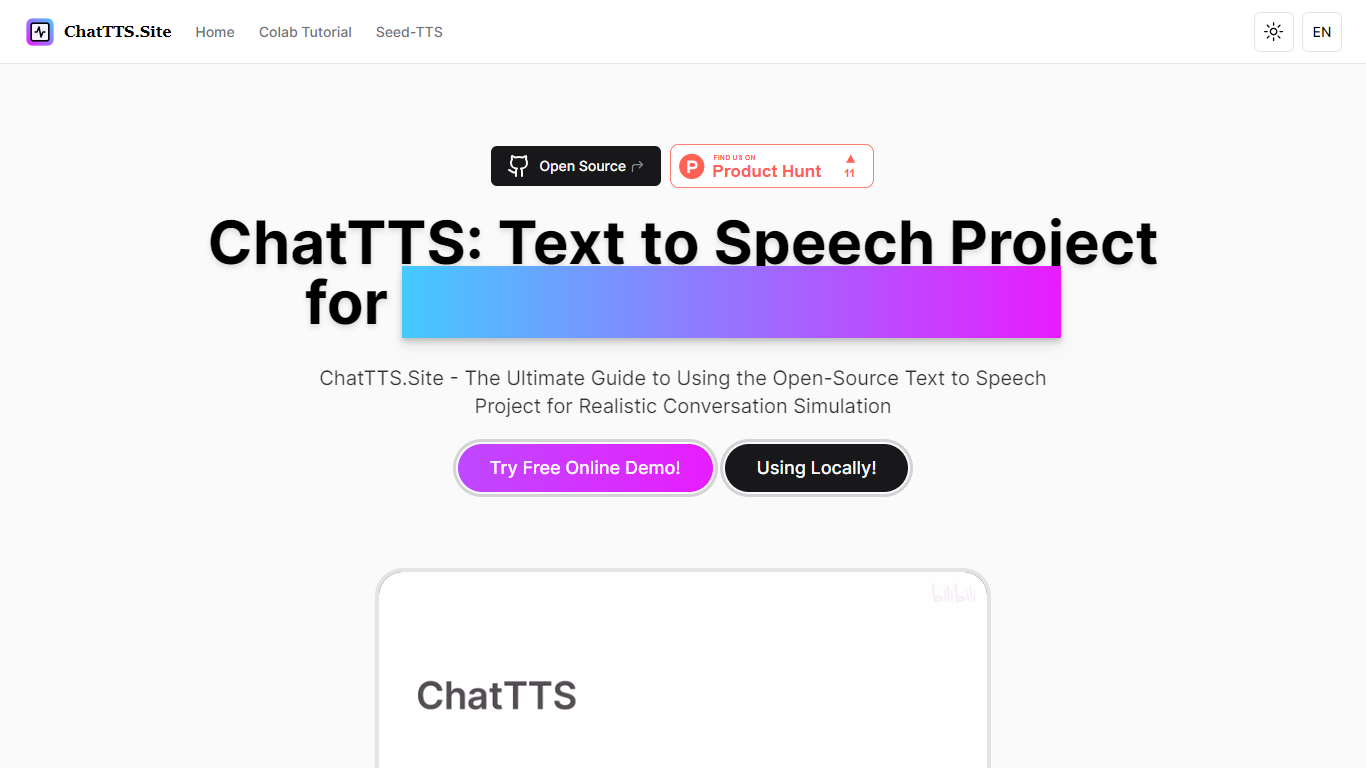
ChatTTS is an open-source text-to-speech model built for dialogue. The 2Noise team trained it on over 100,000 hours of Chinese and English speech so it sounds natural in back-and-forth conversation, not just scripted narration.
What sets it apart is prosody control at a granular level. The model can layer in laughter, pauses, and interjections, and it handles multiple speakers in a single session. That makes it a fit for LLM assistants, conversational audio, and dialogue-heavy multimedia.
Developers install it via pip or clone the GitHub repo. The open-source release on Hugging Face is a 40,000-hour base model under AGPLv3+. The team positions it for research and dialogue use cases, with contact at [email protected] for roadmap questions.
VALL-E
What is VALL-E?
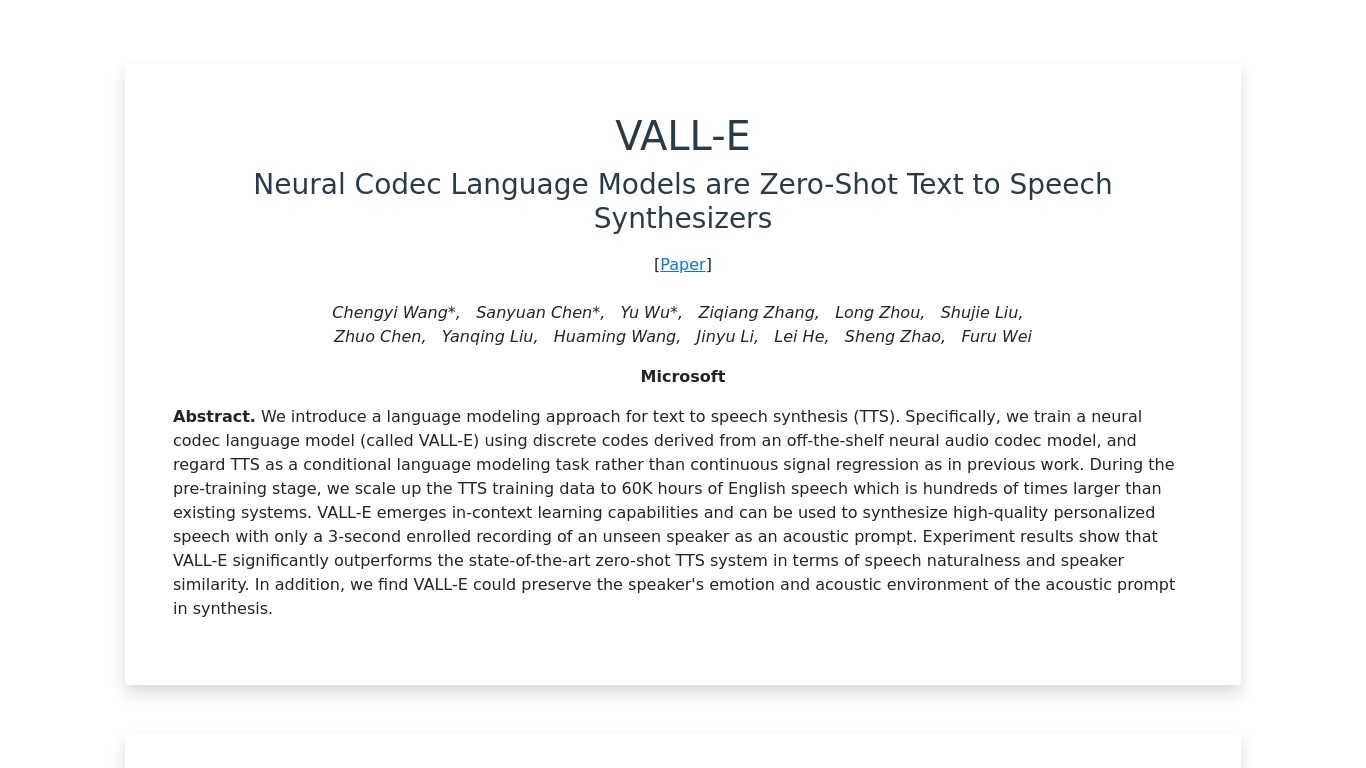
VALL-E is a Microsoft Research text-to-speech model that clones a speaker's voice from a short audio clip and generates new speech from text. It belongs to the audio generation category because it synthesizes natural speech rather than editing existing recordings. The project page hosts sample audio for the original VALL-E model and later variants in the same research family.
Most TTS systems regress continuous waveforms or mel-spectrograms directly. VALL-E instead treats speech as a conditional language modeling task over discrete codes from a neural audio codec. Microsoft trained it on about 60,000 hours of English speech, far larger than typical TTS datasets. A 3-second enrolled recording of an unseen speaker is enough to drive zero-shot synthesis, and the model can keep the emotion and room tone present in that prompt.
The VALL-E family grew beyond the first paper. VALL-E X handles cross-lingual zero-shot TTS, VALL-E R adds phoneme monotonic alignment for more stable speech generation, and VALL-E 2 pairs repetition-aware sampling with grouped code modeling to reach human parity on LibriSpeech and VCTK benchmarks. Related lines like MELLE, FELLE, and PALLE explore continuous mel tokens and hybrid autoregressive plus parallel decoding.
Researchers, speech engineers, and curious listeners use VALL-E to hear what large-scale codec language models can do before building their own pipelines. The public samples are research demos, not a hosted API you can plug into a product without separate licensing and ethics review.
ChatTTS Upvotes
VALL-E Upvotes
ChatTTS Top Features
Shapes laughter, pauses, and interjections into synthesized speech
Runs multi-speaker dialogue from a single inference call
Trained on 100,000+ hours of Chinese and English audio
Streams audio output for real-time playback
Install via pip or pull weights from Hugging Face
VALL-E Top Features
Clones an unseen speaker from a 3-second enrolled audio prompt
Pre-trained on about 60,000 hours of English speech data
VALL-E 2 reports human parity on LibriSpeech and VCTK zero-shot benchmarks
Preserves speaker emotion and acoustic environment from the prompt clip
VALL-E X extends zero-shot synthesis to cross-lingual scenarios
Sample pages cover seven model lines including MELLE, FELLE, and PALLE
ChatTTS Category
- Audio Generation
VALL-E Category
- Audio Generation
ChatTTS Pricing Type
- Free
VALL-E Pricing Type
- Free