Claude 3 \ Anthropic vs CodeGen2
In the clash of Claude 3 \ Anthropic vs CodeGen2, which AI Large Language Model (LLM) tool emerges victorious? We assess reviews, pricing, alternatives, features, upvotes, and more.
When we put Claude 3 \ Anthropic and CodeGen2 head to head, which one emerges as the victor?
Let's take a closer look at Claude 3 \ Anthropic and CodeGen2, both of which are AI-driven large language model (llm) tools, and see what sets them apart. Claude 3 \ Anthropic stands out as the clear frontrunner in terms of upvotes. Claude 3 \ Anthropic has garnered 8 upvotes, and CodeGen2 has garnered 6 upvotes.
Don't agree with the result? Cast your vote and be a part of the decision-making process!
Claude 3 \ Anthropic
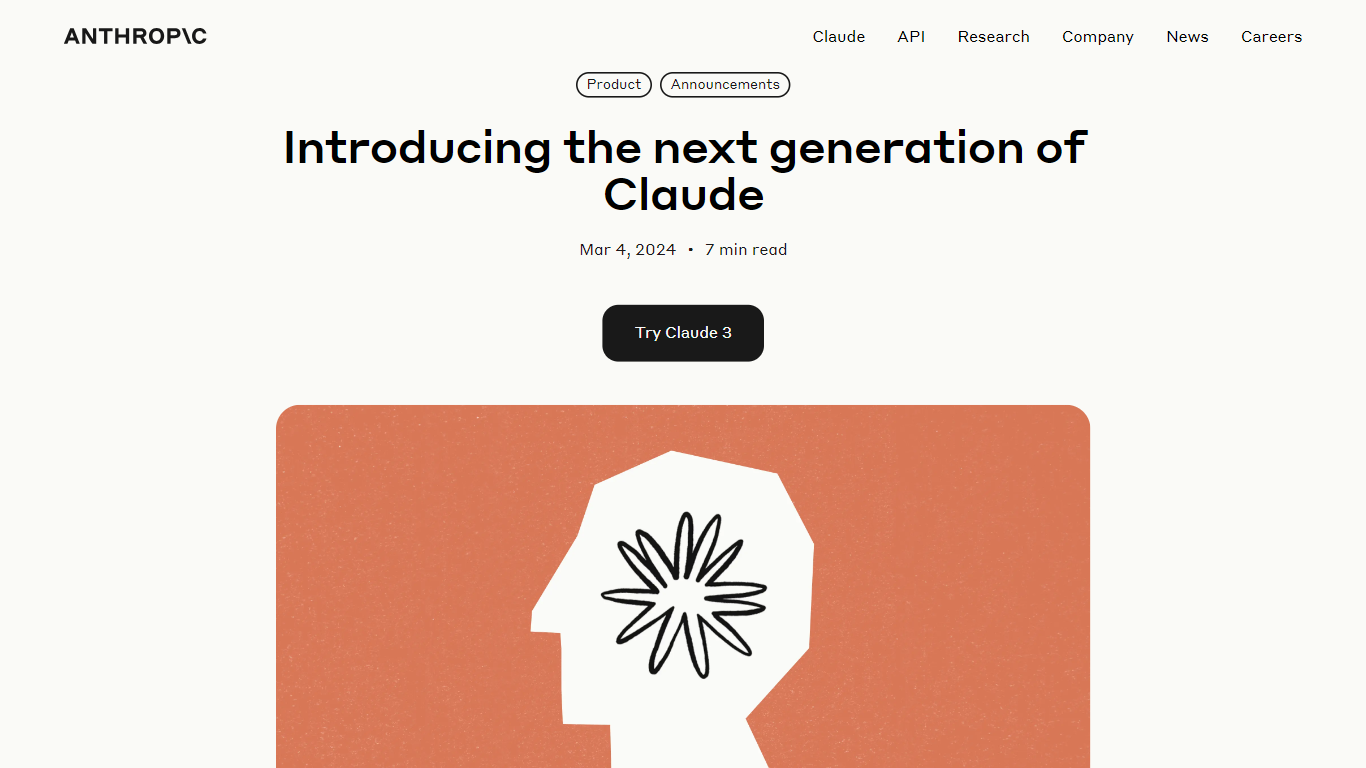

What is Claude 3 \ Anthropic?
Claude 3 is Anthropic's third-generation large language model family, released in March 2024. It includes three tiers: Haiku for speed and cost, Sonnet for balanced performance, and Opus for the highest reasoning depth. Each model targets a different tradeoff between intelligence, latency, and price.
The family handles text, code, analysis, and vision tasks. Claude 3 models process photos, charts, graphs, and technical diagrams. They support a 200K token context window at launch, with inputs exceeding 1 million tokens available to select customers. Opus and Sonnet launched on claude.ai and the Claude API in 159 countries, with Haiku following shortly after.
Anthropic built Claude 3 with Constitutional AI safety methods and Responsible Scaling Policy guardrails. The models are available through the Claude API, Amazon Bedrock, and Google Cloud Vertex AI. Sonnet powers the free tier on claude.ai, while Opus is available to Claude Pro subscribers.
CodeGen2
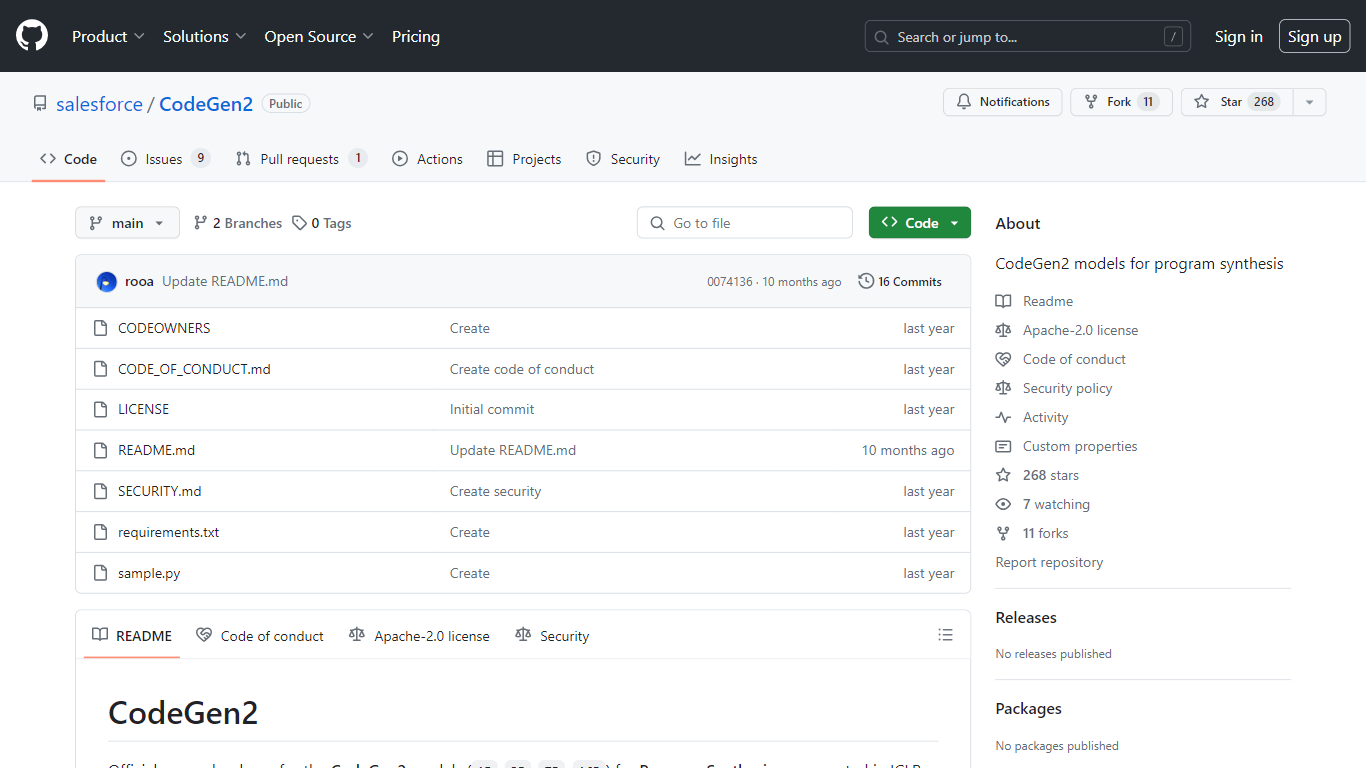
What is CodeGen2?
CodeGen2 is Salesforce's open-source collection of large language models designed specifically for program synthesis. These models range from 1 billion to 16 billion parameters and are trained to generate and complete code snippets effectively. The repository provides access to model checkpoints hosted on Hugging Face, facilitating easy integration and experimentation for developers and researchers.
The models support both causal and infill sampling, allowing users to generate code continuations or fill in missing parts within code blocks. This flexibility makes CodeGen2 suitable for a variety of programming assistance tasks, including code completion, generation, and synthesis from natural language prompts.
Targeted primarily at developers, AI researchers, and organizations interested in advancing code generation technology, CodeGen2 offers a transparent and accessible platform to explore state-of-the-art program synthesis models. The repository includes detailed instructions and examples to help users get started quickly.
Technically, CodeGen2 leverages transformer architectures and is compatible with Hugging Face's transformers library, enabling seamless use within existing machine learning workflows. The models have been presented at ICLR 2023, reflecting their academic rigor and innovation.
By providing open access to these models and their checkpoints, CodeGen2 encourages community collaboration and continuous improvement. Users can contribute to the repository, report issues, and participate in advancing the capabilities of AI-driven code generation.
Overall, CodeGen2 stands out by combining large-scale model capacity with practical usability, making it a valuable resource for anyone looking to integrate AI-powered code synthesis into their development processes.
Claude 3 \ Anthropic Upvotes
CodeGen2 Upvotes
Claude 3 \ Anthropic Top Features
Three model tiers (Haiku, Sonnet, Opus) let you pick the right balance of speed, cost, and reasoning depth
200K token context window at launch, with 1M+ token inputs available to select enterprise customers
Vision support for photos, charts, graphs, PDFs, and technical diagrams
Haiku reads a ~10k token research paper with charts in under three seconds for live chat workloads
Available on claude.ai, the Claude API, Amazon Bedrock, and Google Cloud Vertex AI
CodeGen2 Top Features
📦 Multiple model sizes from 1B to 16B parameters for varied needs
🤖 Supports causal and infill sampling to generate or complete code
🔗 Easy integration with Hugging Face transformers library
🛠️ Open-source with accessible checkpoints for customization
📚 Includes examples and documentation for quick setup and use
Claude 3 \ Anthropic Category
- Large Language Model (LLM)
CodeGen2 Category
- Large Language Model (LLM)
Claude 3 \ Anthropic Pricing Type
- Freemium
CodeGen2 Pricing Type
- Freemium