Claude 3 \ Anthropic vs OPT-IML
When comparing Claude 3 \ Anthropic vs OPT-IML, which AI Large Language Model (LLM) tool shines brighter? We look at pricing, alternatives, upvotes, features, reviews, and more.
In a comparison between Claude 3 \ Anthropic and OPT-IML, which one comes out on top?
When we put Claude 3 \ Anthropic and OPT-IML side by side, both being AI-powered large language model (llm) tools, The upvote count favors Claude 3 \ Anthropic, making it the clear winner. Claude 3 \ Anthropic has 7 upvotes, and OPT-IML has 6 upvotes.
You don't agree with the result? Cast your vote to help us decide!
Claude 3 \ Anthropic

What is Claude 3 \ Anthropic?
Discover the future of artificial intelligence with the launch of the Claude 3 model family by Anthropic. This groundbreaking introduction ushers in a new era in cognitive computing capabilities. The family consists of three models — Claude 3 Haiku, Claude 3 Sonnet, and Claude 3 Opus — each offering varying levels of power to suit a diverse range of applications.
With breakthroughs in real-time processing, vision capabilities, and nuanced understanding, Claude 3 models are engineered to deliver near-human comprehension and sophisticated content creation.
Optimized for speed and accuracy, these models cater to tasks like task automation, sales automation, customer service, and much more. Designed with trust and safety in mind, Claude 3 maintains high standards of privacy and bias mitigation, ready to transform industries worldwide.
OPT-IML
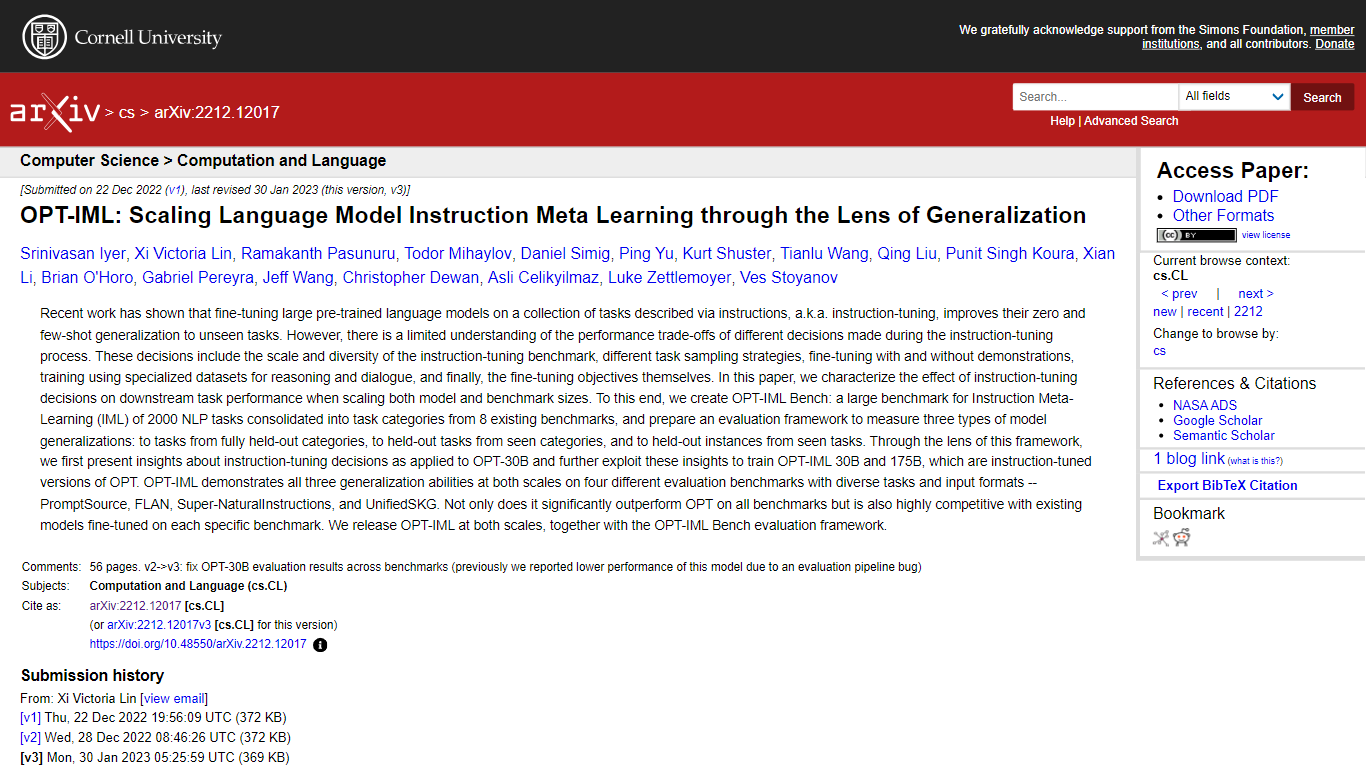
What is OPT-IML?
The paper titled "OPT-IML: Scaling Language Model Instruction Meta Learning through the Lens of Generalization" focuses on fine-tuning large pre-trained language models with a technique called instruction-tuning, which has been demonstrated to improve model performance on zero and few-shot generalization to unseen tasks. The main challenge addressed in the study is grasping the performance trade-offs due to different decisions made during instruction-tuning, such as task sampling strategies and fine-tuning objectives.
The authors introduce the OPT-IML Bench—a comprehensive benchmark comprising 2000 NLP tasks from 8 different benchmarks—and use it to evaluate the instruction tuning on OPT models of varying sizes. The resulting instruction-tuned models, OPT-IML 30B and 175B, exhibit significant improvements over vanilla OPT and are competitive with specialized models, further inspiring the release of the OPT-IML Bench framework for broader research use.
Claude 3 \ Anthropic Upvotes
OPT-IML Upvotes
Claude 3 \ Anthropic Top Features
Next-Generation AI Models: Introducing the state-of-the-art Claude 3 model family, including Haiku, Sonnet, and Opus.
Advanced Performance: Each model in the family is designed with increasing capabilities, offering a balance of intelligence, speed, and cost.
State-Of-The-Art Vision: The Claude 3 models come with the ability to process complex visual information comparable to human sight.
Enhanced Recall and Accuracy: Near-perfect recall on long context tasks and improved accuracy over previous models.
Responsible and Safe Design: Commitment to safety standards, including reduced biases and comprehensive risk mitigation approaches.
OPT-IML Top Features
Instruction-Tuning: Improvement of zero and few-shot generalization of language models via instruction-tuning.
Performance Trade-offs: Exploration of different decisions that affect performance during instruction-tuning.
OPT-IML Bench: Creation of a new benchmark for instruction meta-learning with 2000 NLP tasks.
Generalization Measurement: Implementation of an evaluation framework for measuring different types of model generalizations.
Model Competitiveness: Development of models that outperform OPT and are competitive with models fine-tuned on specific benchmarks.
Claude 3 \ Anthropic Category
- Large Language Model (LLM)
OPT-IML Category
- Large Language Model (LLM)
Claude 3 \ Anthropic Pricing Type
- Freemium
OPT-IML Pricing Type
- Freemium