Claude 3 \ Anthropic vs ggml.ai
Compare Claude 3 \ Anthropic vs ggml.ai and see which AI Large Language Model (LLM) tool is better when we compare features, reviews, pricing, alternatives, upvotes, etc.
Which one is better? Claude 3 \ Anthropic or ggml.ai?
When we compare Claude 3 \ Anthropic with ggml.ai, which are both AI-powered large language model (llm) tools, The community has spoken, Claude 3 \ Anthropic leads with more upvotes. Claude 3 \ Anthropic has garnered 8 upvotes, and ggml.ai has garnered 7 upvotes.
Want to flip the script? Upvote your favorite tool and change the game!
Claude 3 \ Anthropic

What is Claude 3 \ Anthropic?
Claude 3 is Anthropic's third-generation large language model family, released in March 2024. It includes three tiers: Haiku for speed and cost, Sonnet for balanced performance, and Opus for the highest reasoning depth. Each model targets a different tradeoff between intelligence, latency, and price.
The family handles text, code, analysis, and vision tasks. Claude 3 models process photos, charts, graphs, and technical diagrams. They support a 200K token context window at launch, with inputs exceeding 1 million tokens available to select customers. Opus and Sonnet launched on claude.ai and the Claude API in 159 countries, with Haiku following shortly after.
Anthropic built Claude 3 with Constitutional AI safety methods and Responsible Scaling Policy guardrails. The models are available through the Claude API, Amazon Bedrock, and Google Cloud Vertex AI. Sonnet powers the free tier on claude.ai, while Opus is available to Claude Pro subscribers.
ggml.ai
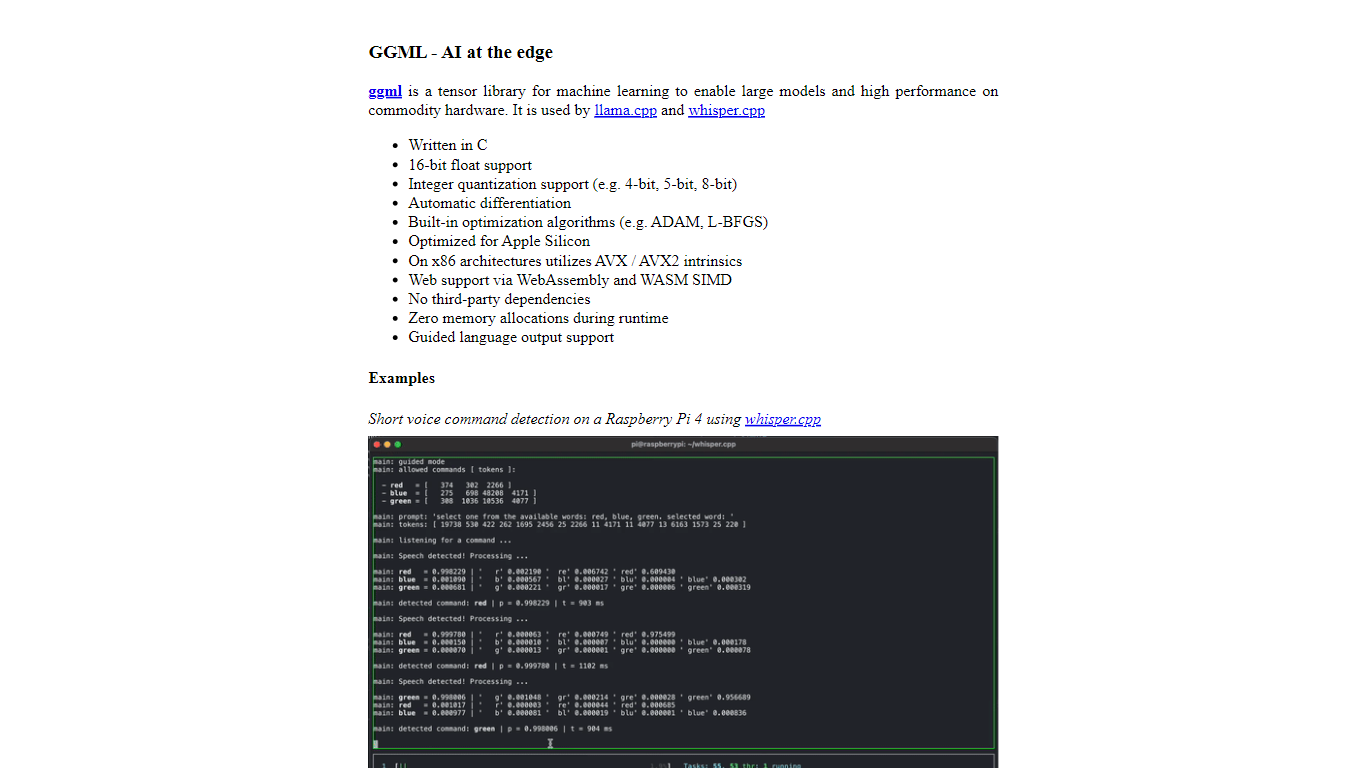
What is ggml.ai?
ggml runs large language and speech models on everyday CPUs and GPUs through a compact C tensor library built for on-device inference. ML engineers and app developers adopt it via llama.cpp and whisper.cpp when they want LLaMA or Whisper workloads without cloud-only dependencies.
Frameworks like PyTorch optimize for training clusters and heavy runtimes. ggml keeps the core library minimal with zero runtime memory allocations, no third-party dependencies, and integer quantization so llama.cpp can serve Meta LLaMA weights on laptops and Apple Silicon.
The ggml.ai company was founded in 2023 by Georgi Gerganov to support the library and was acquired by Hugging Face in 2026. The core ggml project stays MIT licensed with open development on GitHub.
Claude 3 \ Anthropic Upvotes
ggml.ai Upvotes
Claude 3 \ Anthropic Top Features
Three model tiers (Haiku, Sonnet, Opus) let you pick the right balance of speed, cost, and reasoning depth
200K token context window at launch, with 1M+ token inputs available to select enterprise customers
Vision support for photos, charts, graphs, PDFs, and technical diagrams
Haiku reads a ~10k token research paper with charts in under three seconds for live chat workloads
Available on claude.ai, the Claude API, Amazon Bedrock, and Google Cloud Vertex AI
ggml.ai Top Features
Powers llama.cpp for Meta LLaMA inference and whisper.cpp for OpenAI Whisper speech models
Written in C with zero runtime memory allocations during inference
Integer quantization support for smaller models on commodity hardware
No third-party dependencies in the core tensor library
Cross-platform low-level implementation with broad hardware support
MIT licensed open-core library with public development on GitHub
Claude 3 \ Anthropic Category
- Large Language Model (LLM)
ggml.ai Category
- Large Language Model (LLM)
Claude 3 \ Anthropic Pricing Type
- Freemium
ggml.ai Pricing Type
- Free