Claude 3 \ Anthropic vs phi-2
In the contest of Claude 3 \ Anthropic vs phi-2, which AI Large Language Model (LLM) tool is the champion? We evaluate pricing, alternatives, upvotes, features, reviews, and more.
If you had to choose between Claude 3 \ Anthropic and phi-2, which one would you go for?
When we examine Claude 3 \ Anthropic and phi-2, both of which are AI-enabled large language model (llm) tools, what unique characteristics do we discover? With more upvotes, Claude 3 \ Anthropic is the preferred choice. The number of upvotes for Claude 3 \ Anthropic stands at 8, and for phi-2 it's 6.
Disagree with the result? Upvote your favorite tool and help it win!
Claude 3 \ Anthropic

What is Claude 3 \ Anthropic?
Claude 3 is Anthropic's third-generation large language model family, released in March 2024. It includes three tiers: Haiku for speed and cost, Sonnet for balanced performance, and Opus for the highest reasoning depth. Each model targets a different tradeoff between intelligence, latency, and price.
The family handles text, code, analysis, and vision tasks. Claude 3 models process photos, charts, graphs, and technical diagrams. They support a 200K token context window at launch, with inputs exceeding 1 million tokens available to select customers. Opus and Sonnet launched on claude.ai and the Claude API in 159 countries, with Haiku following shortly after.
Anthropic built Claude 3 with Constitutional AI safety methods and Responsible Scaling Policy guardrails. The models are available through the Claude API, Amazon Bedrock, and Google Cloud Vertex AI. Sonnet powers the free tier on claude.ai, while Opus is available to Claude Pro subscribers.
phi-2
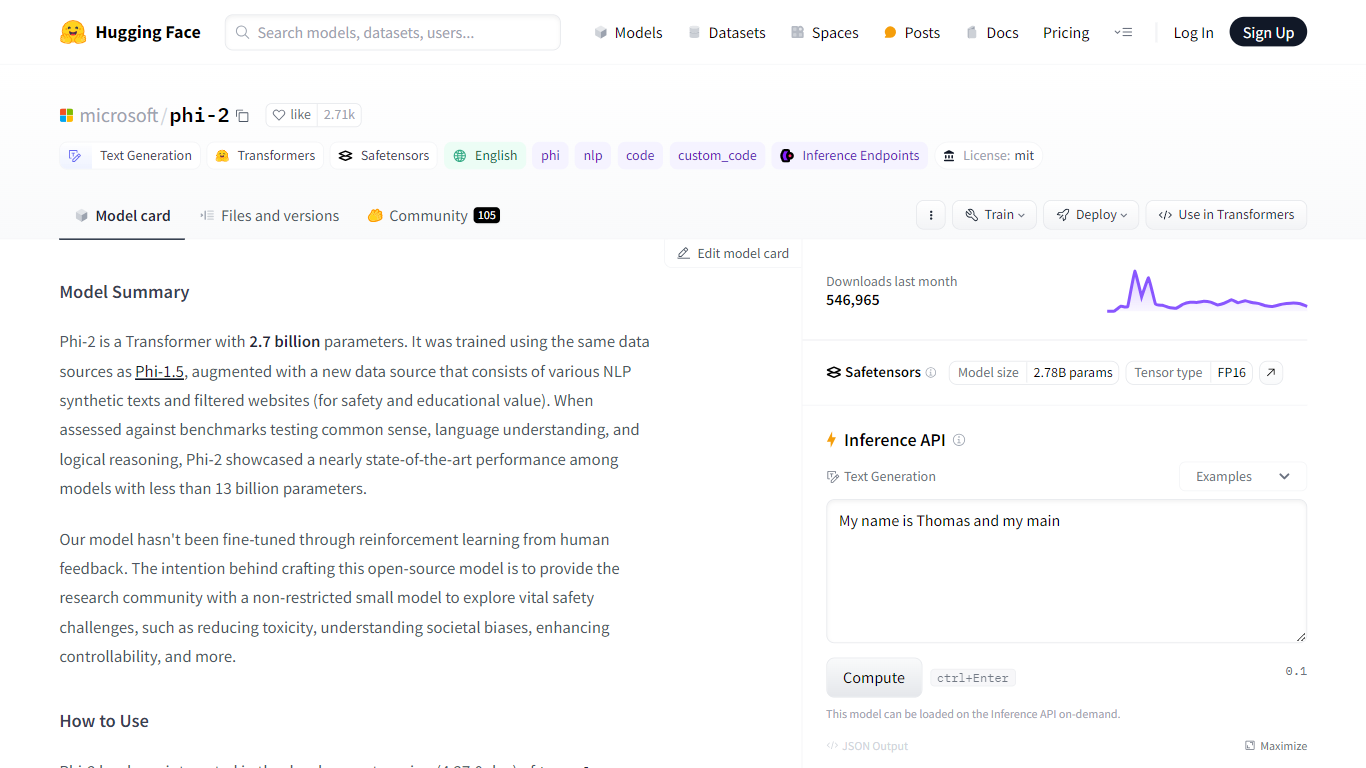
What is phi-2?
Phi-2 is a Transformer-based language model developed by Microsoft with 2.7 billion parameters, designed for English text generation tasks including natural language processing and coding. It was trained on a large dataset combining synthetic NLP texts and filtered web content to enhance safety and educational value. The model performs strongly on benchmarks for common sense reasoning, language understanding, and logical reasoning, ranking near state-of-the-art among models under 13 billion parameters.
Unlike some models, Phi-2 has not been fine-tuned with reinforcement learning from human feedback, making it a base model intended for research and experimentation rather than direct production use. It supports multiple prompt formats such as question-answering, chat dialogues, and code generation, offering flexibility for developers and researchers exploring AI safety, bias reduction, and controllability.
Phi-2 is integrated into the Hugging Face Transformers library (version 4.37.0 and above) and can be deployed locally or via various inference providers. It supports efficient loading and serving through tools like vLLM and SGLang, and is compatible with quantized versions for lightweight applications. The model uses the safetensors format for secure and fast tensor storage.
Users should be aware of limitations including occasional inaccurate code or factual outputs, limited scope in code generation mainly focused on Python and common libraries, verbosity in responses, and potential societal biases despite safety-focused training. It is recommended as a starting point for further fine-tuning and evaluation rather than a turnkey solution.
The model is licensed under the MIT license, promoting open science and community collaboration. It is suitable for AI researchers, developers, and organizations interested in exploring foundational language models with a focus on safety and transparency.
Claude 3 \ Anthropic Upvotes
phi-2 Upvotes
Claude 3 \ Anthropic Top Features
Three model tiers (Haiku, Sonnet, Opus) let you pick the right balance of speed, cost, and reasoning depth
200K token context window at launch, with 1M+ token inputs available to select enterprise customers
Vision support for photos, charts, graphs, PDFs, and technical diagrams
Haiku reads a ~10k token research paper with charts in under three seconds for live chat workloads
Available on claude.ai, the Claude API, Amazon Bedrock, and Google Cloud Vertex AI
phi-2 Top Features
Flexible prompt formats for QA, chat, and code generation 🗣️
Integrated with Hugging Face Transformers for easy deployment 🤗
Supports efficient local serving with vLLM and SGLang 🖥️
Uses safetensors format for secure and fast tensor storage 🔒
Open-source MIT license encourages research and customization 📜
Claude 3 \ Anthropic Category
- Large Language Model (LLM)
phi-2 Category
- Large Language Model (LLM)
Claude 3 \ Anthropic Pricing Type
- Freemium
phi-2 Pricing Type
- Freemium