
Last updated 07-26-2026
Category:
Reviews:
Join thousands of AI enthusiasts in the World of AI!
phi-2
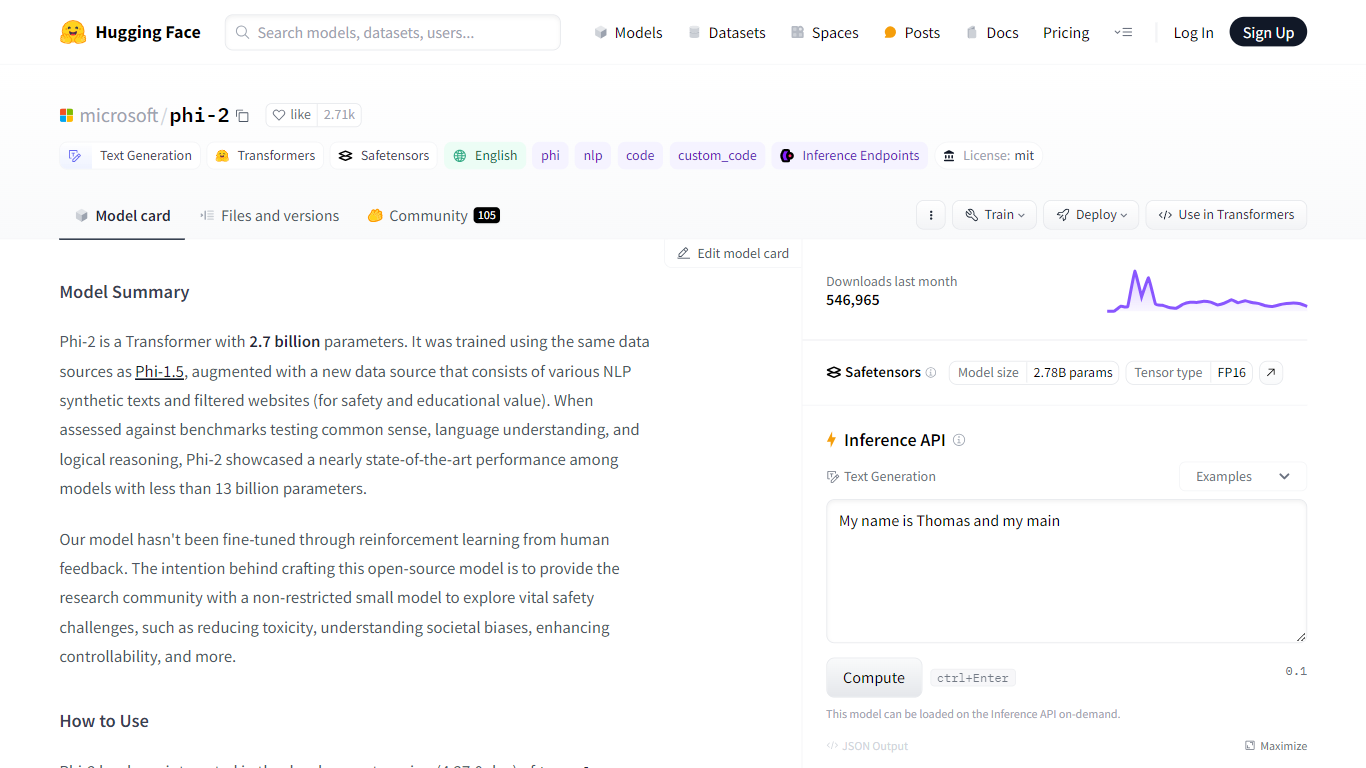
Phi-2 is a Transformer-based language model developed by Microsoft with 2.7 billion parameters, designed for English text generation tasks including natural language processing and coding. It was trained on a large dataset combining synthetic NLP texts and filtered web content to enhance safety and educational value. The model performs strongly on benchmarks for common sense reasoning, language understanding, and logical reasoning, ranking near state-of-the-art among models under 13 billion parameters.
Unlike some models, Phi-2 has not been fine-tuned with reinforcement learning from human feedback, making it a base model intended for research and experimentation rather than direct production use. It supports multiple prompt formats such as question-answering, chat dialogues, and code generation, offering flexibility for developers and researchers exploring AI safety, bias reduction, and controllability.
Phi-2 is integrated into the Hugging Face Transformers library (version 4.37.0 and above) and can be deployed locally or via various inference providers. It supports efficient loading and serving through tools like vLLM and SGLang, and is compatible with quantized versions for lightweight applications. The model uses the safetensors format for secure and fast tensor storage.
Users should be aware of limitations including occasional inaccurate code or factual outputs, limited scope in code generation mainly focused on Python and common libraries, verbosity in responses, and potential societal biases despite safety-focused training. It is recommended as a starting point for further fine-tuning and evaluation rather than a turnkey solution.
The model is licensed under the MIT license, promoting open science and community collaboration. It is suitable for AI researchers, developers, and organizations interested in exploring foundational language models with a focus on safety and transparency.
Flexible prompt formats for QA, chat, and code generation 🗣️
Integrated with Hugging Face Transformers for easy deployment 🤗
Supports efficient local serving with vLLM and SGLang 🖥️
Uses safetensors format for secure and fast tensor storage 🔒
Open-source MIT license encourages research and customization 📜
Strong performance on common sense and logical reasoning benchmarks
Open-source with permissive MIT license for research use
Supports multiple prompt formats including QA, chat, and code
Compatible with popular deployment tools like Transformers, vLLM, and Docker
Trained on filtered data to reduce toxicity and improve safety
Not fine-tuned with reinforcement learning from human feedback
May produce inaccurate code and factual errors
Primarily trained on Python code with limited support for other languages
Can generate verbose or irrelevant text beyond initial answers
What prompt formats does Phi-2 support?
Phi-2 supports question-answering, chat dialogues, and code generation prompt formats, allowing flexible use cases.
Is Phi-2 fine-tuned with human feedback?
No, Phi-2 has not undergone reinforcement learning from human feedback; it is a base model for research and experimentation.
What programming languages does Phi-2 handle for code generation?
Phi-2 mainly generates Python code using common libraries; other languages or packages may require manual verification.
How can I deploy Phi-2 locally?
You can deploy Phi-2 locally using Hugging Face Transformers, vLLM, SGLang, or Docker Model Runner with provided instructions.
What are the main limitations of Phi-2?
Limitations include possible inaccurate outputs, verbosity, limited code scope, and potential societal biases despite safety measures.
What license governs Phi-2?
Phi-2 is released under the MIT license, allowing open-source use and modification.
How does Phi-2 handle safety and bias?
Phi-2 was trained on filtered datasets to reduce toxicity and bias, but users should remain cautious and critically evaluate outputs.