Gemini 3 vs phi-2
Explore the showdown between Gemini 3 vs phi-2 and find out which AI Large Language Model (LLM) tool wins. We analyze upvotes, features, reviews, pricing, alternatives, and more.
In a face-off between Gemini 3 and phi-2, which one takes the crown?
When we contrast Gemini 3 with phi-2, both of which are exceptional AI-operated large language model (llm) tools, and place them side by side, we can spot several crucial similarities and divergences. The upvote count is neck and neck for both Gemini 3 and phi-2. You can help us determine the winner by casting your vote and tipping the scales in favor of one of the tools.
Want to flip the script? Upvote your favorite tool and change the game!
Gemini 3

What is Gemini 3?
Gemini 3 is Google's frontier large language model, released in November 2025 as the flagship of the Gemini family. It combines reasoning, multimodal understanding, and agentic coding in one model so you can learn from mixed media, build interactive apps, and plan multi-step tasks with less back-and-forth prompting.
Where most frontier models compete on raw benchmark scores alone, Gemini 3 ships across Google's consumer and developer stack on day one: Search AI Mode, the Gemini app, AI Studio, Vertex AI, Gemini CLI, and the Antigravity agentic IDE. That breadth is the trade-off profile. You get one model wired into Gmail, Calendar, and generative search UI, not a standalone API you integrate yourself.
Developers, researchers, and students use Gemini 3 for vibe coding, document analysis, long video lectures, and multi-step planning. Google AI Ultra subscribers in the U.S. can run Gemini Agent for inbox and calendar workflows, while enterprises deploy the same model through Vertex AI and Gemini Enterprise.
Google DeepMind led development with extensive safety testing, including third-party evaluations and a published model card. Related posts on the same blog now cover follow-on models like Gemini 3.7 Flash and Gemini 3.5 Transcribe, while Deep Think remains on a staged rollout to Google AI Ultra subscribers.
phi-2
What is phi-2?
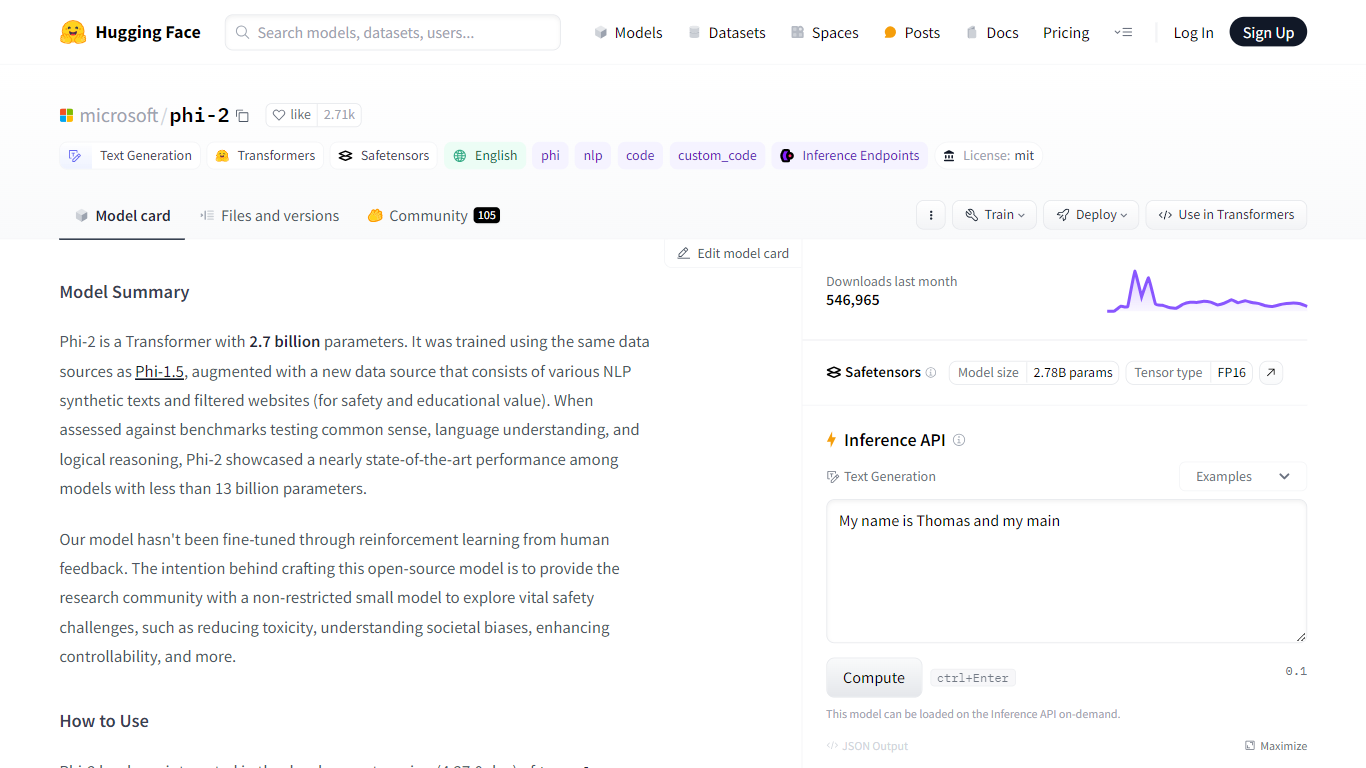
Phi-2 is a Transformer-based language model developed by Microsoft with 2.7 billion parameters, designed for English text generation tasks including natural language processing and coding. It was trained on a large dataset combining synthetic NLP texts and filtered web content to enhance safety and educational value. The model performs strongly on benchmarks for common sense reasoning, language understanding, and logical reasoning, ranking near state-of-the-art among models under 13 billion parameters.
Unlike some models, Phi-2 has not been fine-tuned with reinforcement learning from human feedback, making it a base model intended for research and experimentation rather than direct production use. It supports multiple prompt formats such as question-answering, chat dialogues, and code generation, offering flexibility for developers and researchers exploring AI safety, bias reduction, and controllability.
Phi-2 is integrated into the Hugging Face Transformers library (version 4.37.0 and above) and can be deployed locally or via various inference providers. It supports efficient loading and serving through tools like vLLM and SGLang, and is compatible with quantized versions for lightweight applications. The model uses the safetensors format for secure and fast tensor storage.
Users should be aware of limitations including occasional inaccurate code or factual outputs, limited scope in code generation mainly focused on Python and common libraries, verbosity in responses, and potential societal biases despite safety-focused training. It is recommended as a starting point for further fine-tuning and evaluation rather than a turnkey solution.
The model is licensed under the MIT license, promoting open science and community collaboration. It is suitable for AI researchers, developers, and organizations interested in exploring foundational language models with a focus on safety and transparency.
Gemini 3 Upvotes
phi-2 Upvotes
Gemini 3 Top Features
1501 Elo on LMArena with a 1 million-token context window across text, images, video, audio, and code
Deep Think mode scores 41.0% on Humanity's Last Exam, rolling out to Google AI Ultra subscribers after safety review
Generative UI in AI Mode in Search builds visual layouts and interactive simulations from a single query
1487 Elo on WebDev Arena and 76.2% on SWE-bench Verified for agentic coding
Gemini Agent handles multi-step tasks across Gmail, Calendar, and the web for Google AI Ultra users in the U.S.
Available in Google AI Studio, Vertex AI, Gemini CLI, Antigravity, and third-party platforms like Cursor and GitHub
54.2% on Terminal-Bench 2.0 for terminal-based tool use and computer operation
phi-2 Top Features
Flexible prompt formats for QA, chat, and code generation 🗣️
Integrated with Hugging Face Transformers for easy deployment 🤗
Supports efficient local serving with vLLM and SGLang 🖥️
Uses safetensors format for secure and fast tensor storage 🔒
Open-source MIT license encourages research and customization 📜
Gemini 3 Category
- Large Language Model (LLM)
phi-2 Category
- Large Language Model (LLM)
Gemini 3 Pricing Type
- Freemium
phi-2 Pricing Type
- Freemium